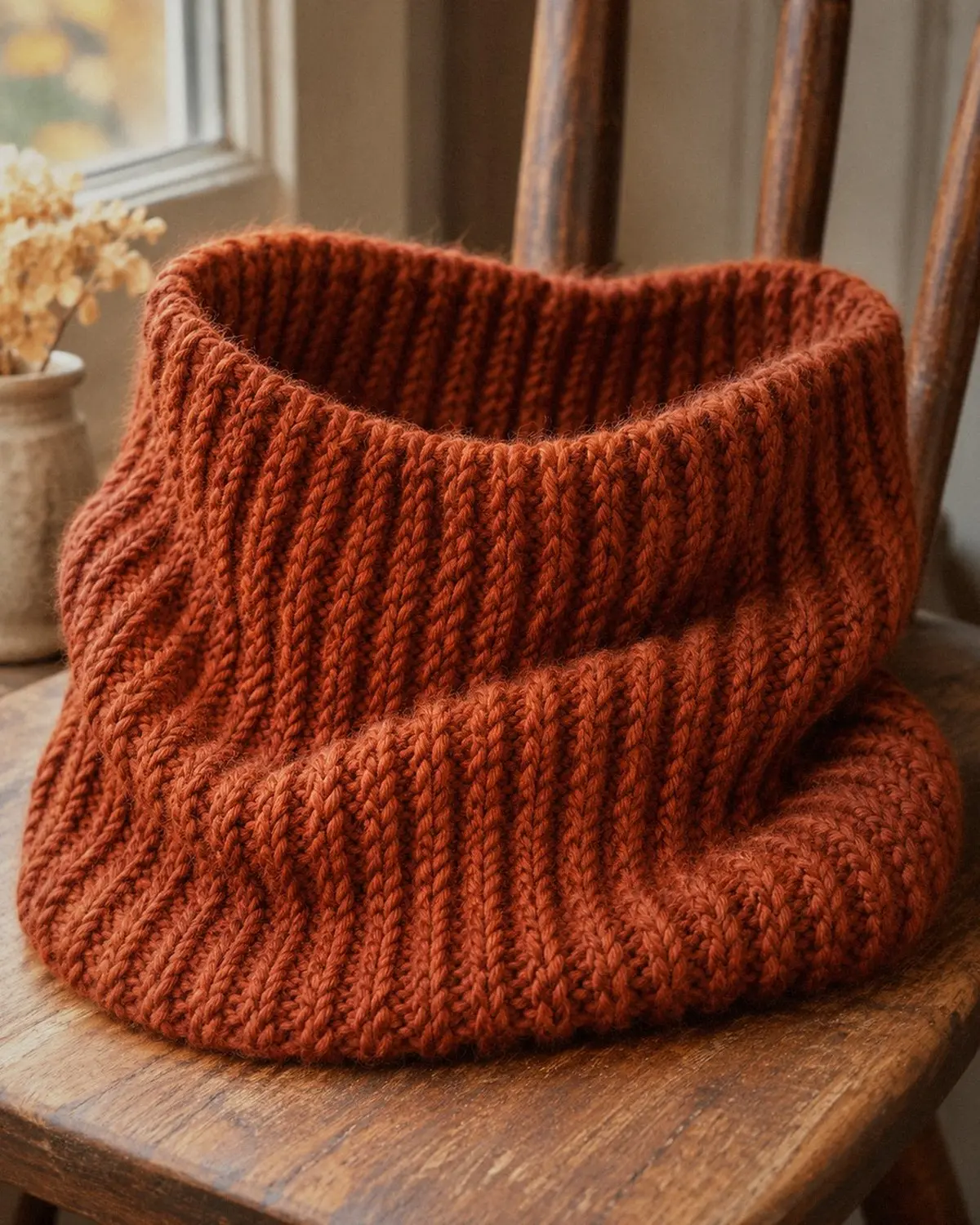
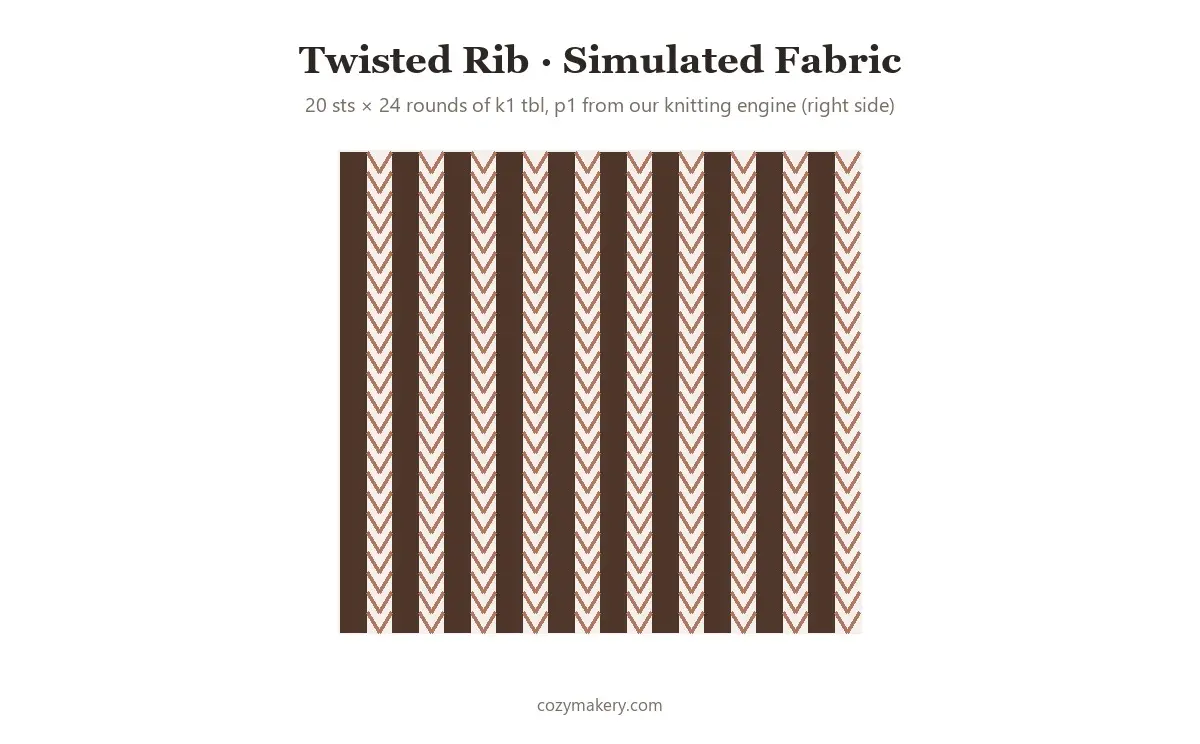
Look closely at a crisp cuff on a good sweater and you’ll often find twisted rib: 1×1 rib where every knit stitch goes through the back loop, k1 tbl, p1. The twist tightens each knit column into a raised cord, so the rib looks neater, stretches less and holds its shape better than plain rib. It’s lovely on its own for a cowl, too. This tutorial covers knitting through the back loop, twisted rib flat and in the round, binding off, and a practice project: a twisted rib cowl in 2 sizes.
In this post
Pattern at a glance
- Skill levelAdvanced beginner
- PracticeCowl, 2 sizes
- YarnWorsted (#4) wool
- NeedlesUS 7 (4.5 mm) circular
- Gauge26 sts × 30 rounds = 4 in (10 cm)
- TimeAbout 6 / 10 hours
The PDF
The 6-page PDF has the k1 tbl steps, the chart, a drawing of the fabric, the size table and both cowls. It prints on US Letter; on A4, choose “Fit to page”.
How to knit twisted rib
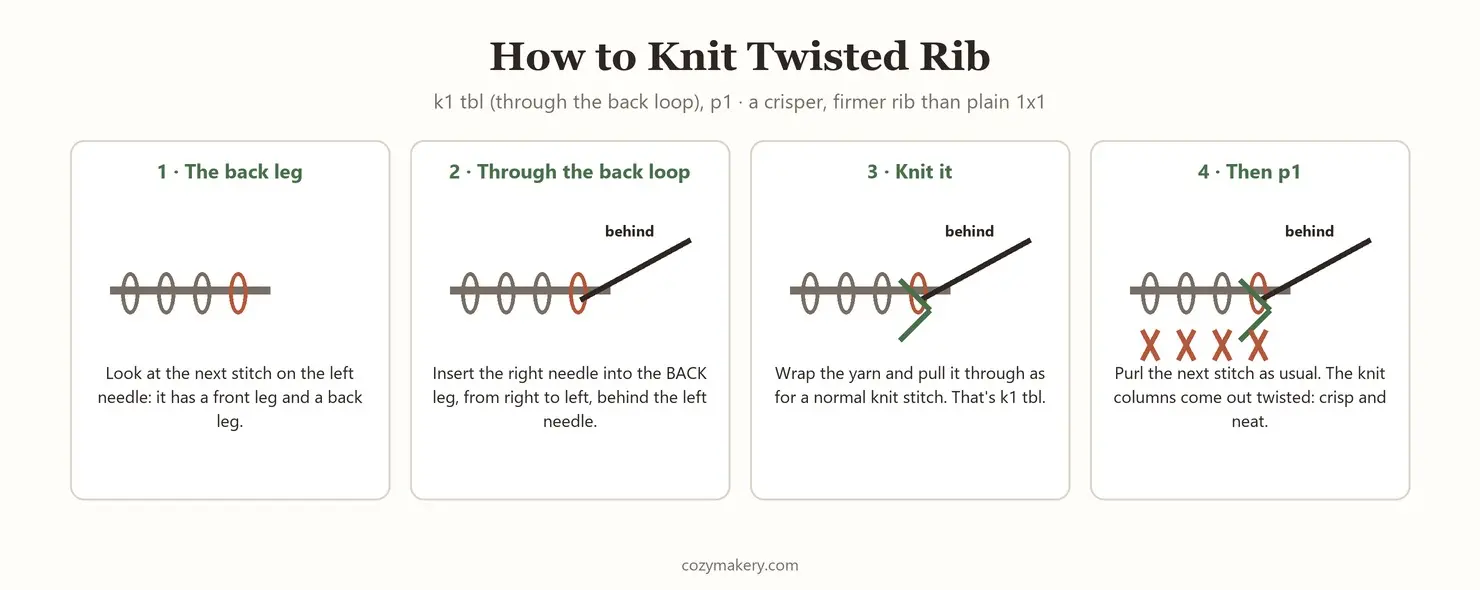
- Find the back leg: Each stitch on the left needle has a front leg and a back leg.
- Through the back loop: Insert the right needle into the BACK leg, from right to left, behind the left needle.
- Knit it: Wrap the yarn and pull it through as for a normal knit stitch. That's k1 tbl.
- Then p1: Purl the next stitch as usual. Repeat: k1 tbl, p1.
Twisted rib flat and in the round
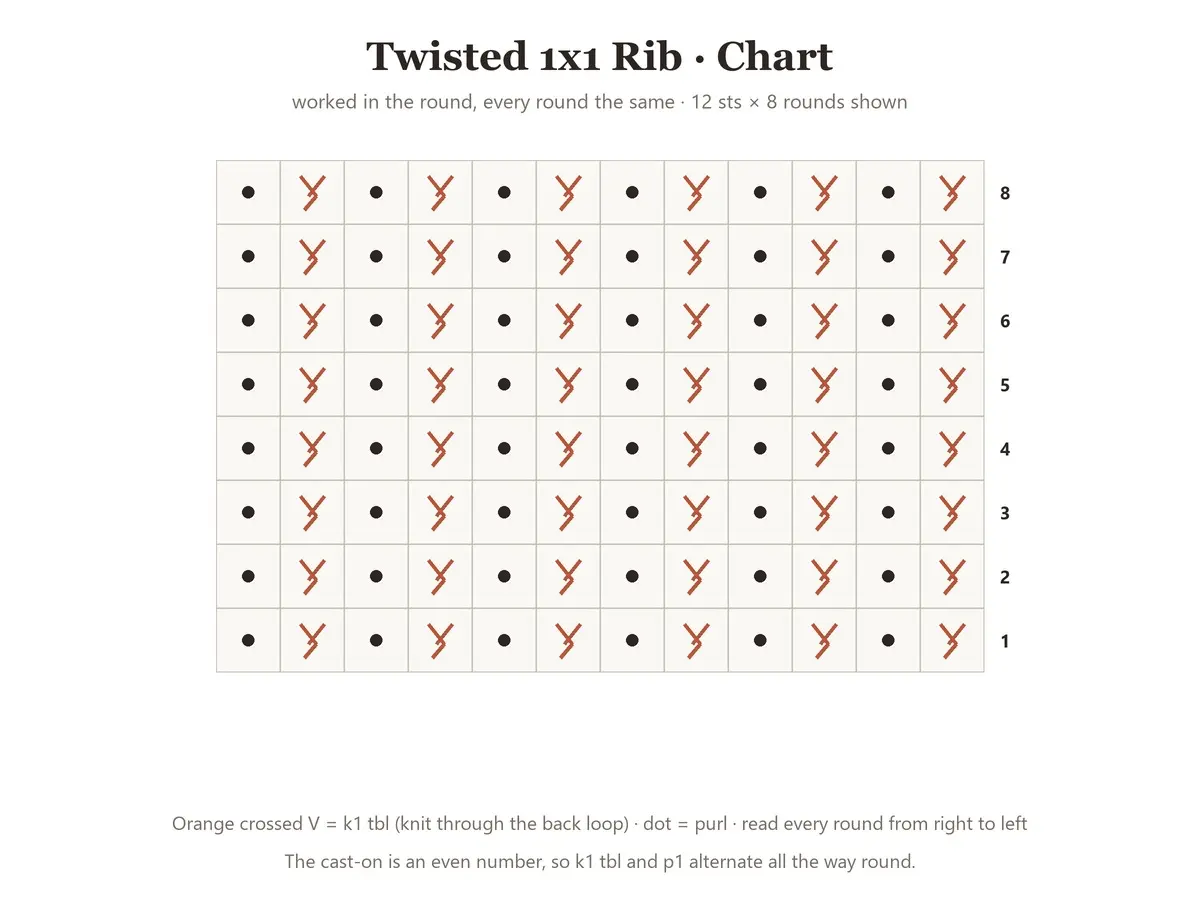
In the round, every round is the same: k1 tbl, p1. Flat, on the wrong side rows you work k1, p1 tbl so the same columns stay twisted on the right side. Some knitters only twist on the right side rows; the result is a little softer. On an even cast-on in the round, the rib meets itself across the join with no break.
Tips for even twisted rib
- It’s slower: going through the back loop is a bit fiddly at first. A pointy needle tip helps.
- Tension: twisted stitches are tighter. If your gauge is off, go up half a needle size.
- Cast on loosely: a stretchy cast on like the German twisted cast on matches the rib.
- Bind off in pattern: k1 tbl the knits and purl the purls as you bind off, loosely.
Twisted rib vs plain rib
Plain 1×1 rib is soft and very stretchy, so it’s great for hats that must hug the head. Twisted rib pulls in less, springs back better and looks sharper, so it shines on cuffs, socks, button bands and anything that should keep its shape after a lot of wear. It also hides uneven tension, because every knit stitch is twisted the same way.
Practice project: twisted rib cowl
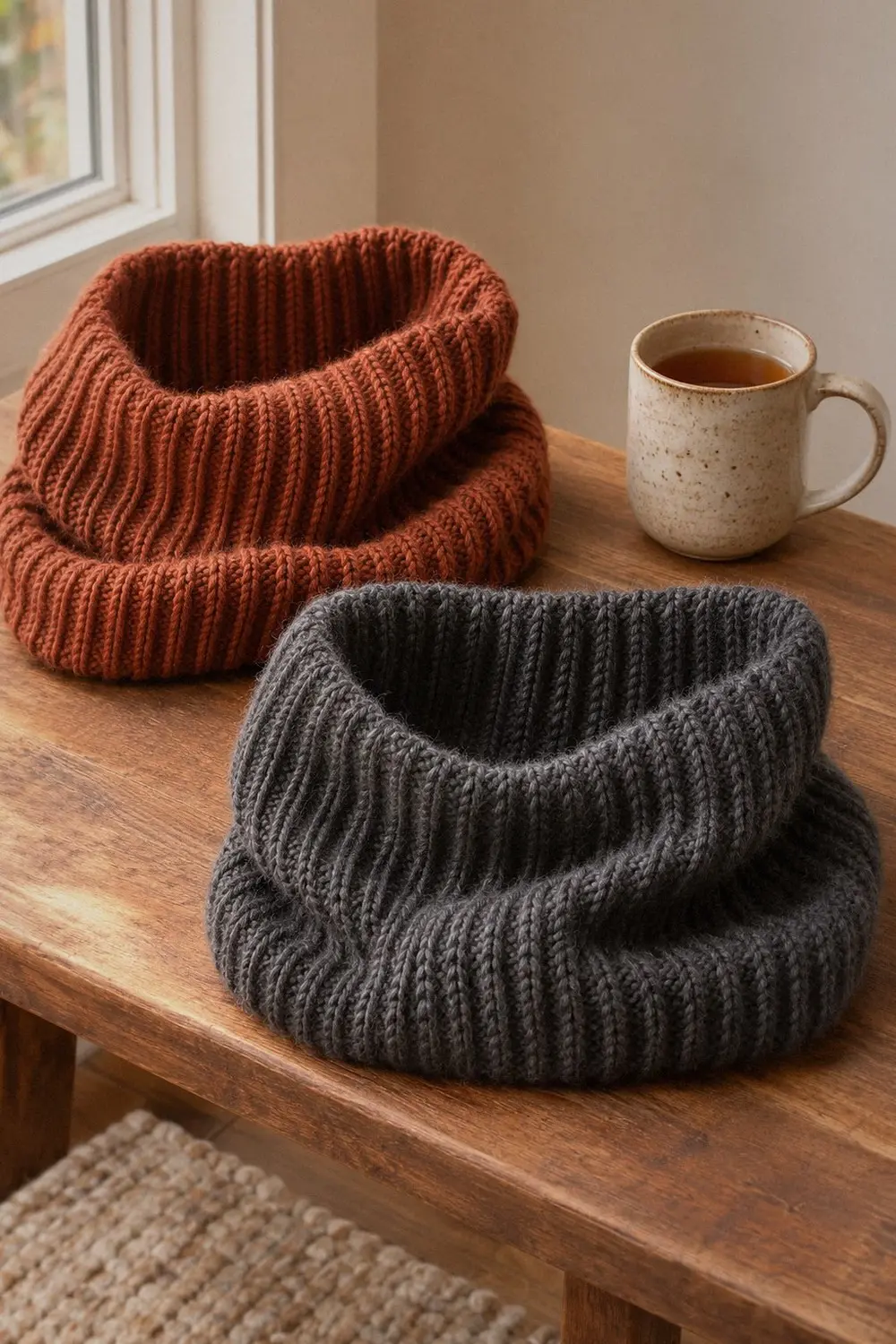
The cowl is one tube of twisted rib in the round, no shaping. The neck warmer is cast on with 144 stitches and worked for 68 rounds.
You'll need
- Worsted (#4) wool: 380 yd (neck warmer) or 625 yd (long cowl)
- US 7 (4.5 mm) 16 in (40 cm) circular needle, stitch marker, tapestry needle
Gauge: 26 sts and 30 rounds = 4 in (10 cm) in twisted rib, unstretched. A typical worsted value, not one we measured.
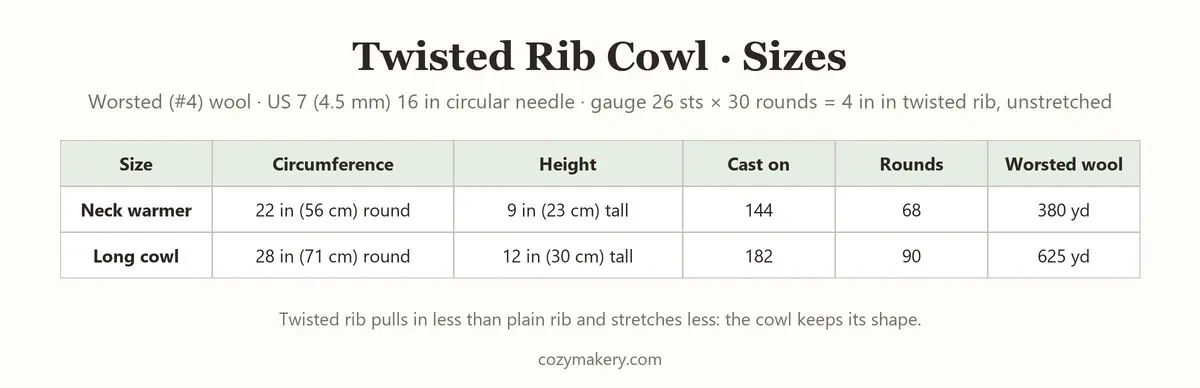
Neck warmer (22 in (56 cm) round, 9 in (23 cm) tall)
- Cast on: Cast on 144 sts with a stretchy cast on (long tail or German twisted) onto a 16 in (40 cm) circular needle. Place a marker and join in the round without twisting. (144)
- Round 1: *K1 tbl, p1*; repeat to the end. (144)
- Rounds 2–68: Repeat round 1. The cowl measures about 9.1 in (23 cm). (144)
- Bind off: Bind off loosely in pattern: k1 tbl the knits, purl the purls as you bind off. Weave in the ends. (0)
Long cowl (28 in (71 cm) round, 12 in (30 cm) tall): cast on 182 sts and work 90 rounds the same way.
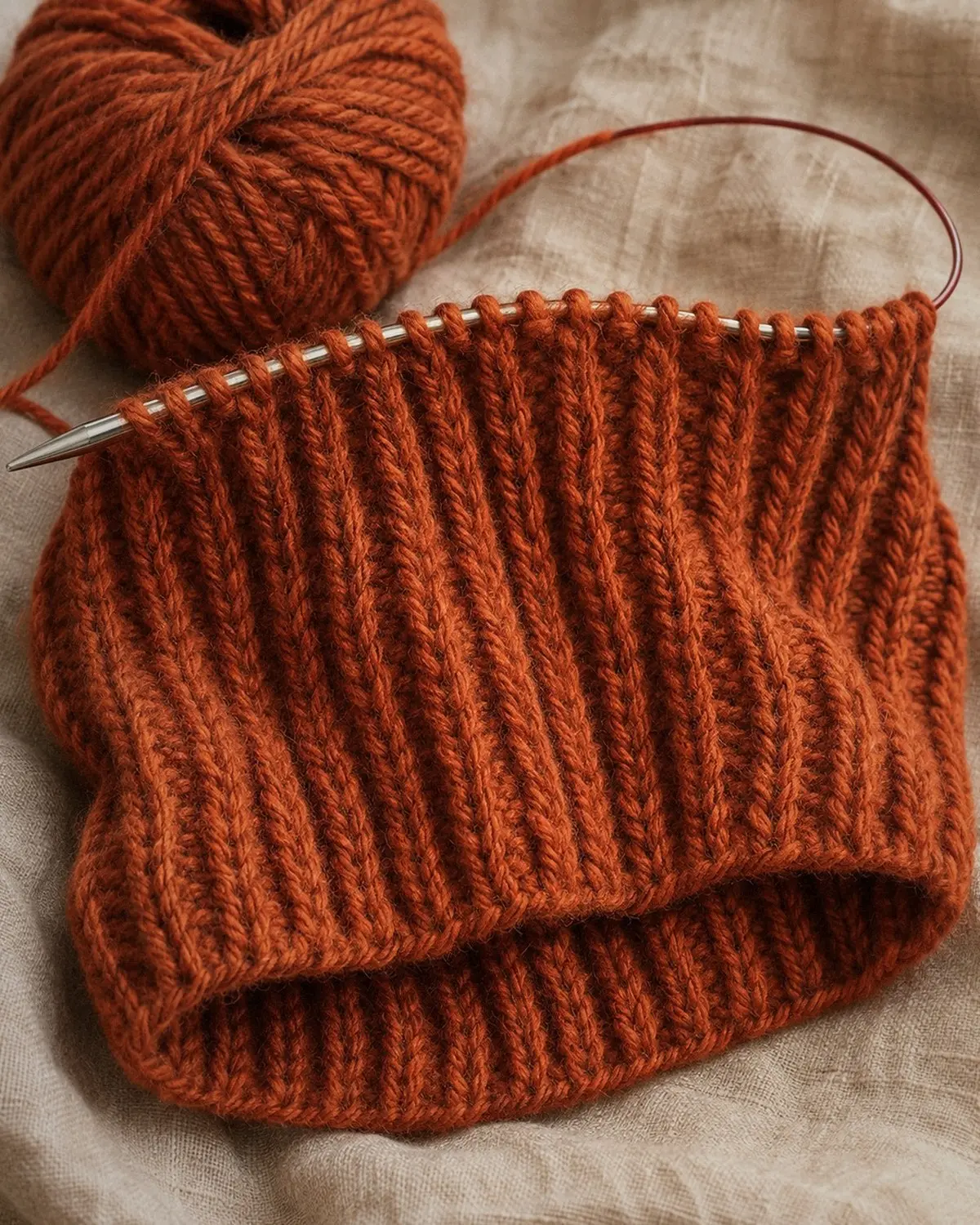
The counts are checked round by round: the cast-on is even so the rib meets at the join, every knit column is twisted on every round, and the number of stitches never changes. For the basics of working in a circle, see how to knit in the round; for more cowls, try this knit cowl pattern.
Twisted rib questions
Can I do 2×2 twisted rib?
Yes: work k2 tbl, p2 in the round, on a cast-on that’s a multiple of 4.
Why is my twisted rib slanting?
Twisted stitches can lean a little. Blocking evens them out, and it helps to make sure every knit is twisted the same way.
More knitting: stockinette stitch, seed stitch and how to cast on.
Plain 1×1 rib looks its best with a tubular cast-on, which makes the edge roll smoothly into the ribbing.