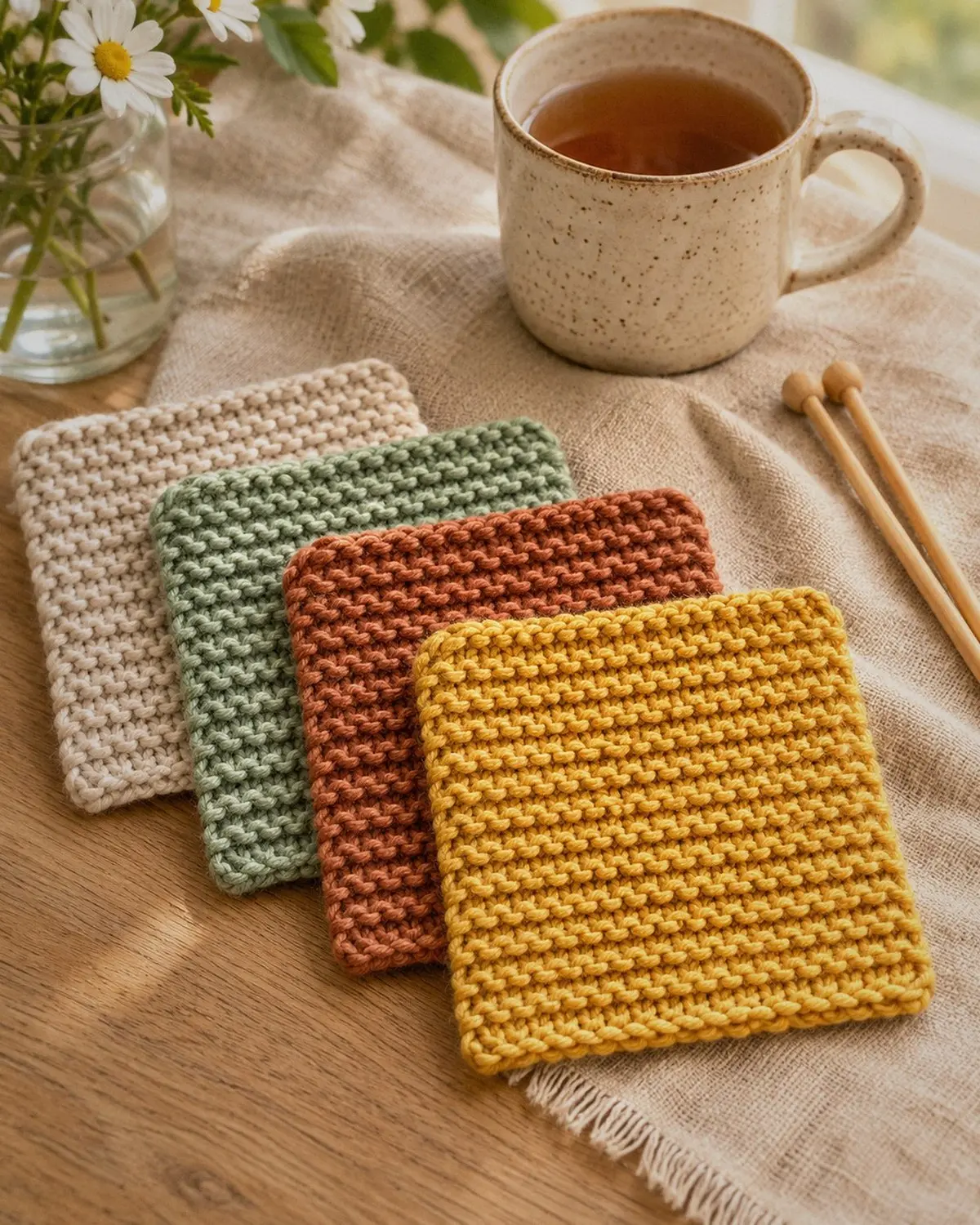
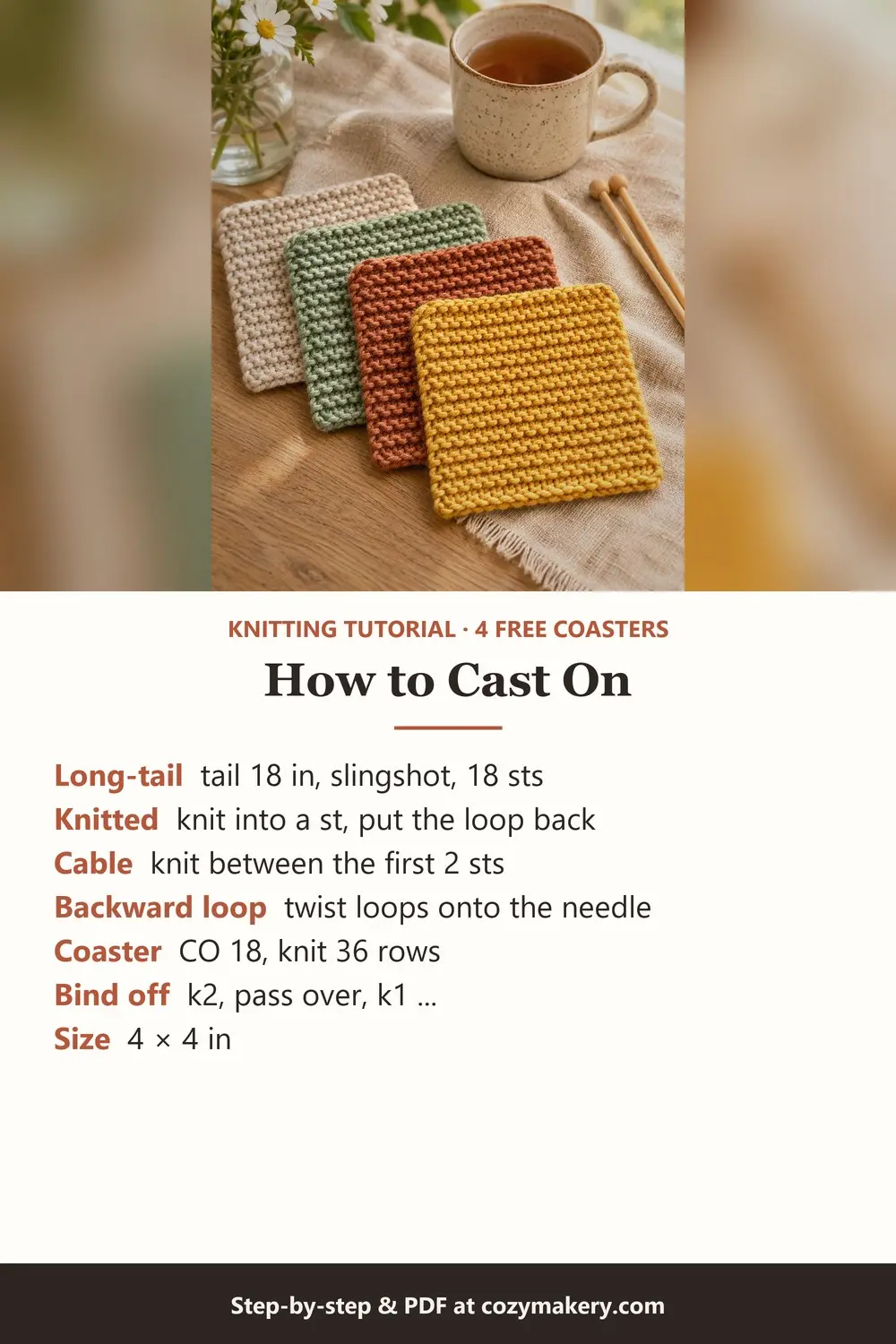
Every knitting project starts with a cast on. This guide shows how to cast on knitting step by step with the long-tail method, plus three other cast-ons every beginner should know: knitted, cable and backward loop. To see the difference for yourself, knit the free practice pattern: four little garter stitch coasters, one for each cast on.
In this post
Pattern at a glance
- Skill levelBeginner
- Practice piece4 coasters, 4 × 4 in (10 × 10 cm)
- YarnWorsted cotton, 28 yd each
- Needles4.5 mm (US 7)
- Stitchescast on, knit, bind off
- Time1 hour per coaster
Free printable pattern
The PDF has all four cast-ons step by step, the coaster pattern and the garter stitch chart.
The How to Cast On Knitting for Beginners PDF has 4 pages and prints on US Letter paper; on A4, choose “Fit to page” in the print dialog.
Long-tail cast on, step by step
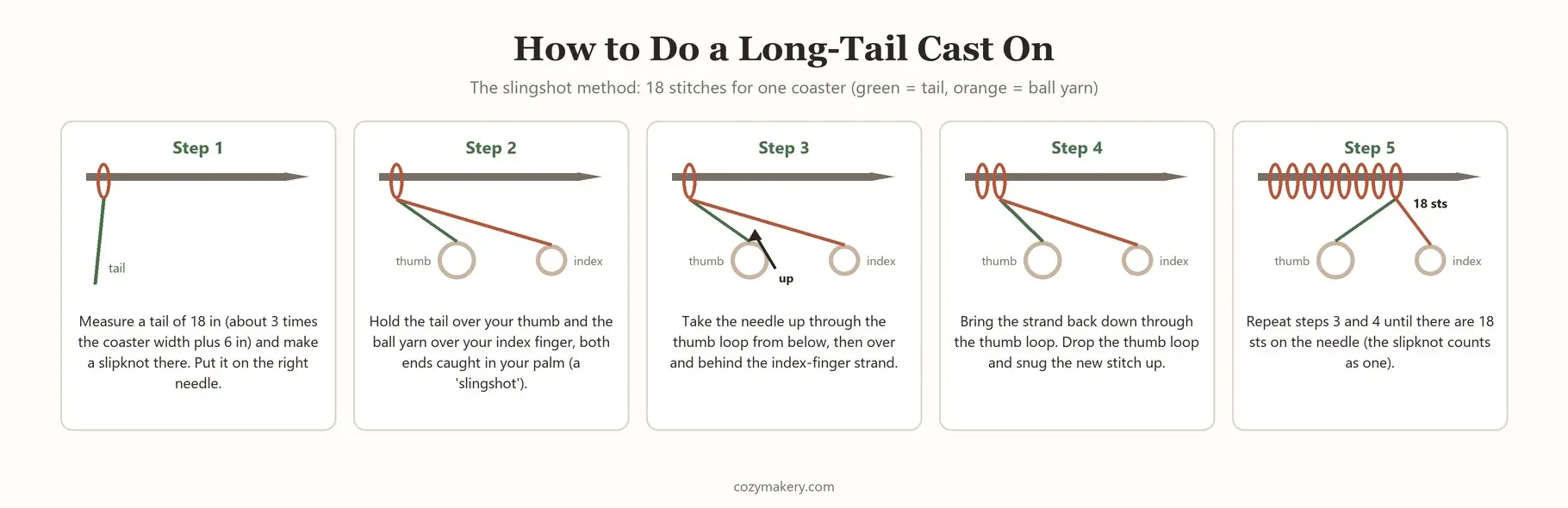
- Step 1: Measure a tail of 18 in (about 3 times the coaster width plus 6 in (15 cm)) and make a slipknot there. Put it on the right needle.
- Step 2: Hold the tail over your thumb and the ball yarn over your index finger, both ends caught in your palm (a 'slingshot').
- Step 3: Take the needle up through the thumb loop from below, then over and behind the index-finger strand.
- Step 4: Bring the strand back down through the thumb loop. Drop the thumb loop and snug the new stitch up.
- Step 5: Repeat steps 3 and 4 until there are 18 sts on the needle (the slipknot counts as one).
How long should the tail be? About 3 times the width of what you are knitting plus 6 in (15 cm). For a 4 in (10 cm) coaster that is 18 in (46 cm). Too short and you run out before the last stitch; just start again with a longer tail.
Knitted cast on
- Step 1: Make a slipknot on the left needle.
- Step 2: Knit into it, but do not slide it off: pull the new loop out long.
- Step 3: Twist the loop and place it on the left needle. That is one new stitch.
- Step 4: Knit into the stitch you just made and repeat until you have 18 sts.
Cable cast on
- Step 1: Make a slipknot and knitted-cast-on one stitch (2 sts on the left needle).
- Step 2: Insert the right needle BETWEEN the first 2 stitches, not into a stitch.
- Step 3: Wrap the yarn and pull a loop through; place it on the left needle.
- Step 4: Repeat, always going between the first 2 stitches, until you have 18 sts.
Backward loop cast on
- Step 1: Make a slipknot on the right needle.
- Step 2: Wrap the working yarn around your thumb from front to back.
- Step 3: Slide the needle up under the front strand of the thumb loop and drop it off your thumb.
- Step 4: Snug it up and repeat until you have 18 sts. Keep the loops even and not too tight.
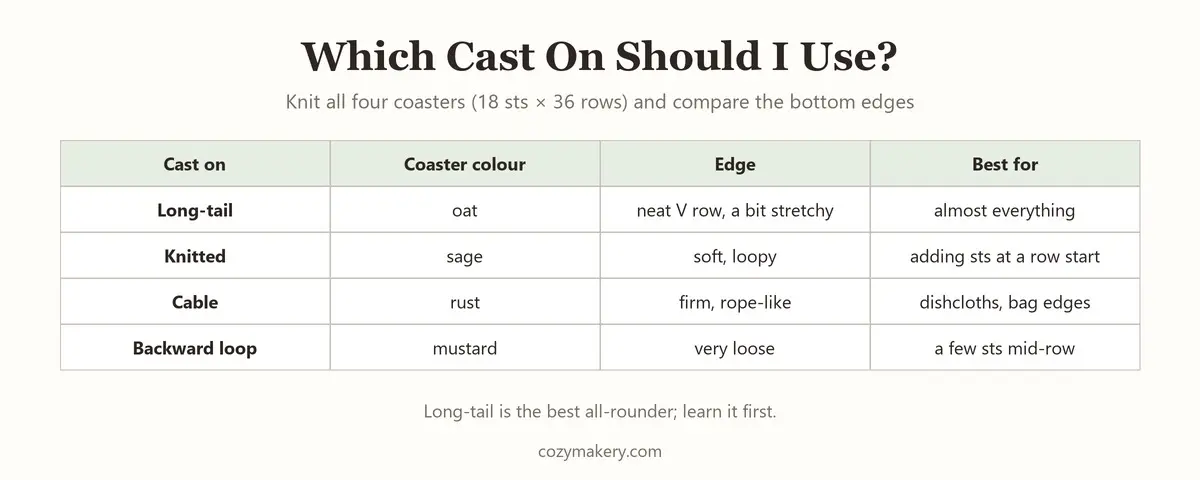
Which cast on should I use?
Practice pattern: cast-on sampler coasters
Materials
- Worsted (#4) cotton in oat, sage, rust and mustard, about 28 yd each
- 4.5 mm (US 7) needles and a tapestry needle
Abbreviations
| Abbreviation | Meaning |
|---|---|
| CO | cast on |
| k | knit |
| st(s) | stitch(es) |
| BO | bind off |
| RS / WS | right / wrong side |
Gauge: 18 sts and 36 rows = 4 in in garter stitch. Coaster 1 (oat) uses the long-tail cast on, 2 (sage) the knitted, 3 (rust) the cable and 4 (mustard) the backward loop.
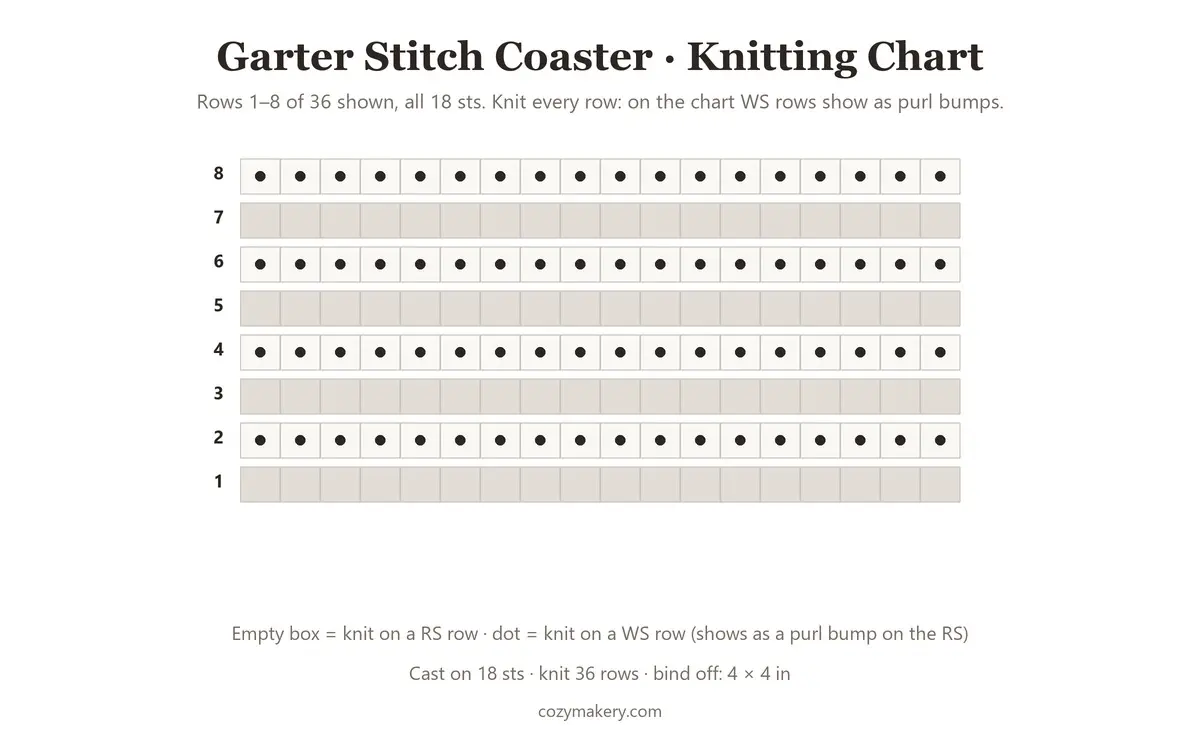
Knitting chart
Coaster (make 4)
- Cast on: Cast on 18 sts with the method for this coaster (see the cast-on steps). (18)
- Rows 1–36: Knit every stitch (garter stitch). Slip the first stitch of each row knitwise for a smooth edge if you like. (18 ridges)
- Bind off: Knit 2, *pass the first stitch over the second, knit 1*; repeat until 1 st remains. Cut the yarn and pull it through the last loop.
- Finish: Weave in the ends on the back along a ridge. Block flat to 4 × 4 in (10 × 10 cm).
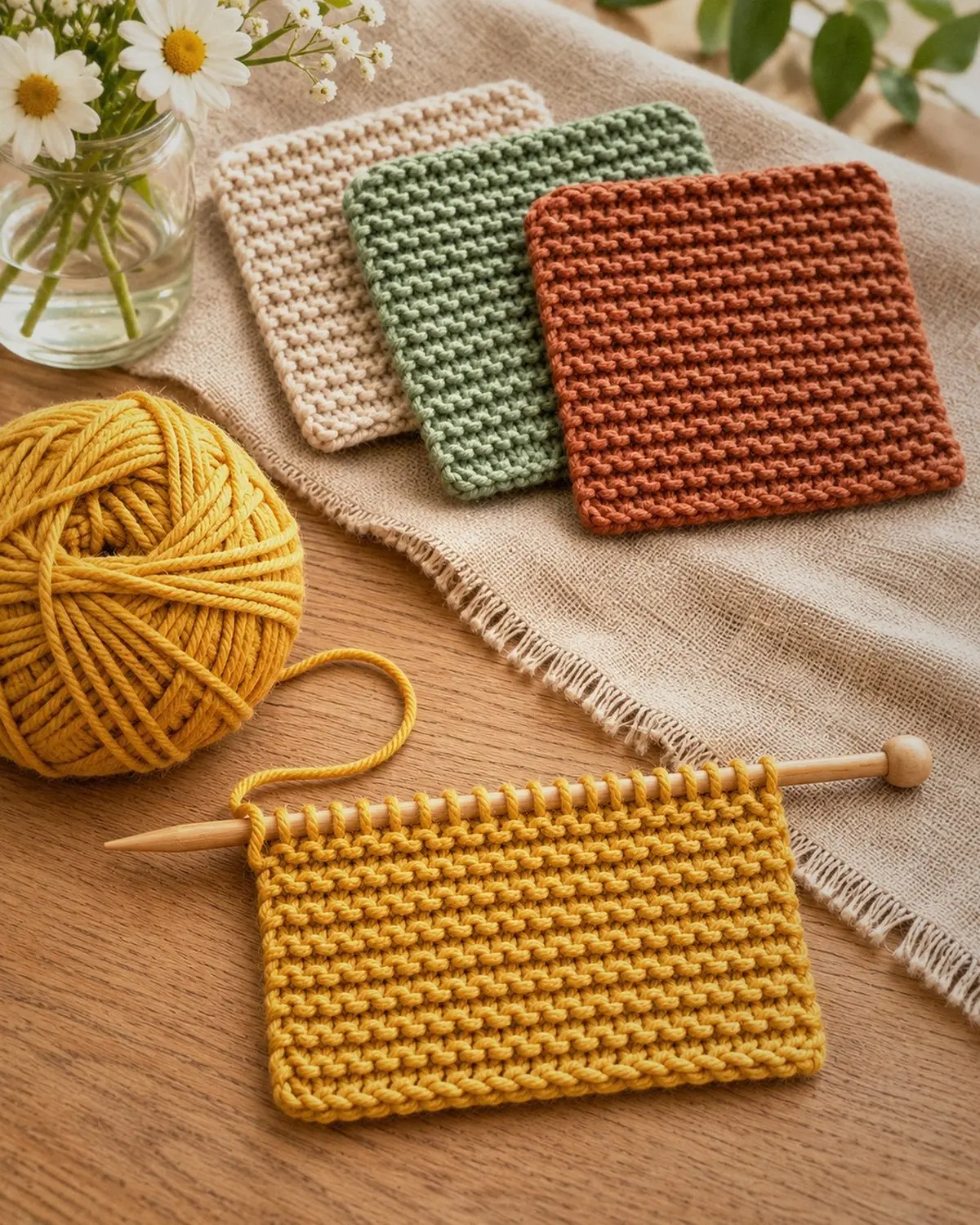
Compare the bottom edges when all four are done: the long-tail edge is neat and a little stretchy, the cable edge is firm, and the backward loop edge is the loosest. Need the last step explained? See how to bind off knitting.
You might also like this easy knit beanie pattern.
Next skill: how to fix a dropped stitch in knitting, so a slipped stitch is never a problem.
Your first project after casting on? Try the easy seed stitch knit scarf.
Frequently asked questions
What is the easiest cast on for beginners?
The backward loop is the easiest to learn, but the long-tail cast on gives a much better edge. Learn the long-tail first; it is worth it.
Does the slipknot count as a stitch?
Yes, in the long-tail, knitted and cable cast-ons the slipknot is your first stitch.
Why is my cast on so tight?
Cast on over two needles held together, or over one needle a size or two larger, then knit the first row with the right size.
How many pages is the cast-on practice coasters PDF?
4 pages on US Letter paper, with every step of the cast-on practice coasters written out. On A4 paper, pick Fit to page when you print the cast-on practice coasters PDF so the charts aren’t cropped.
Can I use a different yarn for the cast-on practice coasters?
Yes, as long as it’s worsted and you check your gauge: a thicker or thinner yarn changes the size of the cast-on practice coasters and how much you need. Cotton keeps the cast-on practice coasters firm and washable; a cotton blend works too.
Save it for later
Pin the image below to keep the cast-on practice coasters pattern on your Pinterest board. Made the cast-on practice coasters? I’d love to see your version: send a photo to info@cozymakery.com.
More knitting basics: how to bind off, how to read a knitting pattern and how to knit in the round.
Cast on and knit a few rows? The next stitch to learn is the purl stitch.
Once you can knit and purl, learn the four ways to add stitches: how to increase in knitting. Once your stitches are on the needle, carry on with how to knit. For a stretchy edge on ribbing, use the German twisted cast on.