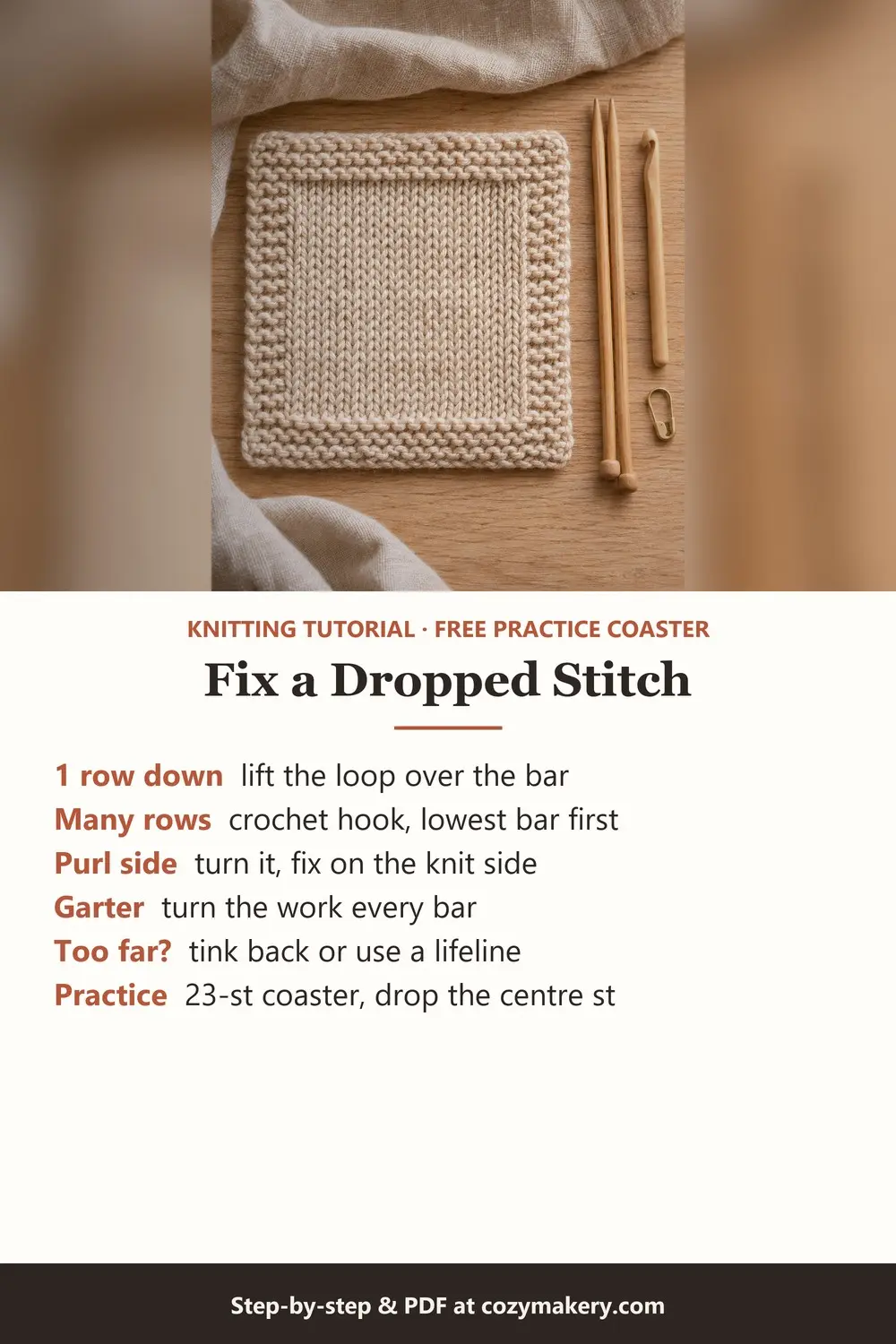
A dropped stitch looks scary: one loop slips off the needle and a ladder runs down your knitting. The good news is that it is one of the easiest mistakes to fix. This guide shows how to fix a dropped stitch in knitting five ways, from one row down to a long ladder, on the purl side and in garter stitch, plus a little practice coaster where you drop a stitch on purpose so the fix is easy the first time it happens for real.
In this post
Pattern at a glance
- Skill levelBeginner
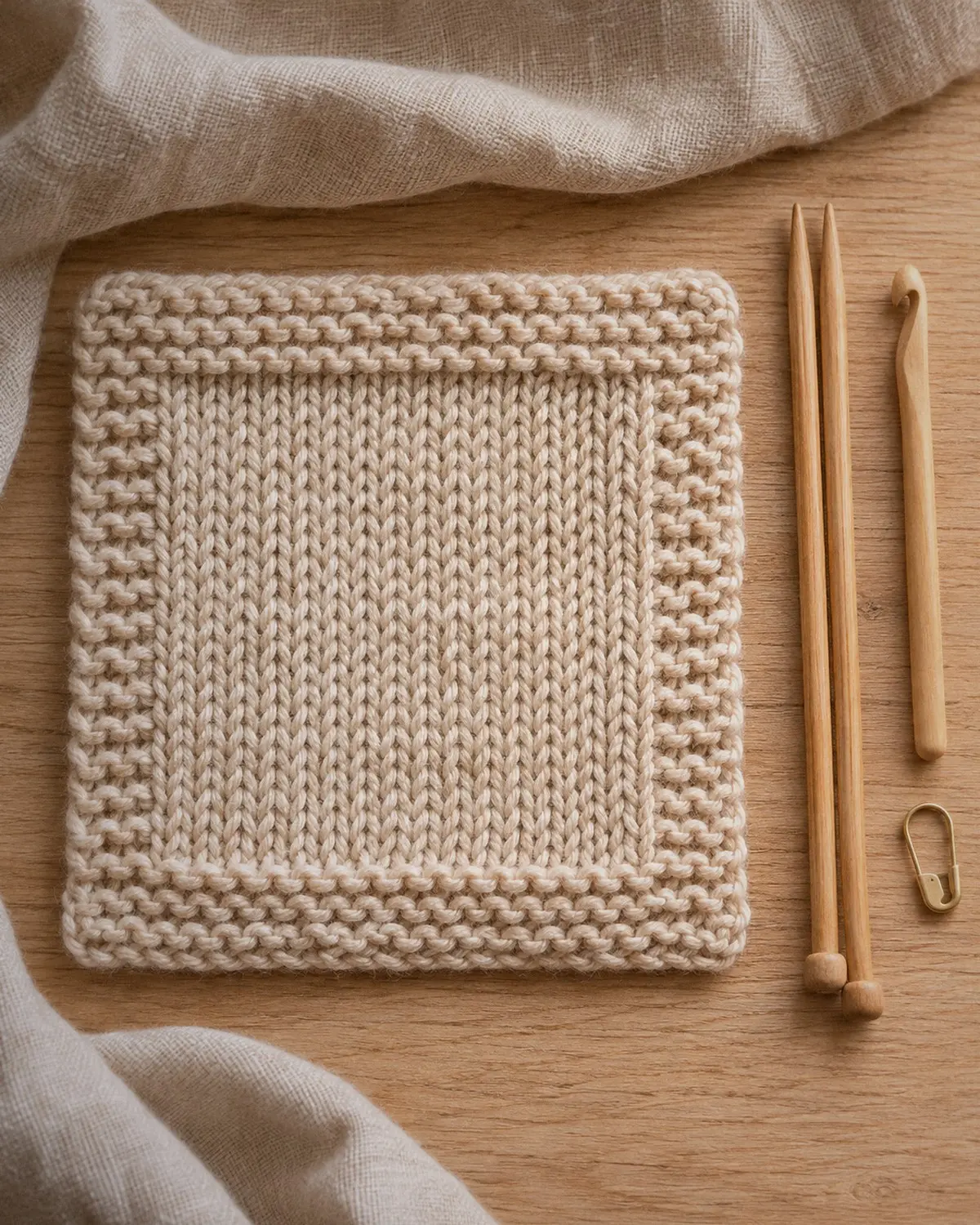
- Practice pieceCoaster, 5.1 × 4.7 in (13 × 12 cm)
- YarnWorsted cotton, 33 yd
- Needles4.5 mm (US 7)
- ToolA crochet hook
- TimeAbout 1 hour
Free printable pattern
The PDF has all five methods step by step, the troubleshooting table and the ladder practice coaster.
The How to Fix a Dropped Stitch in Knitting PDF has 5 pages and prints on US Letter paper; on A4, choose “Fit to page” in the print dialog.
First: stop the ladder
Catch the dropped loop with a locking stitch marker or a safety pin right away, so it can’t run any further while you get your hook. Then look at how many loose bars sit above it: that is how many rows it has dropped.
Fix it with a crochet hook, step by step
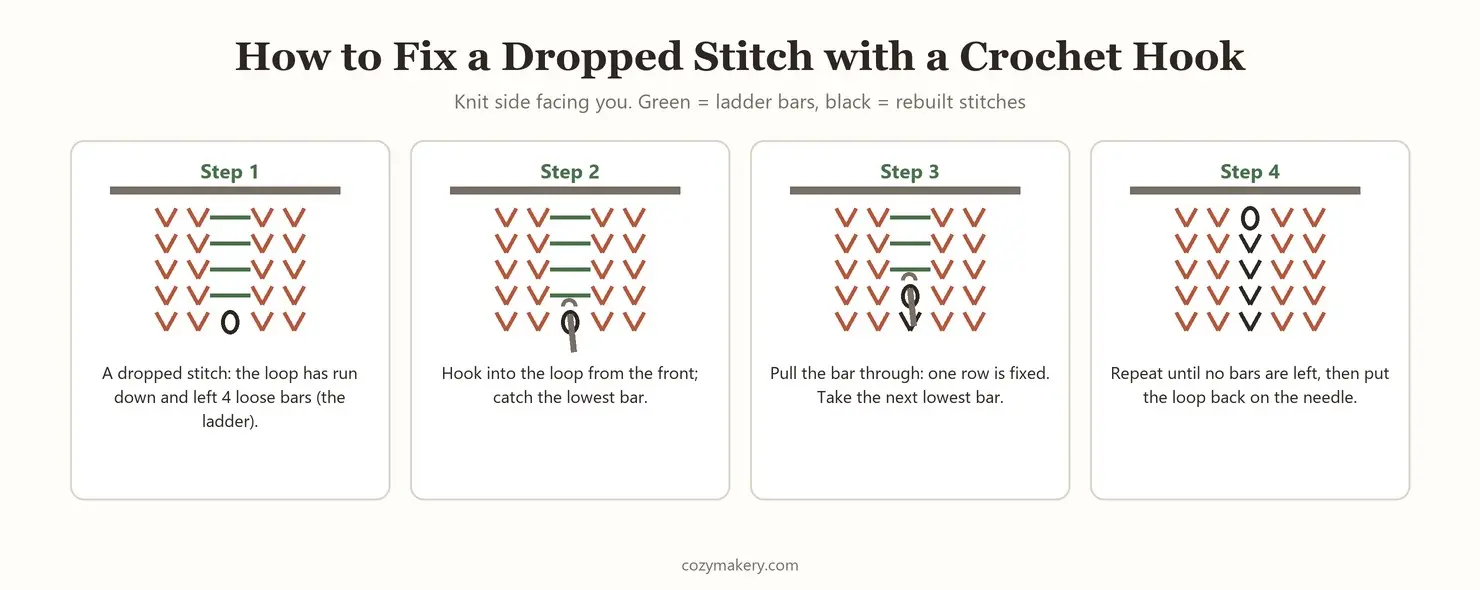
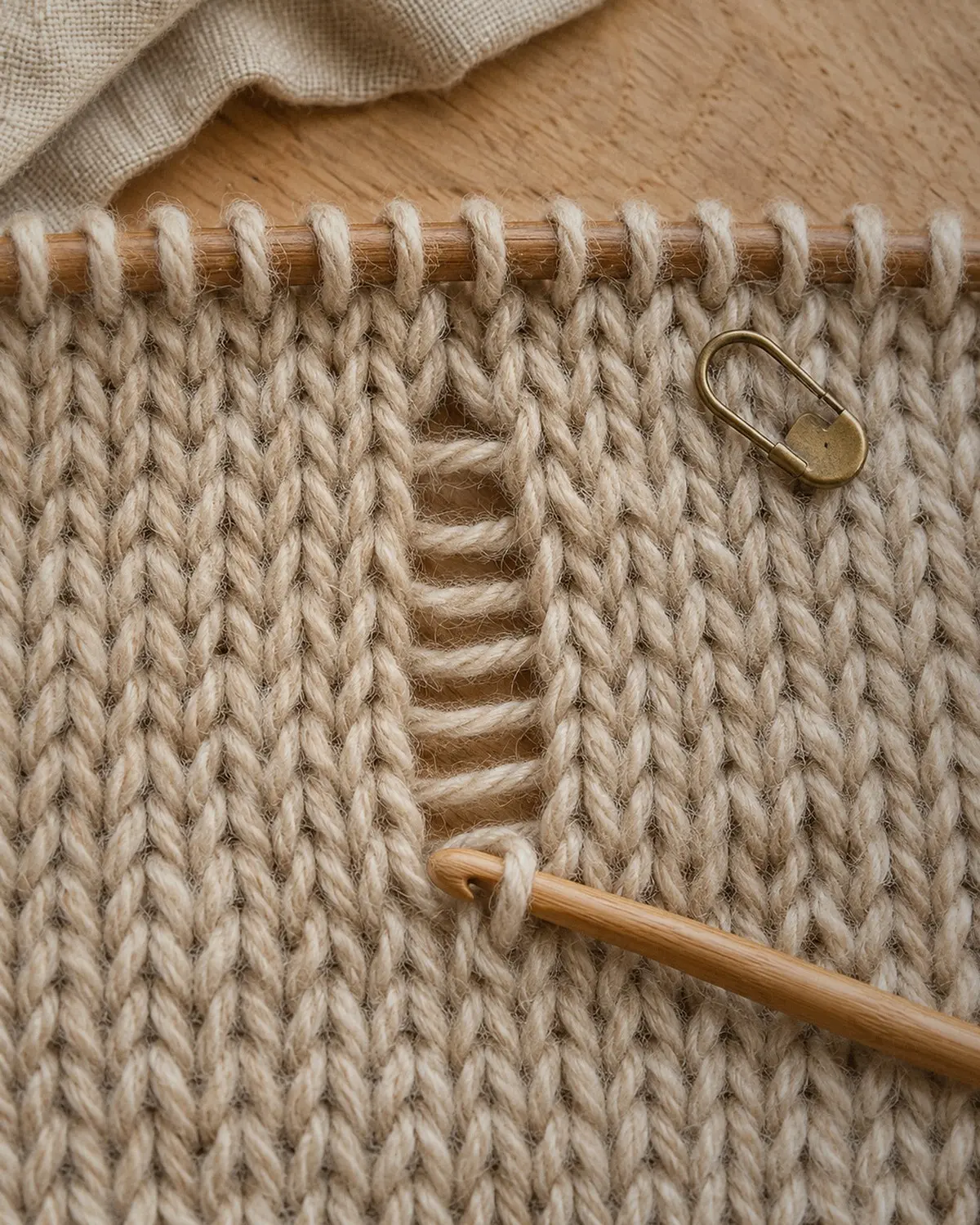
Method 1: one row down (knit side)
- Step 1: Find the dropped loop just below the needle and the loose horizontal bar (the 'ladder rung') above it.
- Step 2: Insert the right needle into the loop from front to back, then under the bar.
- Step 3: With the left needle, lift the loop over the bar and off the right needle: the bar is now a stitch.
- Step 4: Put the new stitch onto the left needle with its right leg in front, then knit it as normal.
Method 2: several rows down (crochet hook)
- Step 1: Hold the work with the knit side facing you. Insert a crochet hook into the dropped loop from front to back.
- Step 2: Catch the lowest bar of the ladder with the hook and pull it through the loop.
- Step 3: Repeat bar by bar, always taking the lowest one, until no bars are left.
- Step 4: Slip the last loop onto the left needle, right leg in front. Check that it isn't twisted.
Method 3: on the purl side
- Step 1: The easiest fix: turn the work so the knit side faces you and use Method 2.
- Step 2: To fix it from the purl side, put the bar in FRONT of the loop, insert the hook from back to front and pull the bar through.
- Step 3: Repeat for every bar, then place the stitch on the needle.
Method 4: in garter stitch
- Step 1: In garter stitch the ladder alternates knit and purl bumps.
- Step 2: Pick up the first bar as a knit stitch (hook from the front, Method 2).
- Step 3: Turn the work over and pick up the next bar the same way: from the other side it is a knit stitch too.
- Step 4: Keep turning the work for each bar until you reach the needle.
Method 5: when it has gone too far
- Step 1: If the ladder runs into a cable, lace or a cast-on edge, or several stitches dropped, it is faster to undo.
- Step 2: Tink (knit backwards) stitch by stitch to the problem, or rip back to a lifeline.
- Step 3: Prevention: every 10–20 rows thread a smooth yarn through all the live stitches (a lifeline); you can always rip back to it.
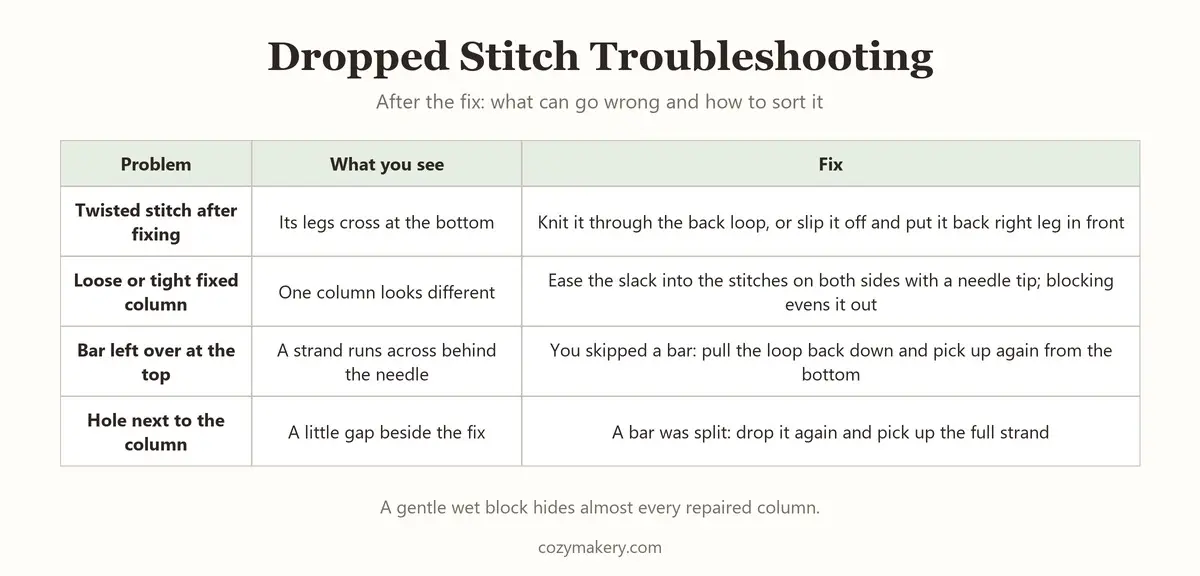
Troubleshooting
Practice pattern: ladder practice coaster
Materials
- Worsted (#4) cotton, about 33 yd
- 4.5 mm (US 7) needles, a 3.5–4.5 mm crochet hook, a locking stitch marker and a tapestry needle
Abbreviations
| Abbreviation | Meaning |
|---|---|
| k | knit |
| p | purl |
| RS / WS | right side / wrong side |
| tink | knit backwards to undo stitches |
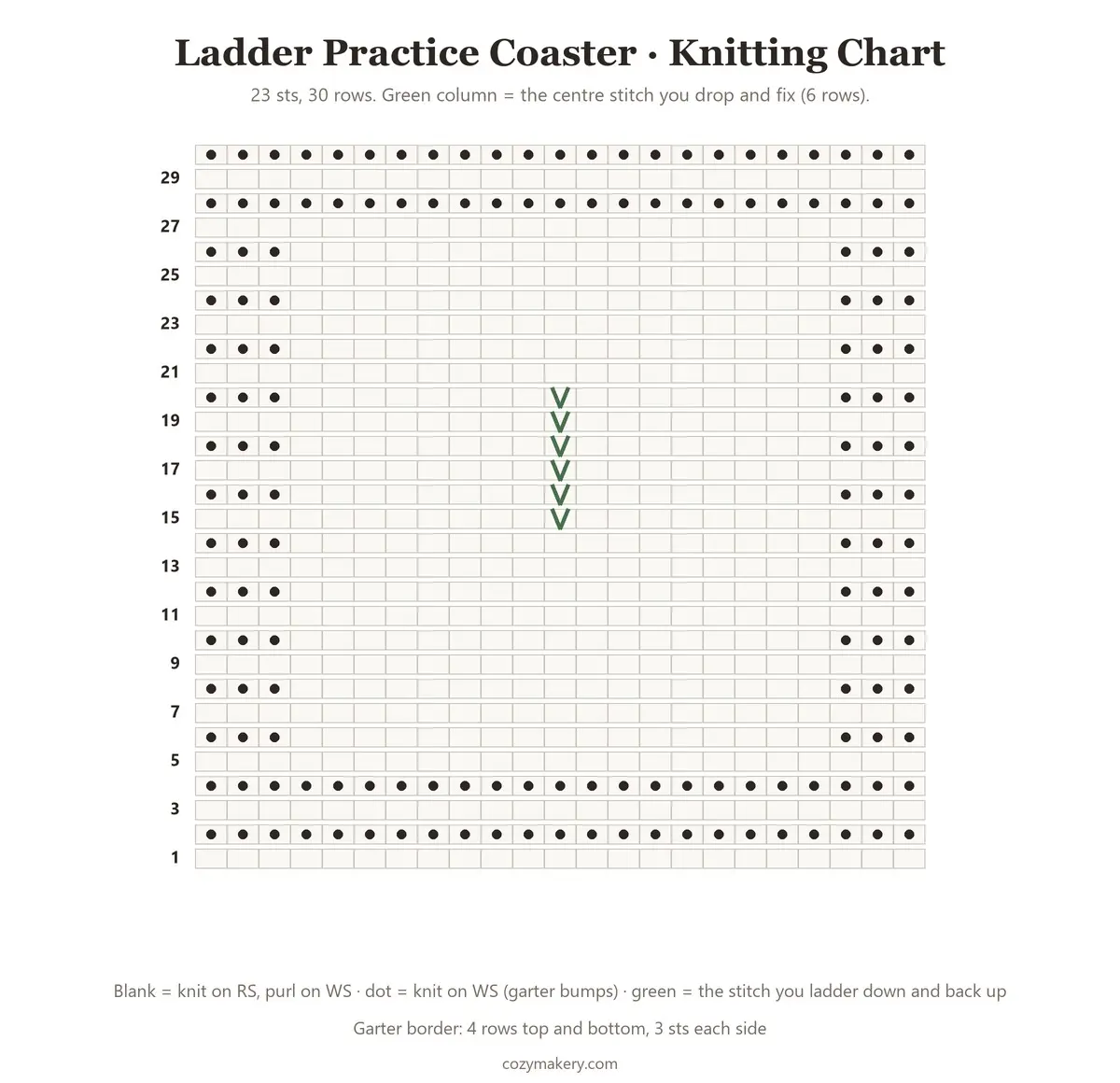
Chart
Coaster
- Cast on: Cast on 23 sts with the long-tail cast on.
- Rows 1–4: Knit every row (garter border).
- Row 5 (RS): Knit.
- Row 6 (WS): K3, p17, k3.
- Rows 7–26: Repeat the last 2 rows 10 more times.
- Practice (after Row 20): On the next RS row, knit to the centre stitch (st 12). Slip it off the needle on purpose and pull the fabric sideways until it runs down 6 rows. Fix it with a crochet hook (Method 2), then finish the row.
- Rows 27–30: Knit every row (garter border).
- Bind off: Bind off knitwise. Weave in the ends and block flat.
Frequently asked questions
Can I fix a dropped stitch without a crochet hook?
Yes. Use the tip of a knitting needle for each bar (Method 1), one row at a time. A hook is just faster for long ladders.
How do I know if a stitch is twisted after fixing it?
Look at the bottom of the V: in a correct stitch the legs sit side by side; in a twisted one they cross. Knit it through the back loop to untwist it.
Why does my fixed column look loose?
The yarn from the ladder is a little longer than a normal stitch. Ease the slack into the neighbouring stitches with a needle tip, then block.
Does gauge matter for the practice coaster?
Only a little: the practice coaster isn’t fitted, so a tighter or looser tension just makes it slightly smaller or bigger and changes the yarn amount. For the size in the pattern, make a 4 in (10 cm) swatch for the practice coaster with the 4.5 mm (US 7) needles first and compare.
How many pages is the practice coaster PDF?
5 pages on US Letter paper, with every step of the practice coaster written out. On A4 paper, pick Fit to page when you print the practice coaster PDF so the charts aren’t cropped.
Save it for later
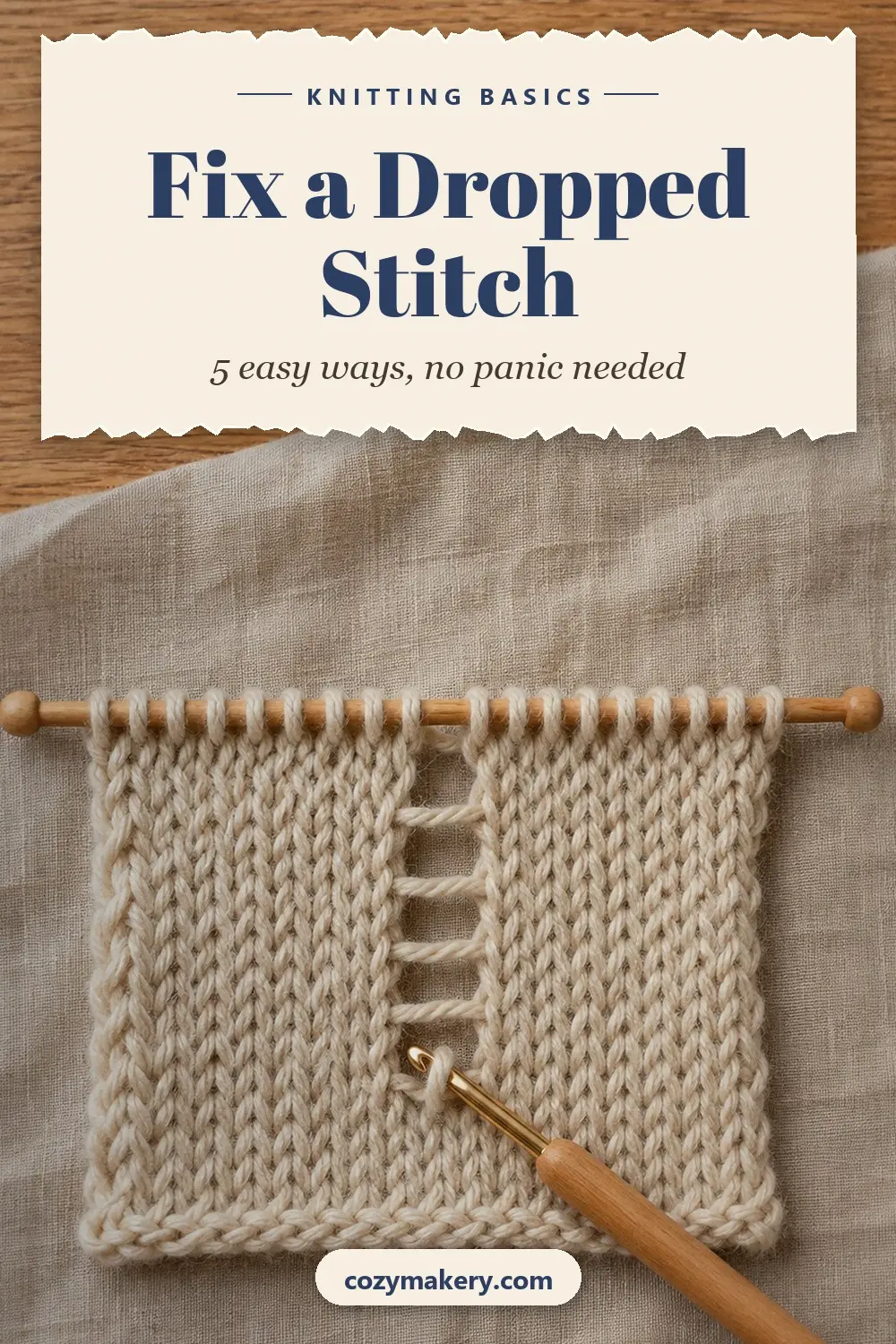
Pin the image below to keep the practice coaster pattern on your Pinterest board. Made the practice coaster? I’d love to see your version: send a photo to info@cozymakery.com.
More knitting basics: how to cast on, how to bind off and how to read a knitting pattern.