Knitting in the round means knitting a seamless tube instead of a flat piece. Hats, cowls, socks, mittens and sweater bodies are all knit this way. It sounds harder than knitting flat, but in one way it’s easier: the right side always faces you, so stockinette is just knitting every round. No purl rows at all.
This beginner’s guide covers how to cast on and join without twisting, the three ways to knit in the round (circular needle, double-pointed needles and magic loop), and how to read a round chart. Then you’ll practise with a free pattern: the First Round Cowl, a striped cowl on a 16 in circular needle, in child and adult sizes, with a printable PDF.
In this post
Pattern at a glance
- Skill levelBeginner
- SizesChild 19.6 in · Adult 24.9 in (63 cm) around
- Height9 / 11.7 in (30 cm)
- YarnWorsted, about 170 / 270 yd
- NeedleUS 8 (5 mm), 16 in circular
- Stitchesknit, purl, slip 1
- TimeAbout 9 hours (estimate from the yarn amount)
Free printable pattern
The PDF has the cowl pattern in both sizes, the round chart and the diagrams for joining and for the three methods.
The How to Knit in the Round PDF has 3 pages and prints on US Letter paper; on A4, choose “Fit to page” in the print dialog.
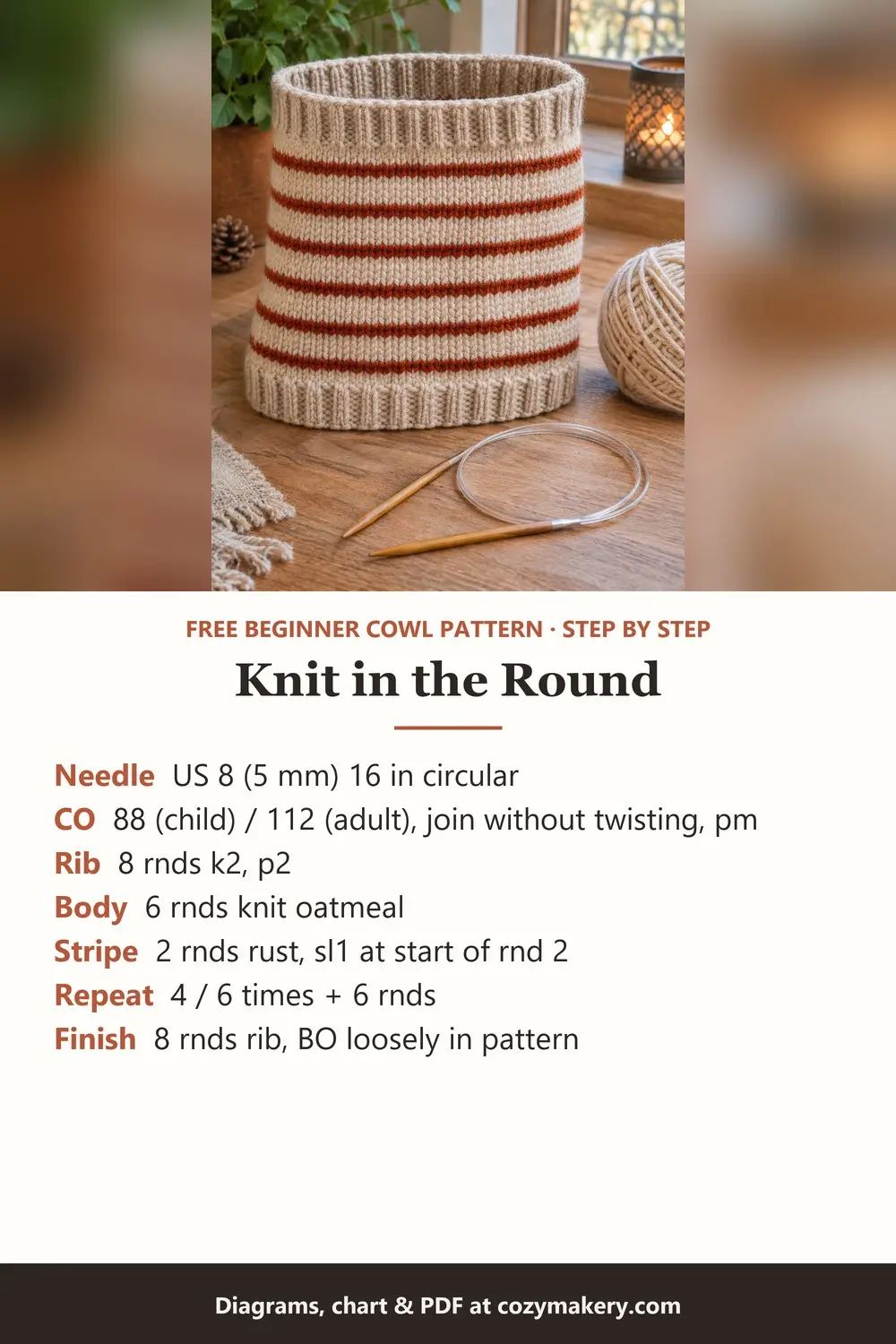
What you need to knit in the round
- A circular needle that is shorter than the tube you’re knitting. For hats and cowls, a 16 in (40 cm) circular is ideal. The stitches have to reach all the way around the needle, so a 16 in needle needs a tube of about 18 in or more.
- Double-pointed needles (DPNs) or a long circular for magic loop, for tubes too small for a circular (hat crowns, mittens, socks).
- A stitch marker to mark the beginning of the round.
How to join in the round without twisting
This is the one step that really matters. If the cast-on twists around the needle when you join, your tube turns into a Möbius loop, and the only fix is to start again.
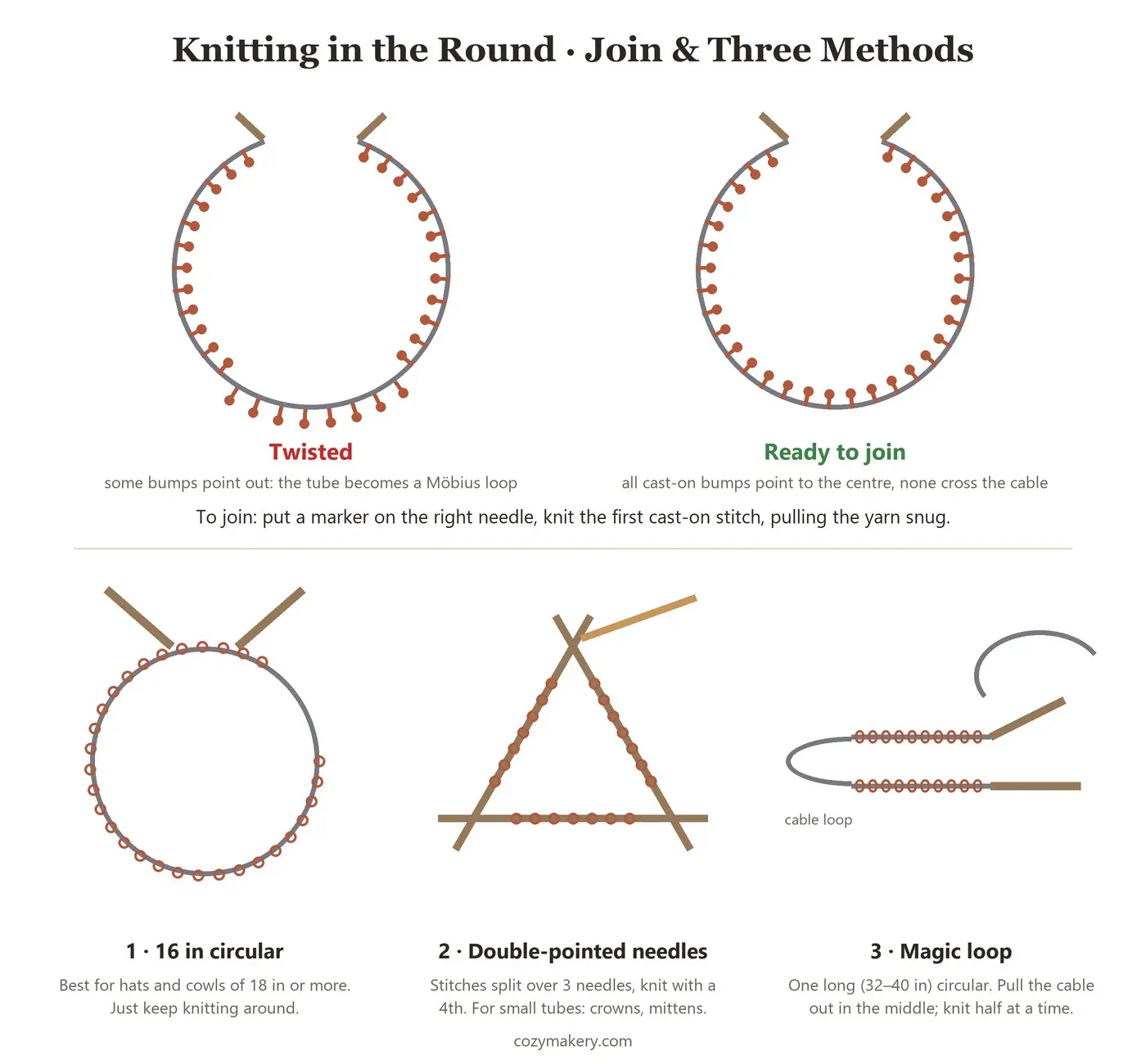
- Cast on all your stitches onto the circular needle (long-tail cast on works well).
- Lay the needle flat on a table and slide the stitches around until the cast-on edge sits on the inside of the circle all the way around. No stitch should cross over the cable.
- Hold the needle tips: the tip with the working yarn goes in your right hand, the first cast-on stitch is on the left tip.
- Place a marker on the right tip: this is the beginning of the round (BOR).
- Knit the first stitch from the left tip, pulling the yarn snug so there’s no gap. You’ve joined, and from now on you just keep going around.
Three ways to knit in the round
| Method | Best for | Good to know |
|---|---|---|
| 16 in circular | Hats, cowls (about 18 in (46 cm) around or more) | Easiest: just keep knitting around. |
| Double-pointed needles | Small tubes: crowns, mittens, socks | Stitches split over 3 needles, knit with a 4th. Pull the first stitch on each needle snug to avoid ladders. |
| Magic loop | Any small tube, with one long (32–40 in (81–102 cm)) circular | Pull out a loop of cable in the middle of the stitches and knit half the round at a time. |
Free pattern: the First Round Cowl
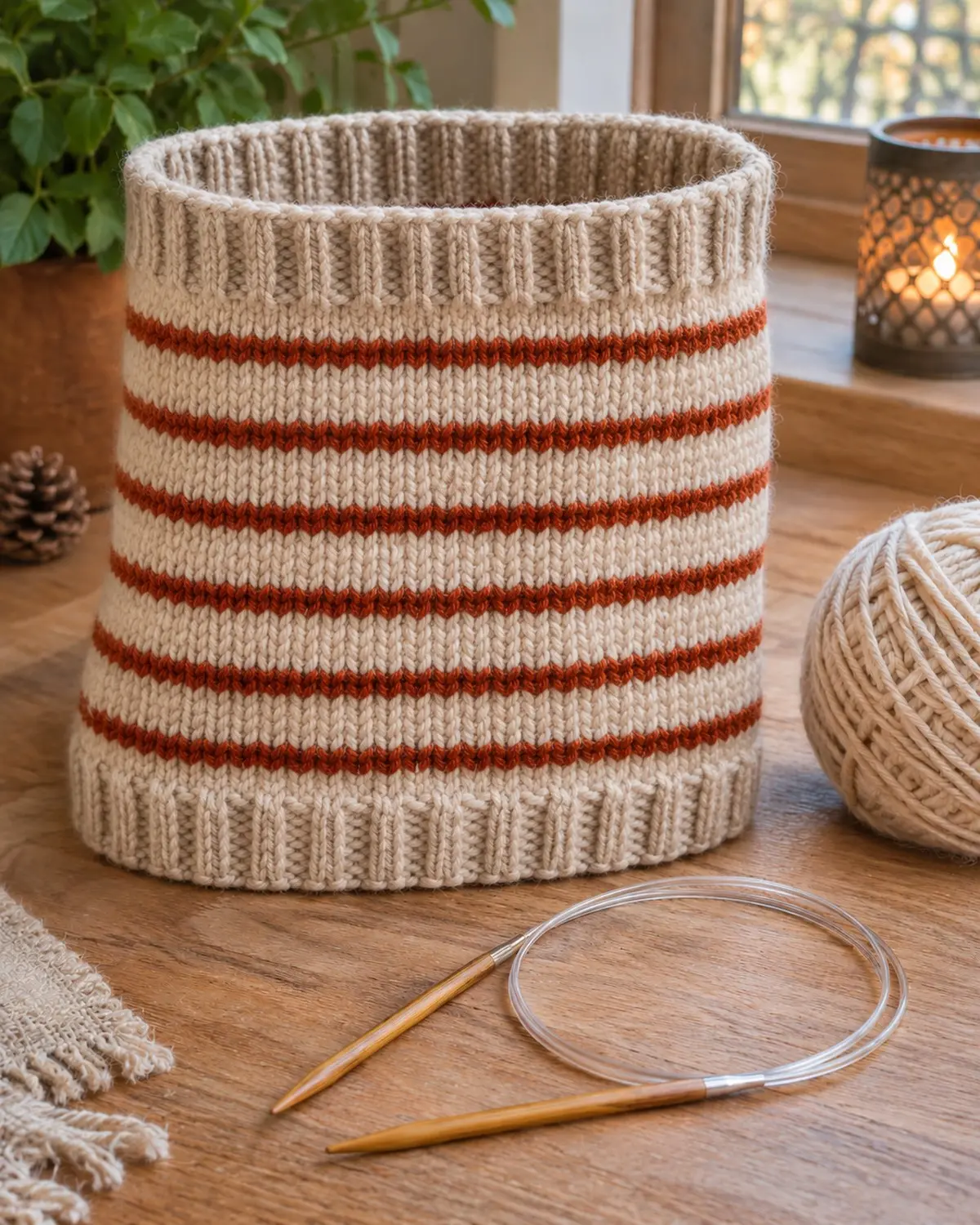
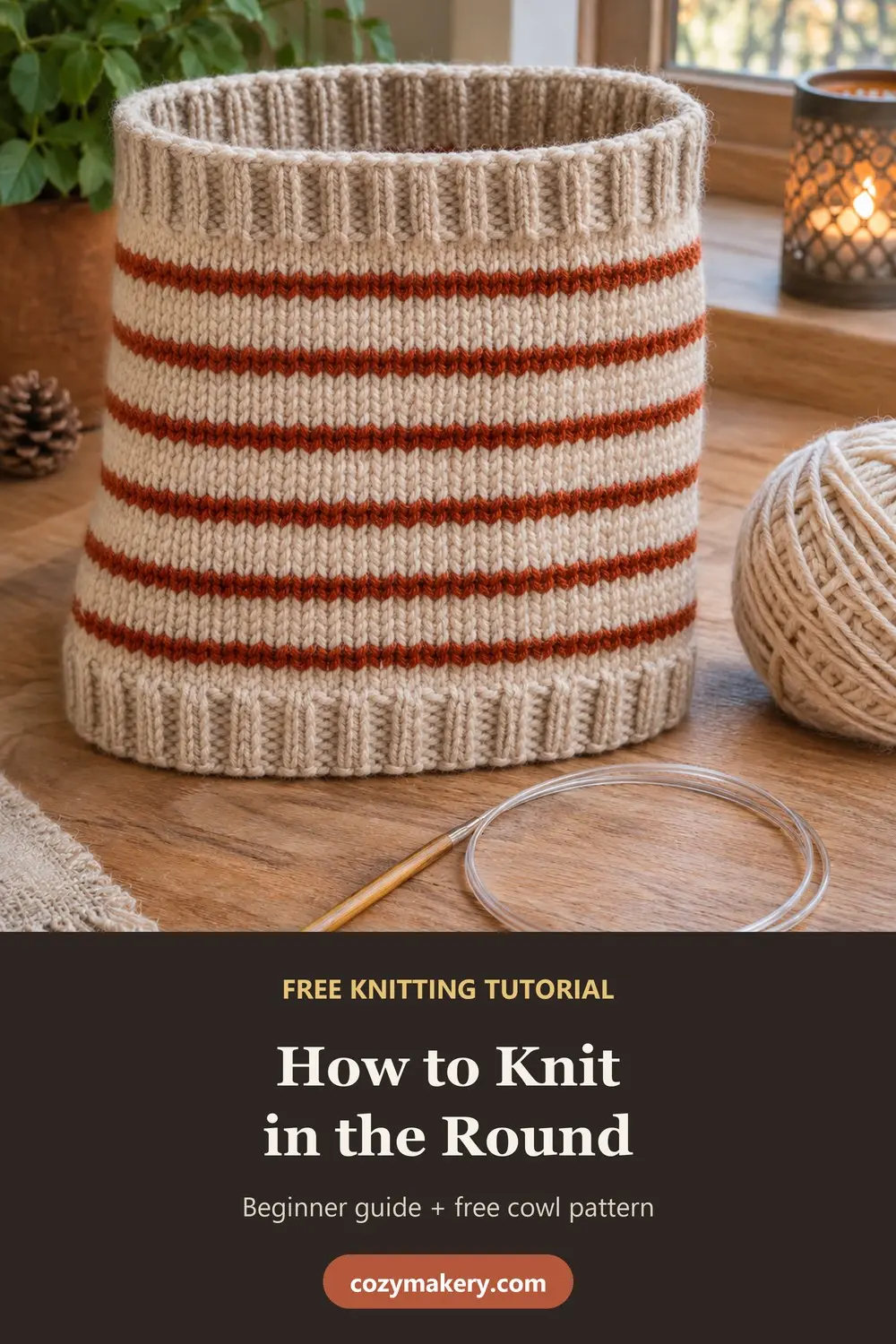
Gauge: 18 sts and 24 rounds = 4 in (10 cm) in stockinette. Numbers are given as Child / Adult. You’ll need worsted (#4) yarn: oatmeal (MC) 140 / 220 yd and rust (CC) 30 / 50 yd, a US 8 (5 mm) 16 in circular needle, 1 stitch marker and a tapestry needle.
- Cast on: with MC, cast on 88 / 112 sts. (a multiple of 4 for the 2×2 rib)
- Join: check that the cast-on isn’t twisted, place the marker and join in the round.
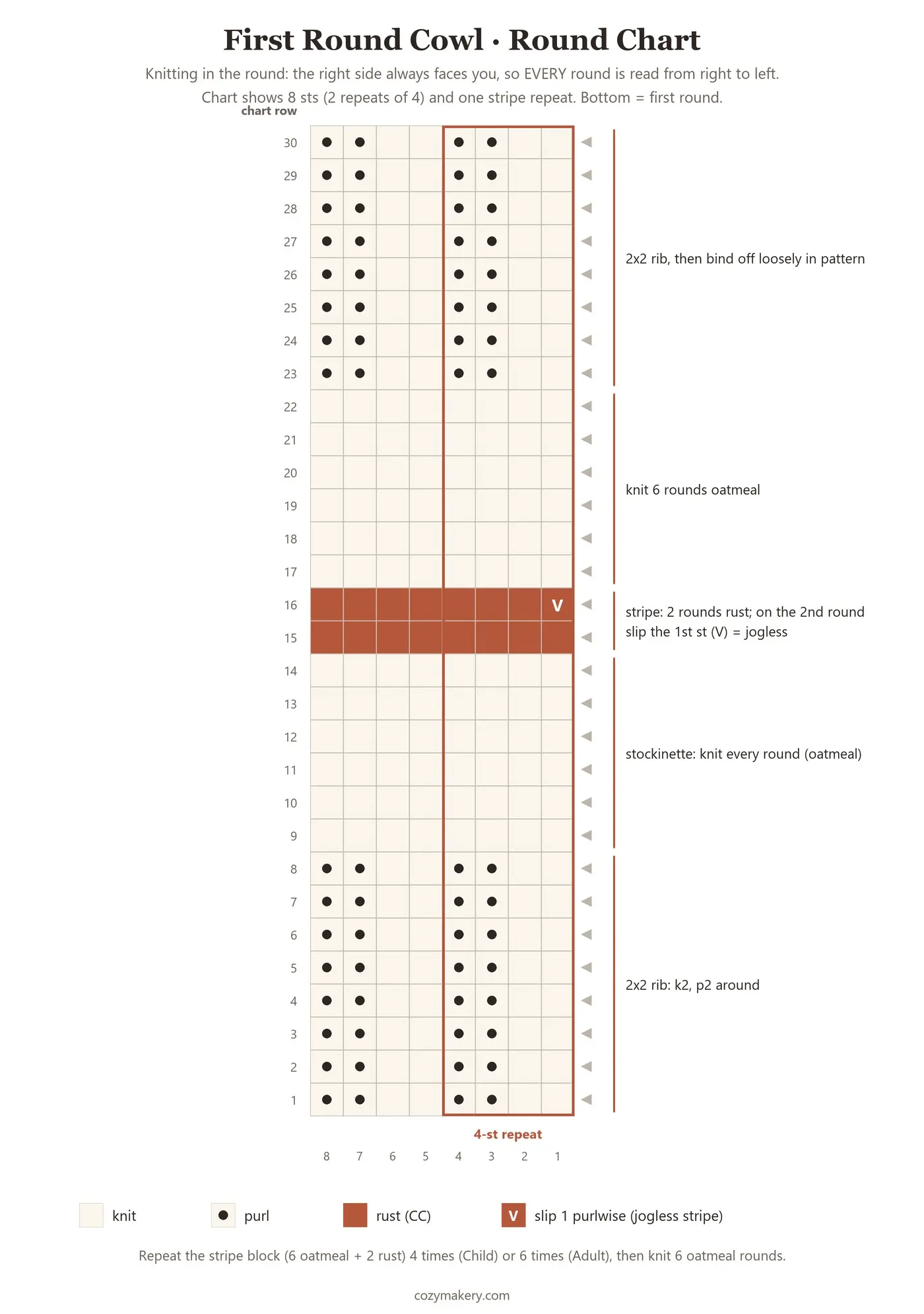
- Rounds 1–8: *k2, p2*; repeat around.
- Body: knit 6 rounds with MC.
- Stripe: knit 1 round with CC. On the next round, slip the first stitch purlwise, then knit to the end with CC (this is the jogless stripe). Change back to MC.
- Repeat: work Body + Stripe 4 / 6 times in total, then knit 6 more rounds with MC.
- Top rib: work 8 rounds of *k2, p2*.
- Bind off loosely in pattern (knit the knits, purl the purls). Weave in the ends. (54 / 70 rounds in total)
How to read the round chart
When you knit flat you read a chart back and forth, but in the round the right side always faces you, so every round is read from right to left, starting at the bottom. The chart shows 2 repeats of the 4-stitch rib and one stripe block; repeat them around and up.
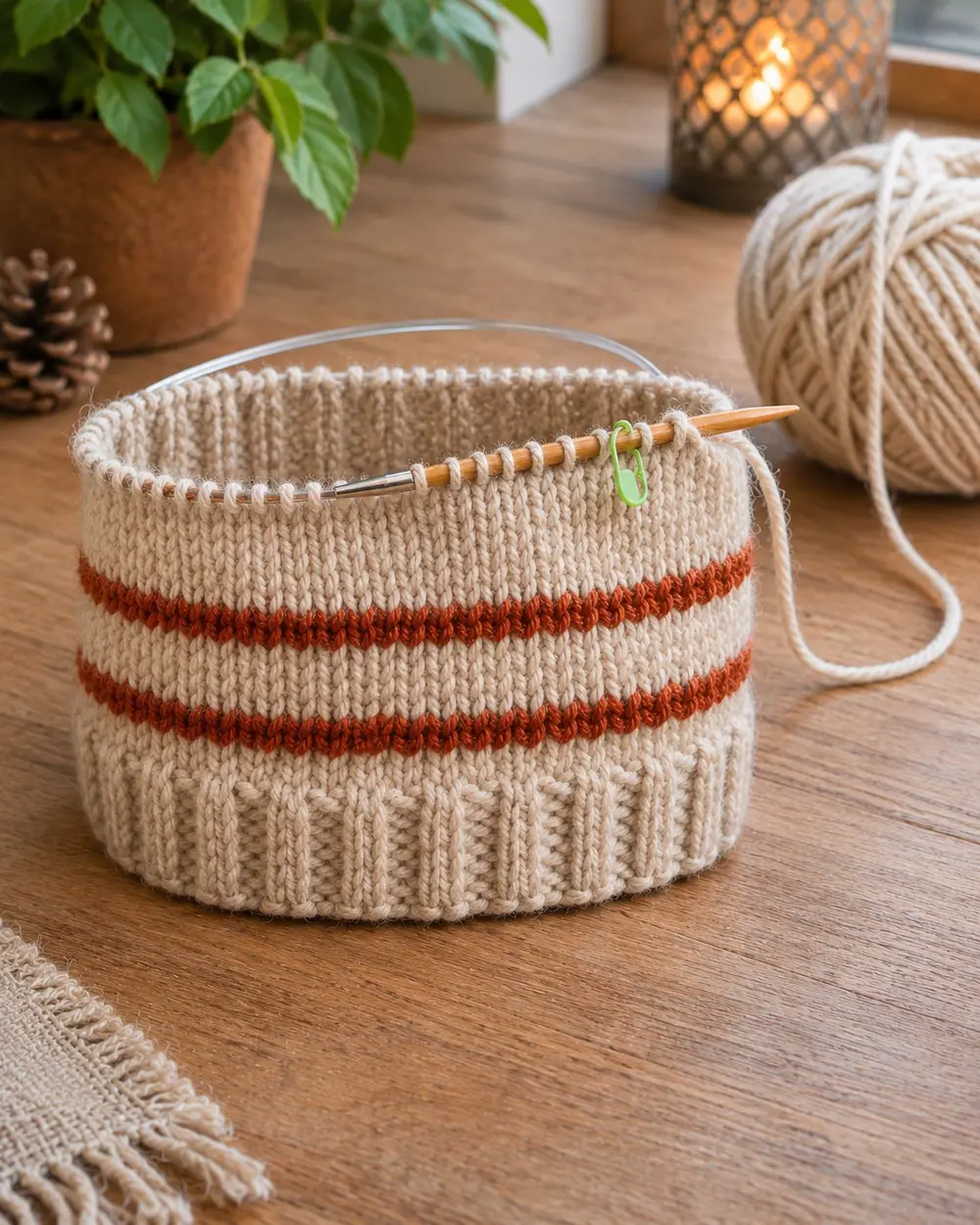
Tips for knitting in the round
- Check for twists twice: once before you join and again after the first round, while it’s still easy to fix.
- Close the join gap by casting on one extra stitch and knitting it together with the first stitch, or simply by weaving the cast-on tail across the gap at the end.
- Jogless stripes: rounds are really a spiral, so stripes step up at the start of the round. Slipping the first stitch on the second round of each stripe hides that step.
- Count your rounds by the stripes: each stripe block is 8 rounds.
- Bind off loosely, or use a needle one size larger, so the cowl still goes over your head.
Ready for colour? Try Fair Isle for beginners with four small charts and a cowl.
Borders and neckbands start with how to pick up stitches in knitting.
Frequently asked questions
Can I knit in the round with straight needles?
Not with two straight needles. You need a circular needle, double-pointed needles or a long circular for magic loop. The alternative is to knit flat and seam the piece into a tube.
Why is my knitting in the round inside out?
If you knit with the needle tips pointing toward you and the work on the far side, the purl side ends up outside. Make sure the right side (the knit V’s) faces out and the tips point away from you.
What size circular needle do I need?
Pick a cable length a few inches shorter than the circumference of what you’re knitting: 16 in for hats and cowls, 24 in for a child’s sweater body, 29–32 in for an adult sweater.
How many pages is the first round cowl PDF?
3 pages on US Letter paper, with every step of the first round cowl written out. On A4 paper, pick Fit to page when you print the first round cowl PDF so the charts aren’t cropped.
Can I use a different yarn for the first round cowl?
Yes, as long as it’s worsted and you check your gauge: a thicker or thinner yarn changes the size of the first round cowl and how much you need. Pick a yarn you like to touch, since the first round cowl is handled a lot.
Save it for later
Pin the image below so the guide is easy to find. If you knit the cowl, I’d love to see it: send a photo to info@cozymakery.com.
Ready for the next step? Knit the free knit hat, learn 5 ways to bind off, or try the knitted Christmas stocking. Browse everything in Knitting.
New to patterns? Read how to read a knitting pattern and knitting charts. Closing the bottom of a tube invisibly? That is Kitchener stitch, with a lavender sachet to practise. Knitting every round gives you stockinette stitch without a single purl.