Some edges shouldn’t exist. The start of a headband that has to meet its own end, the middle of a scarf you want to knit outwards in both directions, a hem you haven’t decided on yet: in each case a normal cast-on leaves a firm, finished row exactly where you wanted something open.
A provisional cast-on solves that. It holds your first row of loops on a scrap of waste yarn, so later you can pull the scrap out and find live stitches waiting, ready to knit in the other direction, bind off any way you like, or graft to another set of live stitches. The method below uses a crochet chain, which is the easiest version to unzip cleanly.
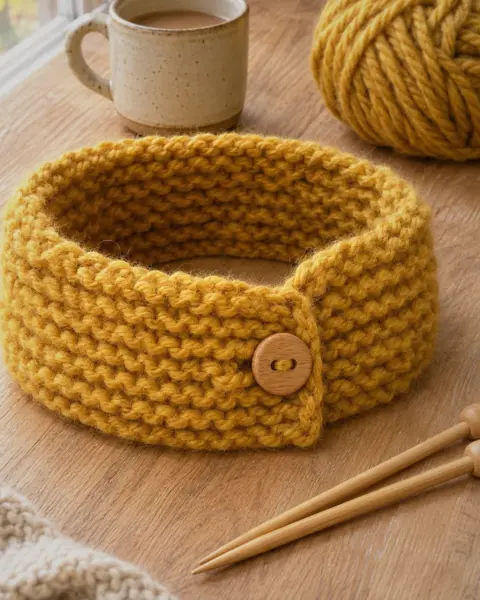
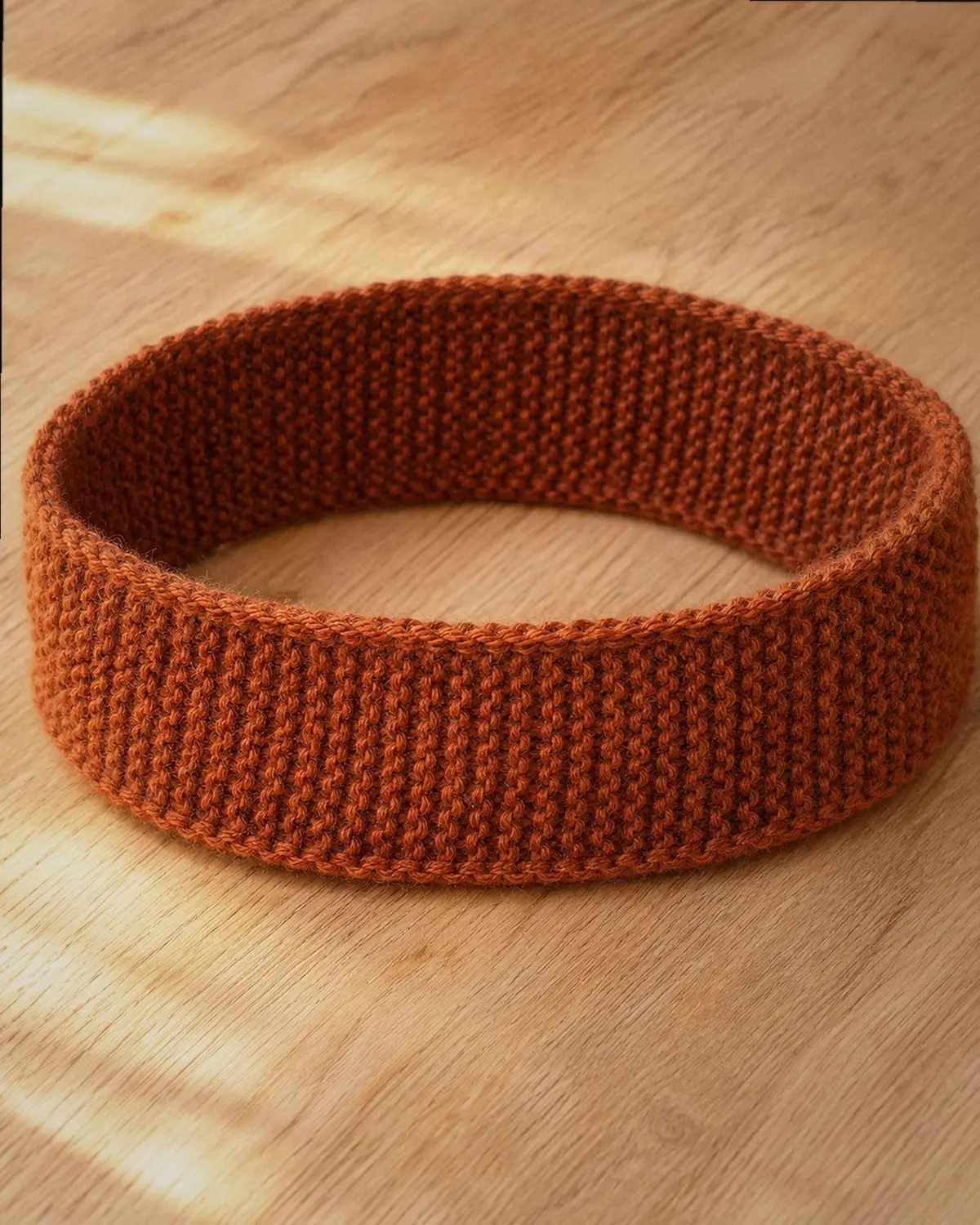
The practice piece is a garter ear warmer with chain edges. You knit it as a strip, then join the 2 live ends into a ring, so there’s no cast-on ridge and no bind-off ridge anywhere. The adult S band is 16 stitches by 166 rows.
In this post
At a glance
- Skill levelAdvanced beginner
- TimeAbout 3 to 4 hours
- TechniqueCrochet chain provisional cast-on
- PracticeGarter ear warmer, 3 sizes
- YarnWorsted (#4) wool + smooth waste yarn
- NeedlesUS 8 (5 mm), plus a US H-8 (5 mm) hook
- Gauge18 sts × 36 rows = 4 in (10 cm), garter
- JoinThree-needle bind off or Kitchener
The crochet chain method, step by step
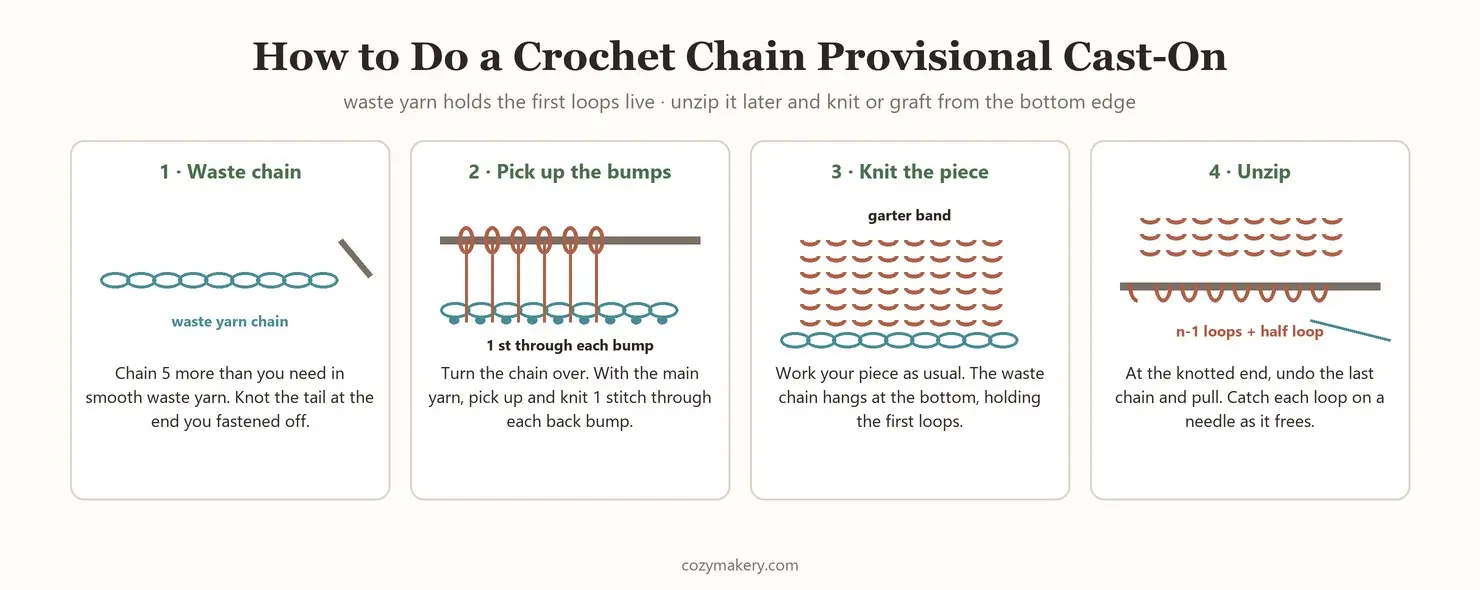
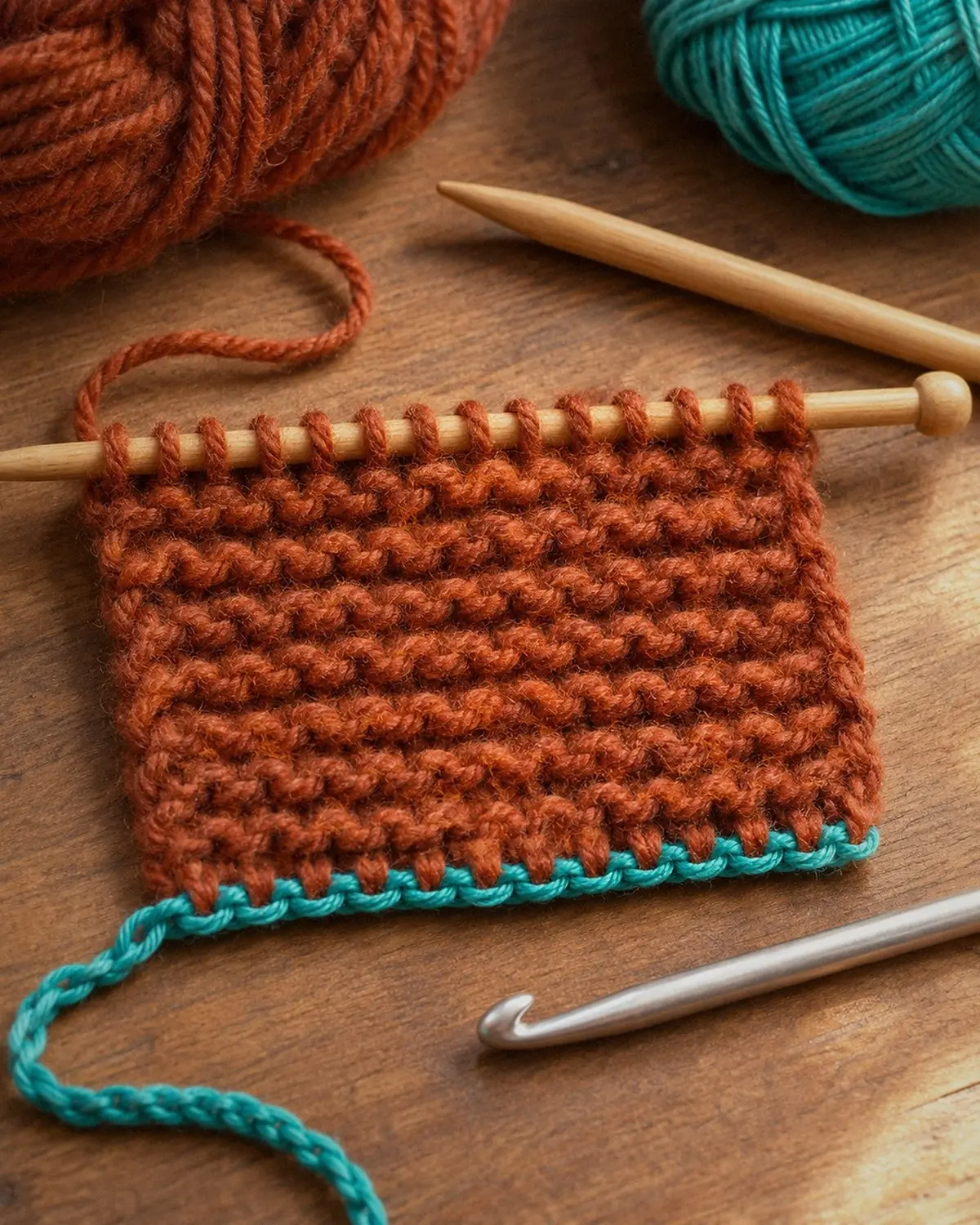
- Chain in waste yarn: With smooth cotton in a contrast color and a hook about the size of your needle, chain about 5 more than the stitches you need. Cut the yarn, pull it through the last loop and tie a small knot in that tail. The knot marks the end you'll unzip from.
- Find the bumps: Turn the chain over. The front shows Vs; the back shows a ridge of bumps, one per chain.
- Pick up: Skip 1 or 2 chains at the slip-knot end. With the main yarn, insert the needle under a bump, wrap and pull a loop through. Repeat until you have enough stitches.
- Knit on: Work row 1 and carry on as the pattern says.
New to chaining? See how to start a crochet chain. Keep it loose, or the bumps are hard to find.
Hooking straight onto the needle
This version skips the separate chain. With a slip knot of waste yarn on the hook and the yarn behind the needle, reach the hook over the needle, catch the yarn and pull it through the loop on the hook: 1 stitch. Take the yarn back behind the needle and repeat. Finish with 4 chains off the needle, cut, pull through and knot the tail, then knit row 1 in the main yarn. It unzips like the chain method.
Unzipping without losing stitches
At the knotted end, undo the last chain and pull the tail gently: each link releases a loop. Catch the loops on a spare needle a size smaller as they appear, or slide the needle through them first and then pull the chain out, which is safer with slippery yarn.
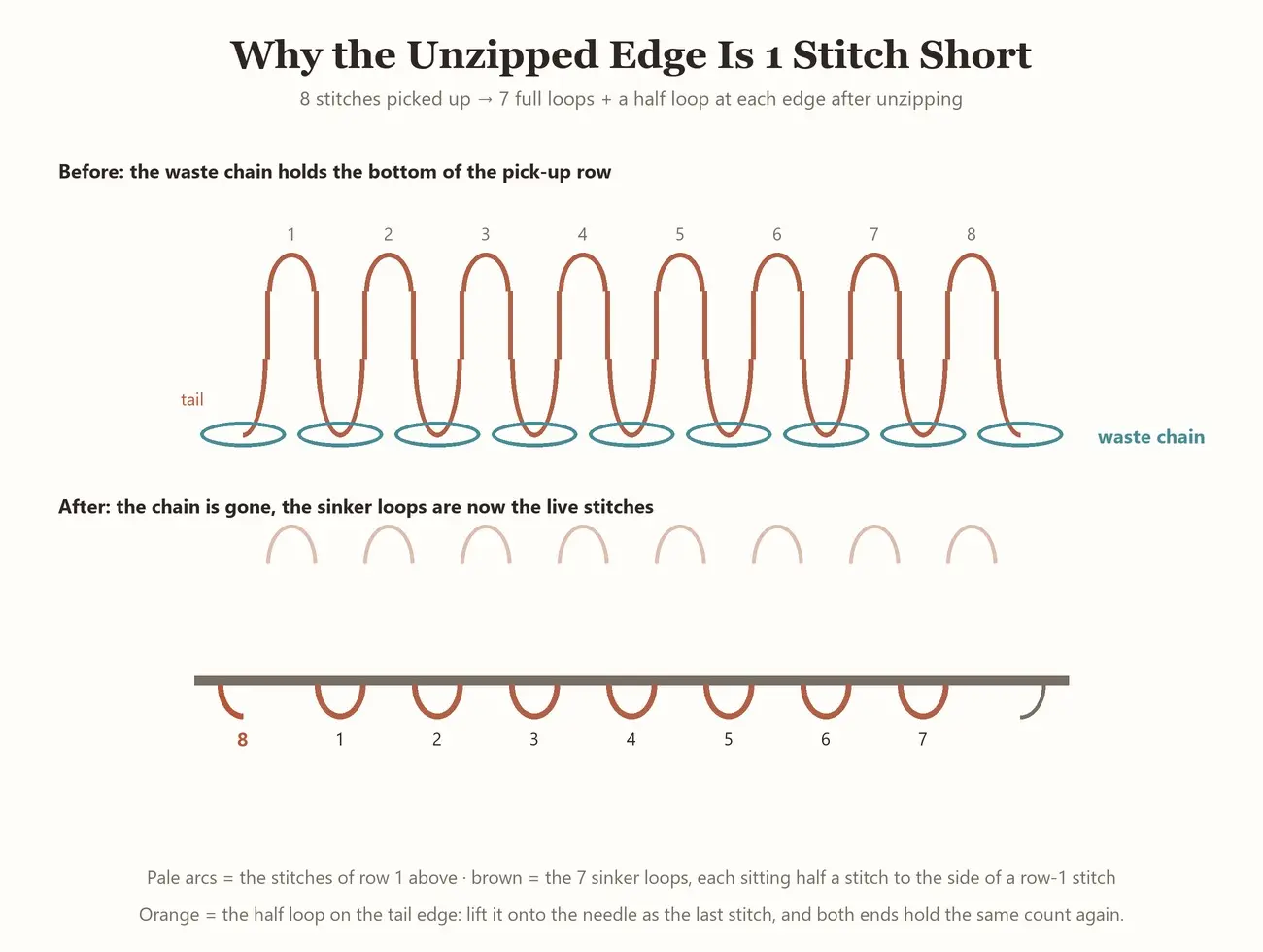
Count them and you’ll be 1 short. That’s not a dropped stitch. The loops you get back are the U-shaped bits of yarn between the stitches of the first row, turned upside down, and between 16 stitches there are only 15 gaps. At each edge there’s a half loop instead; one of them is the tail. Lift the edge strand on the tail side onto the needle and the counts match again. The loops also sit half a stitch over, which shows in rib but disappears in garter, one reason I chose garter for the practice band.
When it goes wrong
- It won’t unzip: you’re probably pulling the slip-knot end. Try the other end, the one where you fastened off.
- It unzips, then jams: a stitch went through the front of the chain or split the waste yarn. Snip that single link with small scissors and keep going, catching each loop as it frees.
- Fuzz left behind: a fuzzy waste yarn leaves fibres in the stitches. Use smooth cotton.
- A twisted loop on the needle: loops can come off facing either way. Knit or graft each one so its leading leg is at the front of the needle.
Where it earns its place
- Seamless joins. Rings, cowls knit flat and toy bodies close with a three-needle bind off or the Kitchener stitch instead of a sewn seam.
- Edges you’ll decide later. Add a hem, ribbing or an i-cord edge once you know what looks right.
- Scarves from the middle out. Start at the center of a scarf, knit one half, unzip and knit the other half the opposite way, so both ends match.
- Folded hems and the tubular cast-on. The stretchy tubular cast-on often starts with a provisional row in waste yarn.
For an edge you won’t revisit, a regular long-tail cast-on is quicker.
Practice piece: a garter ear warmer with no seam
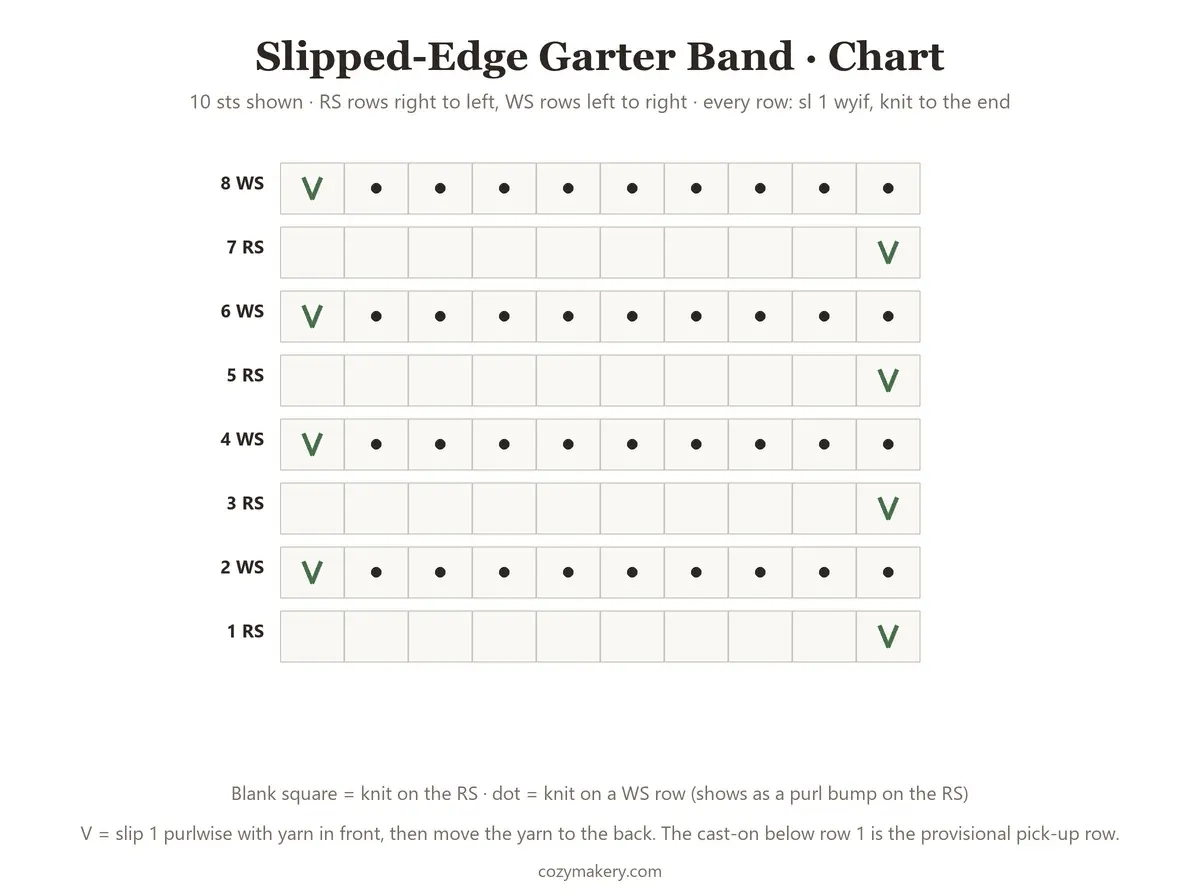
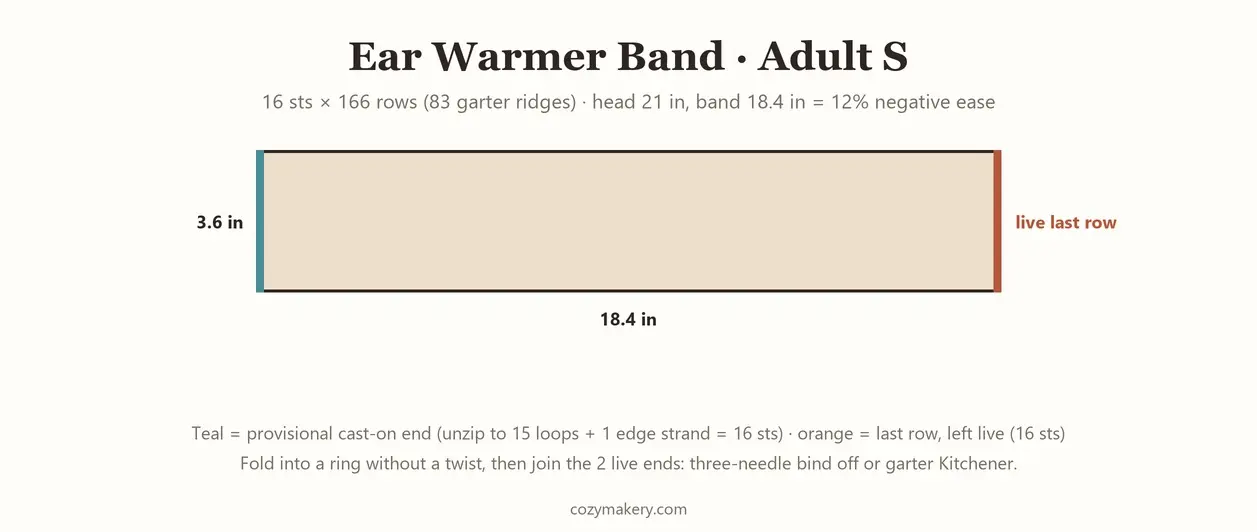
The band is garter stitch with a slipped first stitch on every row, which builds a tidy chain along both edges. I sized it about 12% shorter than the head because garter stretches along its length; that negative ease keeps it snug over the ears. The row count is always even, so the last row and the provisional row face the same way when you fold the band into a ring.
You'll need
- Worsted (#4) wool: 85 yd (child), 105 yd (adult S) or 130 yd (adult L), tail for the join included
- About 1 yd (1 m) of smooth cotton waste yarn in a contrast color and a US H-8 (5 mm) crochet hook
- US 8 (5 mm) needles plus a spare needle, tapestry needle
Gauge: 18 sts and 36 rows (18 ridges) = 4 in (10 cm) in garter. That’s a typical worsted value, assumed rather than measured, so swatch first. If your rows differ, knit to the table length, keeping the row count even.
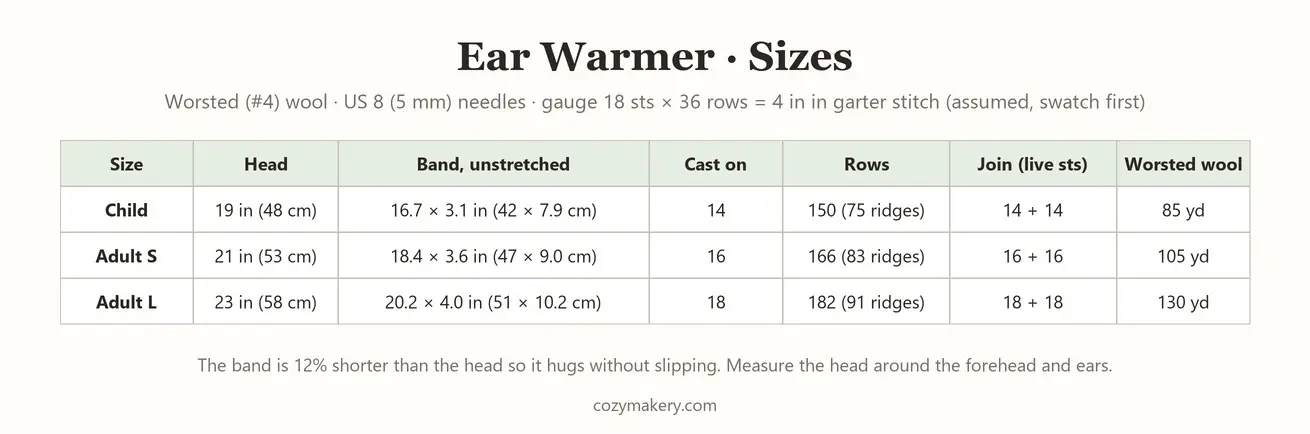
Adult S (21 in (53 cm) head)
- Waste chain: With waste yarn and a US H-8 (5 mm) hook, chain 21. Cut the yarn, pull it through the last loop and tie a knot in that tail: that knotted end is where you'll unzip later.
- Pick up: With the main yarn and a US 8 (5 mm) needle, skip the first 2 chains at the slip-knot end and pick up and knit 1 st through the back bump of each of the next 16 chains. 3 chains are left free at the knotted end. (16)
- Row 1 (RS): Sl 1 purlwise with yarn in front, move the yarn to the back between the needles, knit to the end. (16)
- Rows 2–166: Repeat row 1. Every row is the same; the slipped stitches make a neat chain along both edges (83 chains per edge). Stop after row 166: the band measures about 18.44 in (47 cm) unstretched. (16)
- Leave live: Don't bind off. Cut the yarn leaving a tail of 20 in (51 cm) and leave the 16 sts on the needle. (16)
- Unzip: At the knotted end, undo the last chain and pull the waste yarn gently: each loop that pops free goes onto a spare needle. You'll have 15 loops plus a half loop at the tail edge; lift that edge strand onto the needle too. (16)
- Join: Bring the 2 needles together, ends of the band meeting without a twist. Join with a three-needle bind off (16 pairs, the ridge on the inside) or graft with garter Kitchener. Weave in the ends. (0)
Child (19 in (48 cm) head): waste chain 19, pick up 14 sts, work 150 rows (the band is about 16.7 in (42 cm) long and 3.1 in (7.9 cm) wide), unzip to 13 loops plus the edge strand, and join 14 + 14 sts.
Adult L (23 in (58 cm) head): waste chain 23, pick up 18 sts, work 182 rows (the band is about 20.2 in (51 cm) long and 4 in (10 cm) wide), unzip to 17 loops plus the edge strand, and join 18 + 18 sts.
Closing the ring
Bring the 2 ends together into a ring and check for a twist: the chain edges should run unbroken all the way round.
- Three-needle bind off: hold the band inside out, right sides facing, and work 16 pairs. The small ridge sits on the inside.
- Garter Kitchener: for a truly invisible join, graft with the garter version, which repeats the same 2 moves (knitwise off, purlwise on) on both needles. Set it up so the front needle has a ridge right below its stitches facing you and the back needle shows a smooth row facing you. Leave a tail of about 20 in (51 cm) for it.
Weave the ends into the edge chains and steam the join lightly.
Get the PDF
The PDF has both cast-on methods, the unzip diagram, the chart, the band diagram, all 3 sizes and the joining steps. 7 US Letter pages in all (for A4, tick “Fit to page”).
Questions and fixes
My counts are still off by 1 at the join. What now?
With a three-needle bind off, knit the extra stitch together with its neighbour on the same needle in the first pair. For Kitchener, decrease it away on the last row before you graft.
Will ribbing work instead of garter?
Yes, but the half-stitch shift shows in rib, so join it with a three-needle bind off on the inside rather than grafting.
More knitting to try next: German twisted cast-on for a stretchy everyday edge, picking up stitches along a finished edge, and more ideas in our free knit hat patterns.