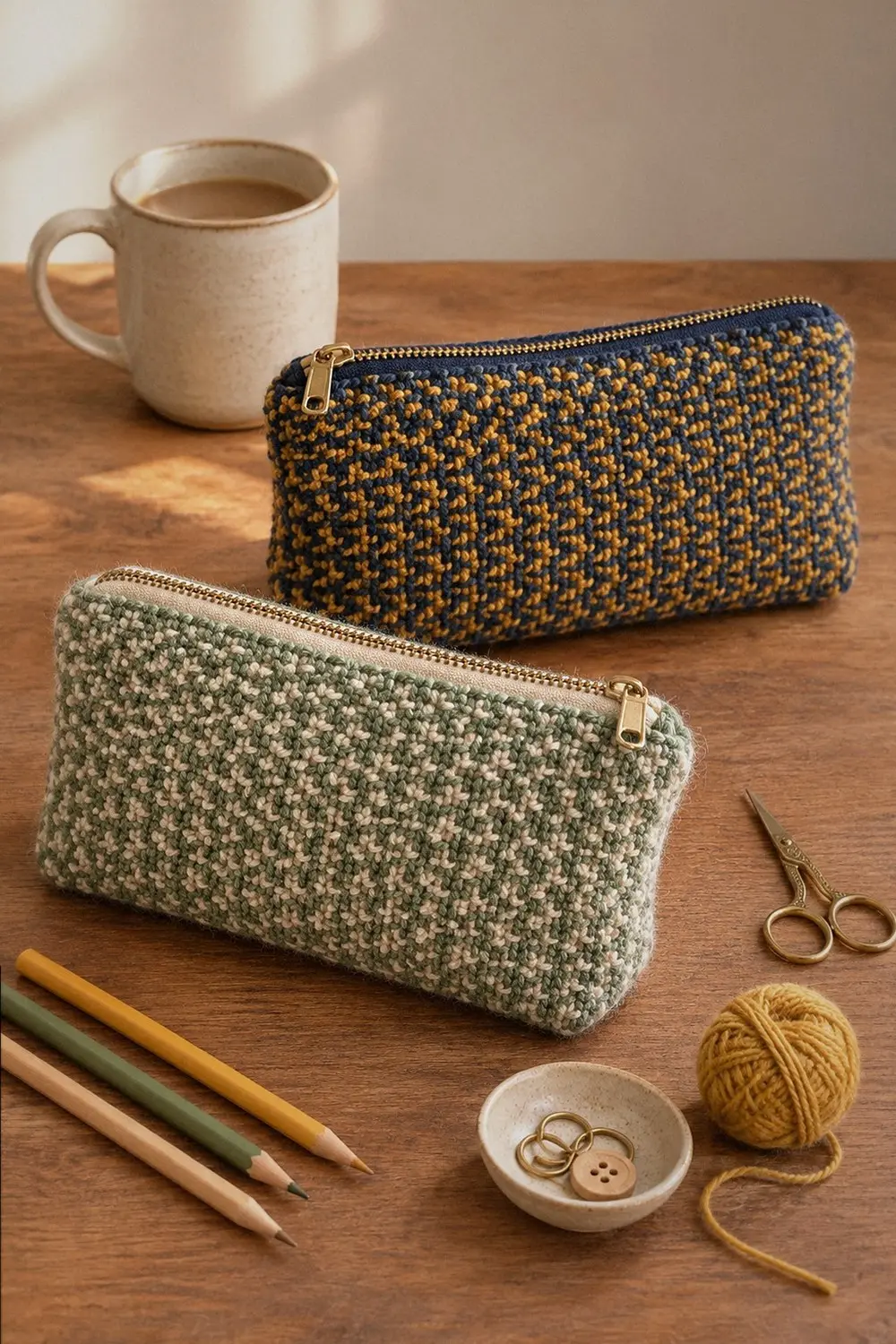
Linen stitch knitting makes a dense fabric that looks woven, not knitted. Every other stitch is slipped with the yarn in front, so short floats of yarn lie across the stitches like the weft of a cloth. In 2 or more colours, the colours blend into tiny flecks instead of plain stripes. This tutorial covers the 2-row pattern, how to slip with the yarn in front and back, changing colours, keeping it from getting too tight, and a practice project: a zip pencil case in navy and mustard.
In this post
Pattern at a glance
- Skill levelBeginner
- PracticePencil case / pouch
- YarnWorsted (#4), 2 colours
- NeedlesUS 8 (5 mm)
- Gauge26 sts × 44 rows = 4 in (10 cm)
- TimeAbout 5–6 hours
Free printable pattern
The PDF has the linen stitch steps, the simulated swatch, the size table and both sizes row by row. The Linen Stitch Knitting PDF has 5 pages and prints on US Letter paper; on A4, choose “Fit to page” in the print dialog.
How to knit linen stitch
You need an odd number of stitches. Both rows start and end with a worked stitch, and the stitches you slip on one row are the ones you work on the next.
- Row 1 (right side): K1, *slip 1 purlwise with the yarn in front, k1*; repeat to the end.
- Row 2 (wrong side): P1, *slip 1 purlwise with the yarn at the back, p1*; repeat to the end.
- Repeat: Rows 1 and 2 are the whole pattern.
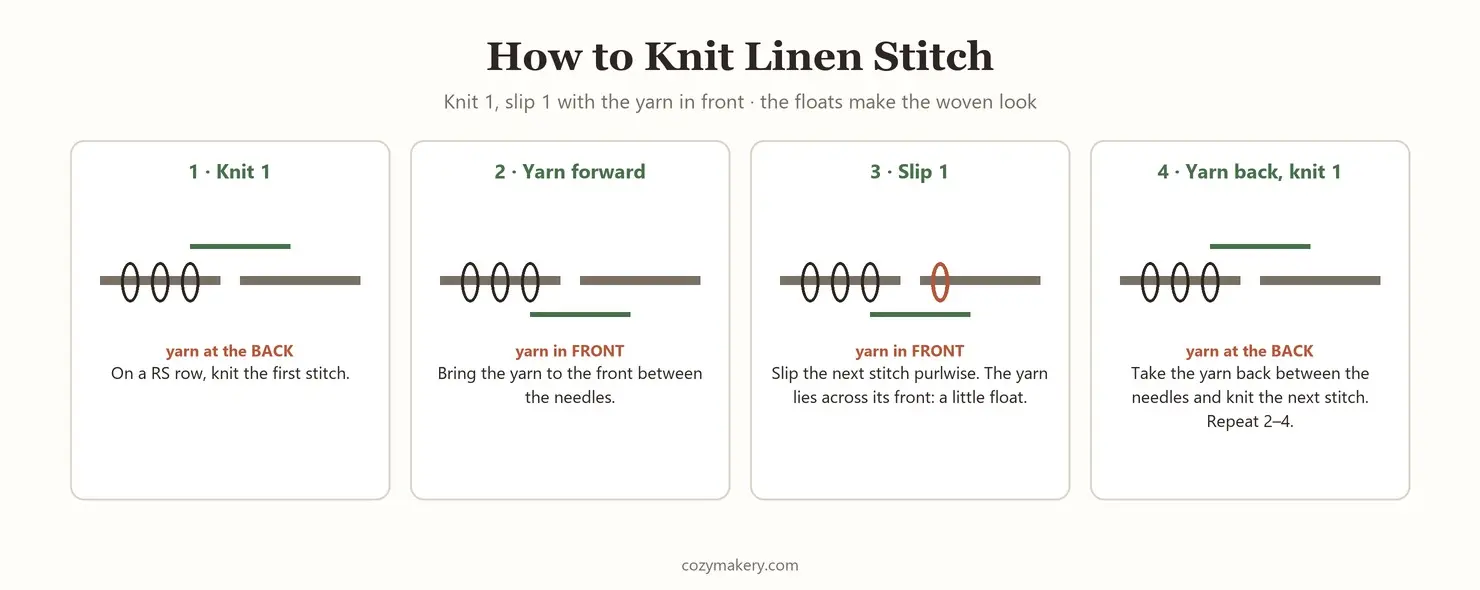
On the wrong side, ‘yarn at the back’ means the side away from you, which is the right side of the fabric: that’s why the floats always end up on the front. Always slip purlwise, so the stitch isn’t twisted.
Linen stitch in 2 colours
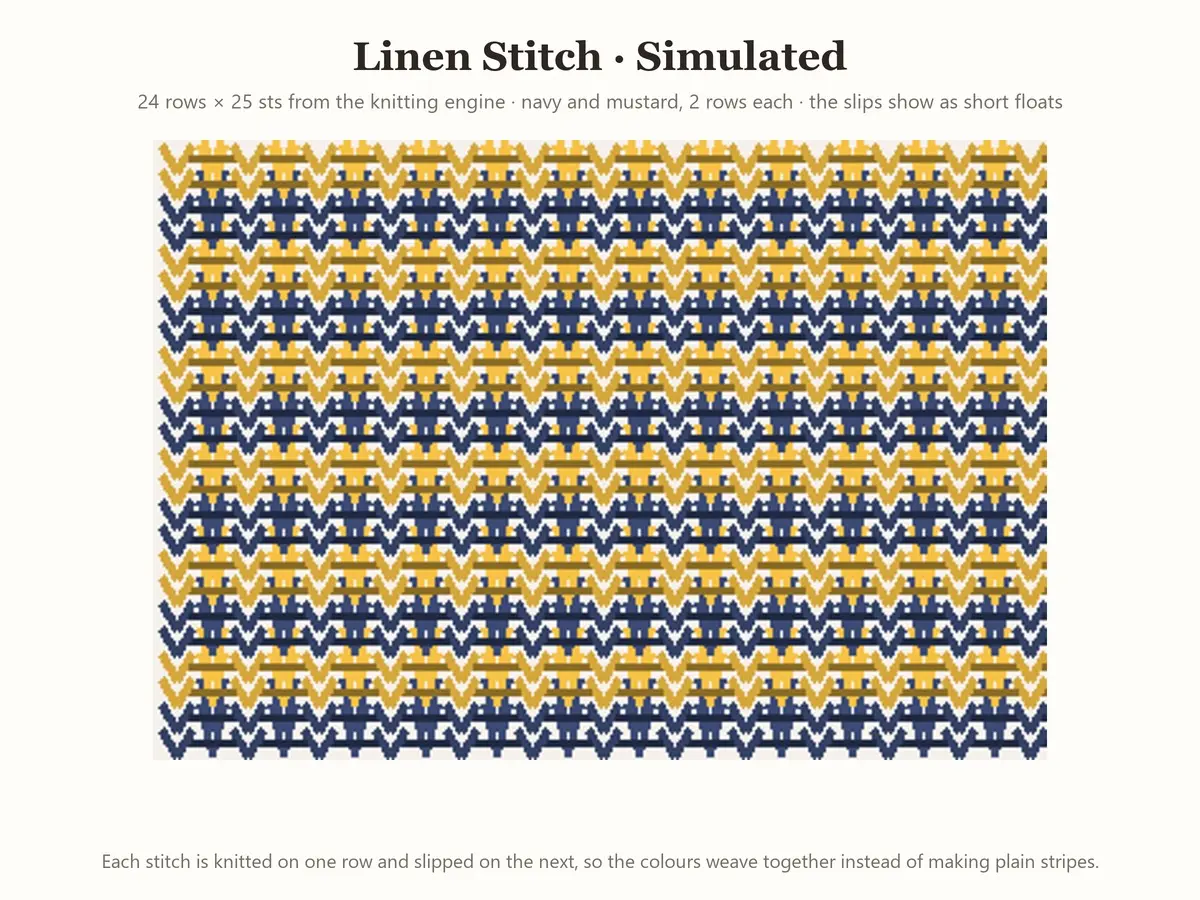
Change colour every 2 rows and carry the yarn not in use up the side, without cutting it. Because each stitch is slipped on one row and worked on the next, every colour shows up in every row, and the fabric gets a tweedy, woven look. With 3 colours, change every row instead.
Tips for even linen stitch
- Go up 1 or 2 needle sizes. Linen stitch pulls in a lot, both in width and length; on the label size it gets stiff.
- Don’t pull the floats tight. Spread the stitches on the right needle before you slip, so each float is as wide as a stitch.
- Cast on and bind off loosely, or with a needle 1 or 2 sizes bigger, or the edges will be narrower than the fabric.
- Count the rows by colour: every 2-row stripe of a colour is 1 ‘step’, and 2 steps (navy + mustard) make the 4-row repeat.
Practice project: linen stitch pencil case
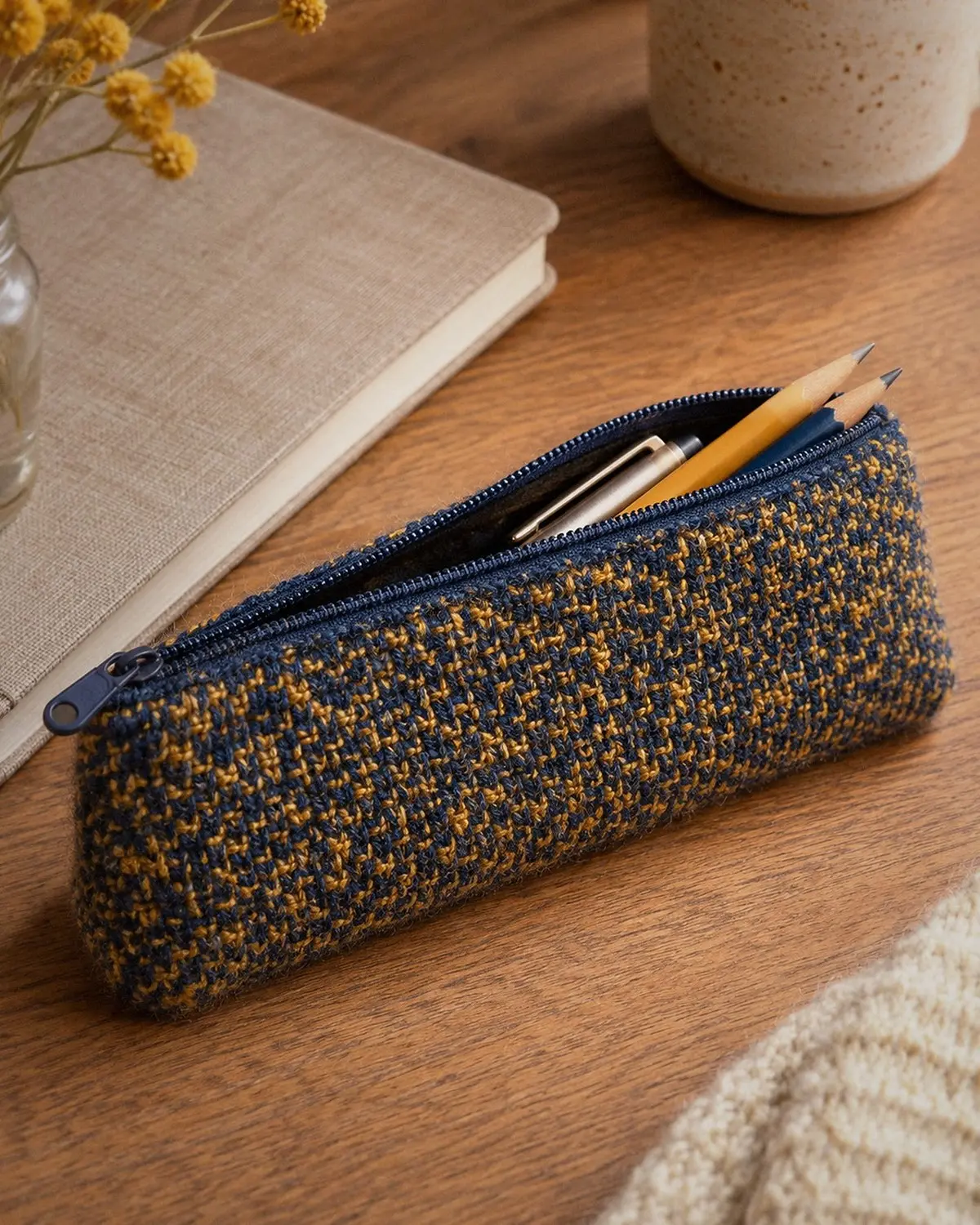
The pencil case is one rectangle in linen stitch, folded in half at the bottom, seamed up the sides and closed with a zip. Linen stitch is perfect here: it’s firm, it doesn’t curl, and pencil points can’t poke through it.
You'll need
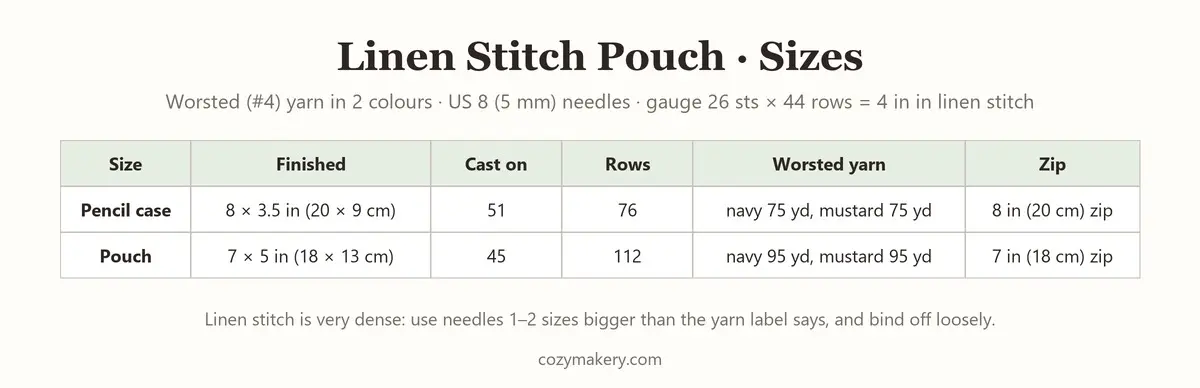
- Worsted (#4) yarn in navy and mustard: about 75 yd of each for the pencil case or 95 yd of each for the pouch
- US 8 (5 mm) needles, tapestry needle
- An 8 in (20 cm) zip for the pencil case or a 7 in (18 cm) zip for the pouch, sewing needle and thread
Gauge: 26 sts and 44 rows = 4 in (10 cm) in linen stitch. This is a typical value for worsted on US 8, not one we measured, and linen stitch varies a lot, so knit a small swatch: the zip length is the one thing that needs to match.
Pencil case (8 × 3.5 in, 20 × 9 cm)
- Cast on: With navy, cast on 51 sts (an odd number). (51)
- Row 1 (RS): Navy: k1, *slip 1 purlwise with the yarn in front, k1; repeat from * to the end. (51)
- Row 2 (WS): Navy: p1, *slip 1 purlwise with the yarn at the back, p1; repeat from * to the end. (51)
- Rows 3–4: Mustard: as rows 1–2. Don't cut the yarn: carry it up the side. (51)
- Rows 5–76: Repeat rows 1–4. The piece measures about 6.9 in (18 cm). (51)
- Bind off: With navy, bind off loosely in pattern (or with a needle 1 size bigger). (0)
- Make up: Fold in half with the cast-on and bind-off edges together at the top, right side out. Mattress stitch both sides. Sew a zip into the top opening.
Pouch (7 × 5 in, 18 × 13 cm): cast on 45 sts and work 112 rows, then make it up the same way.
We knitted every row of both sizes in our knitting engine: the stitch count never changes, exactly half the stitches (all but 1) are slipped on every row, and the rows come in whole 4-row colour repeats, so you finish with the same colour you started. Cast-on, rows and yarn come from the gauge. The sides are joined with mattress stitch; for a different firm texture try seed stitch.
Frequently asked questions
Why is linen stitch so slow?
Each row only adds half a row of height, because half the stitches are slipped. It takes about twice as many rows as stockinette.
Does linen stitch curl?
No. The floats hold it flat, which makes it great for bags, pouches, coasters and scarves.
Do I slip knitwise or purlwise in linen stitch?
Always purlwise, so the slipped stitch keeps its normal mount.
Is linen stitch reversible?
Not quite: the floats are on the right side, and the back looks like little bumps. Both sides are tidy.
How many pages is the Linen Stitch Knitting PDF?
5 pages on US Letter: the steps, the simulated swatch and both sizes. On A4, print with “Fit to page”.
Can I knit linen stitch in 1 colour?
Yes. It looks like fine woven cloth, and you don’t need to change yarn at all.
Save it for later
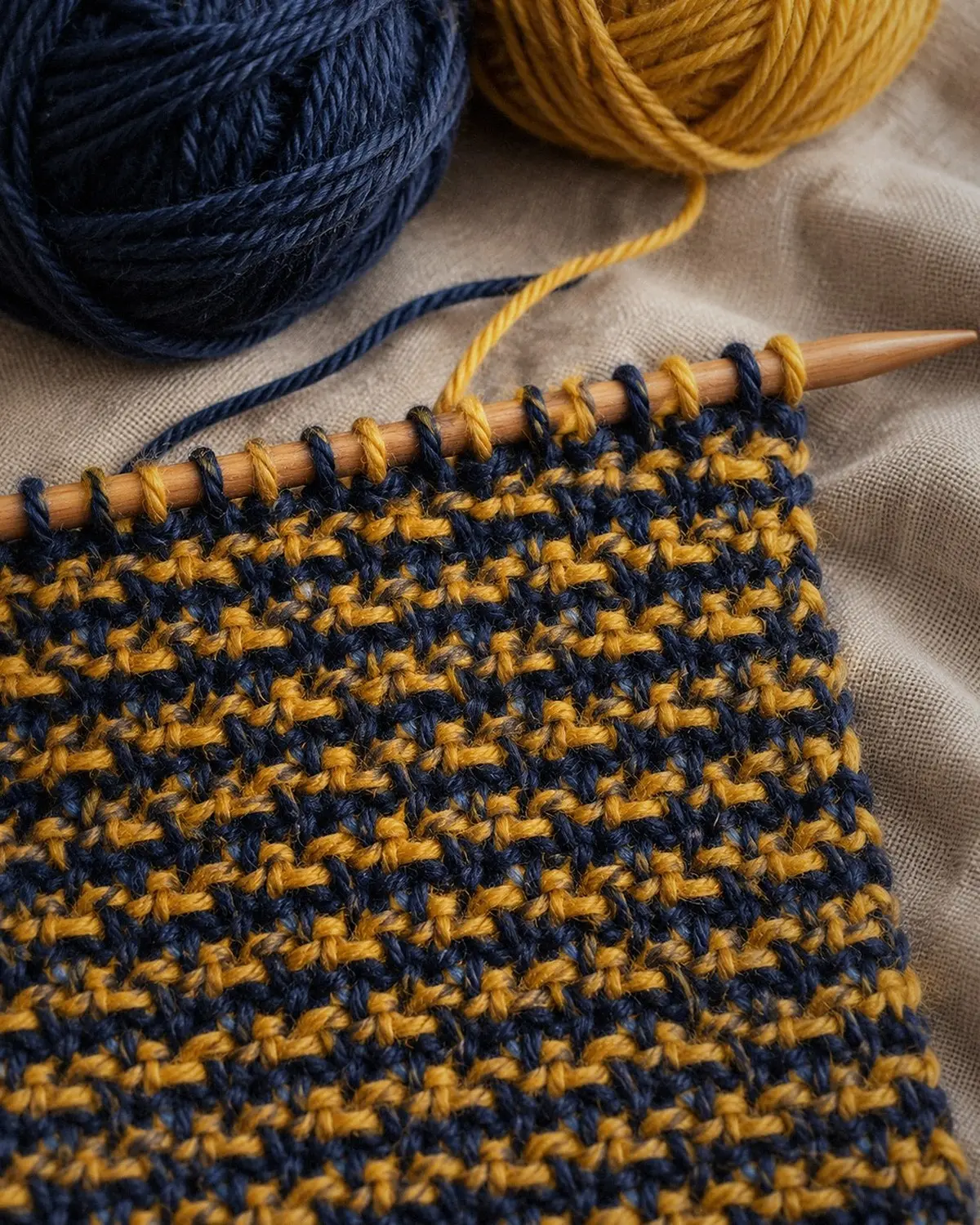
Pin the photo below to keep the linen stitch pencil case on your Pinterest board. Made the linen stitch pencil case? I’d love to see it: send a photo to info@cozymakery.com.
More knitting: how to knit, how to bind off and easy knitting patterns for beginners. Another slip-stitch fabric, deep and squishy instead of flat: brioche knitting. Slipped stitches can also carry colour: see our slip stitch knitting brick dishcloth.