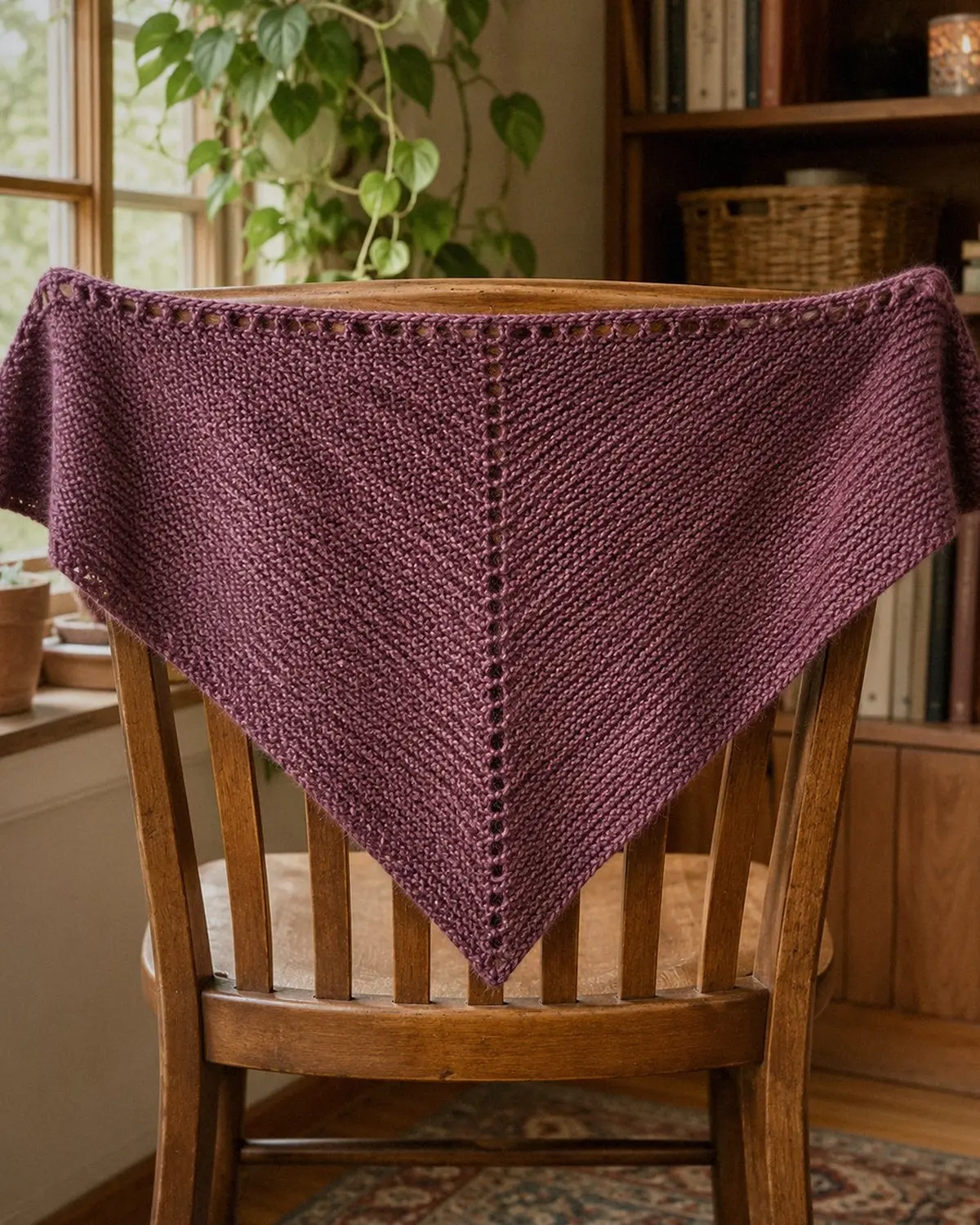
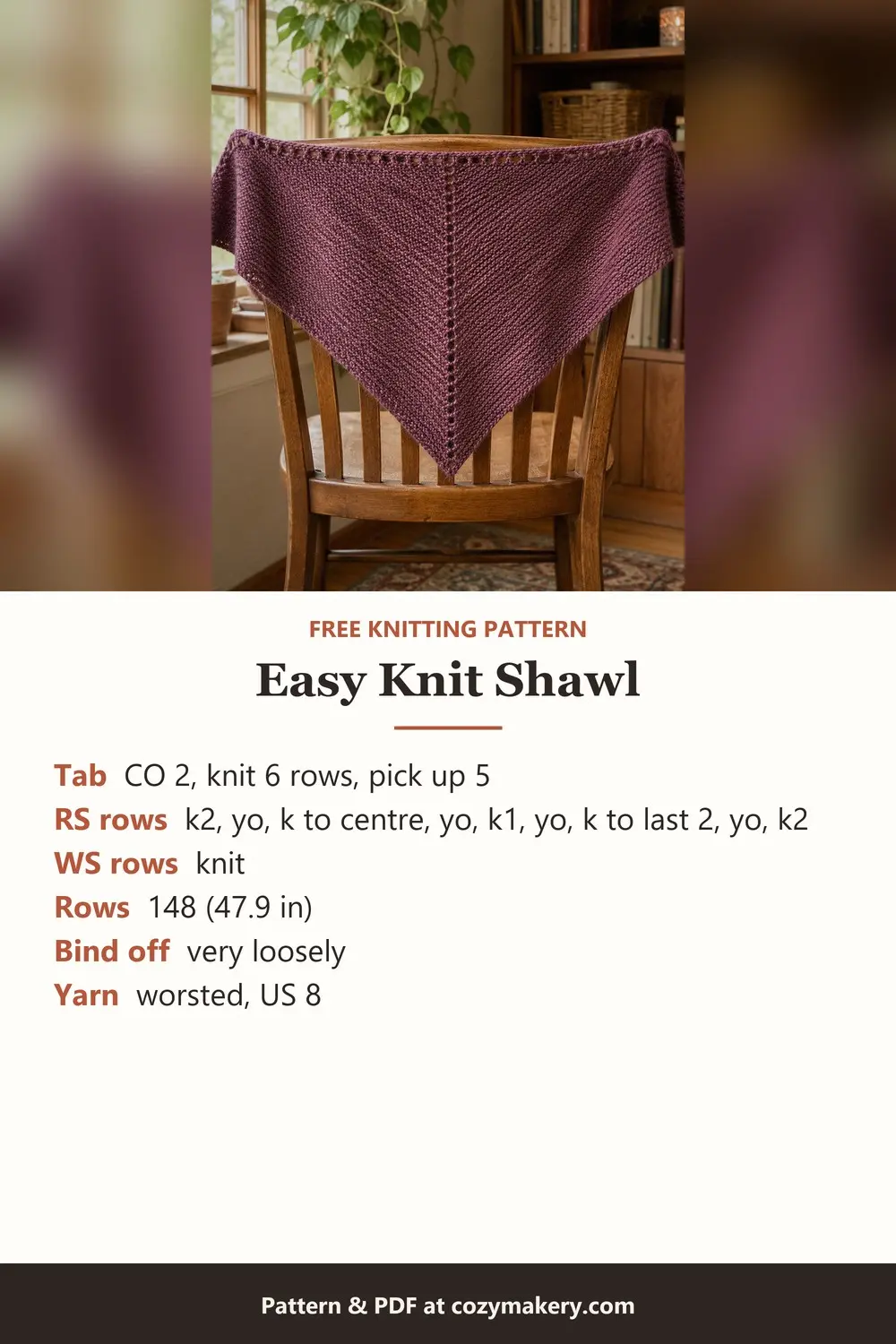
This easy knit shawl pattern is a classic top-down triangle in garter stitch: you start with just 2 stitches at the back of the neck and add 4 stitches on every right-side row, so it grows into a big triangle with a line of little eyelets down the centre and along the top edge. There’s no purling and no shaping to count beyond that. Knit it as a 47.9 × 24 in shawlette or a 59.9 × 29.9 in wrap.
In this post
- Pattern at a glance
- Free printable pattern
- Materials
- Abbreviations
- Gauge
- The garter tab
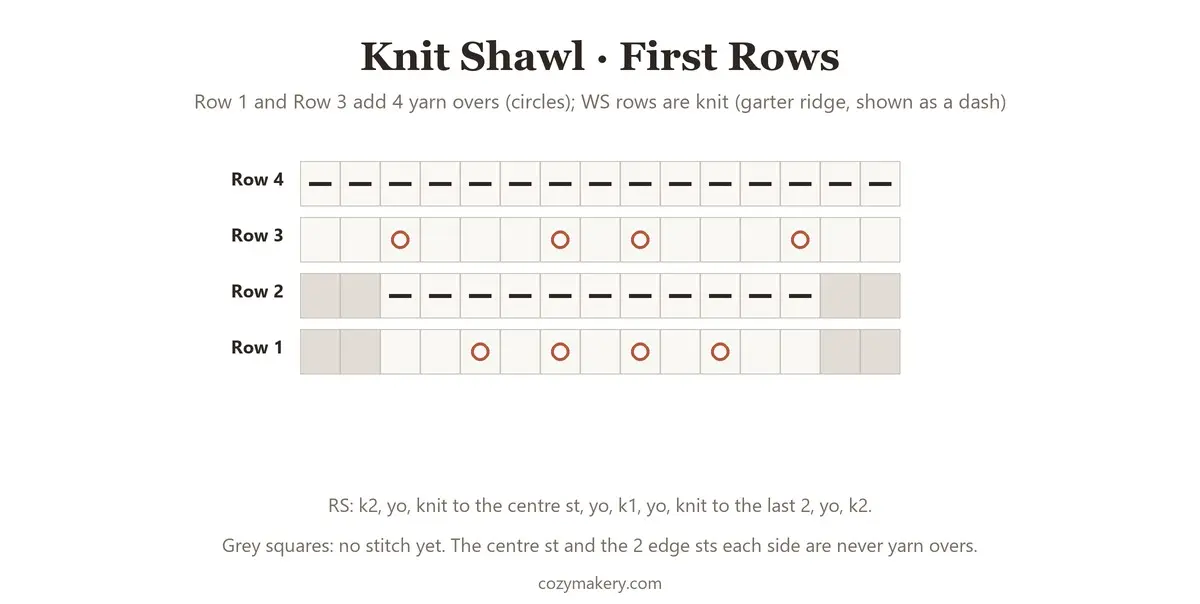
- First rows chart
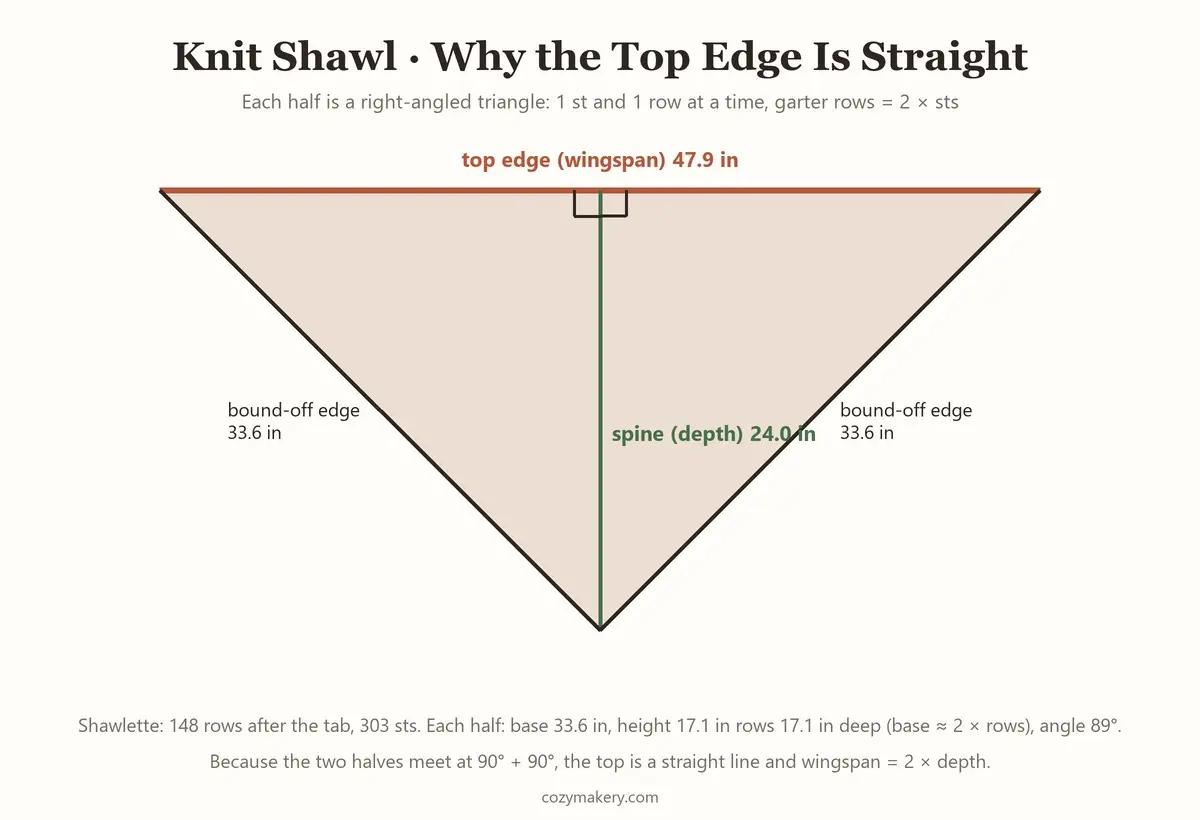
- Why the top edge is straight
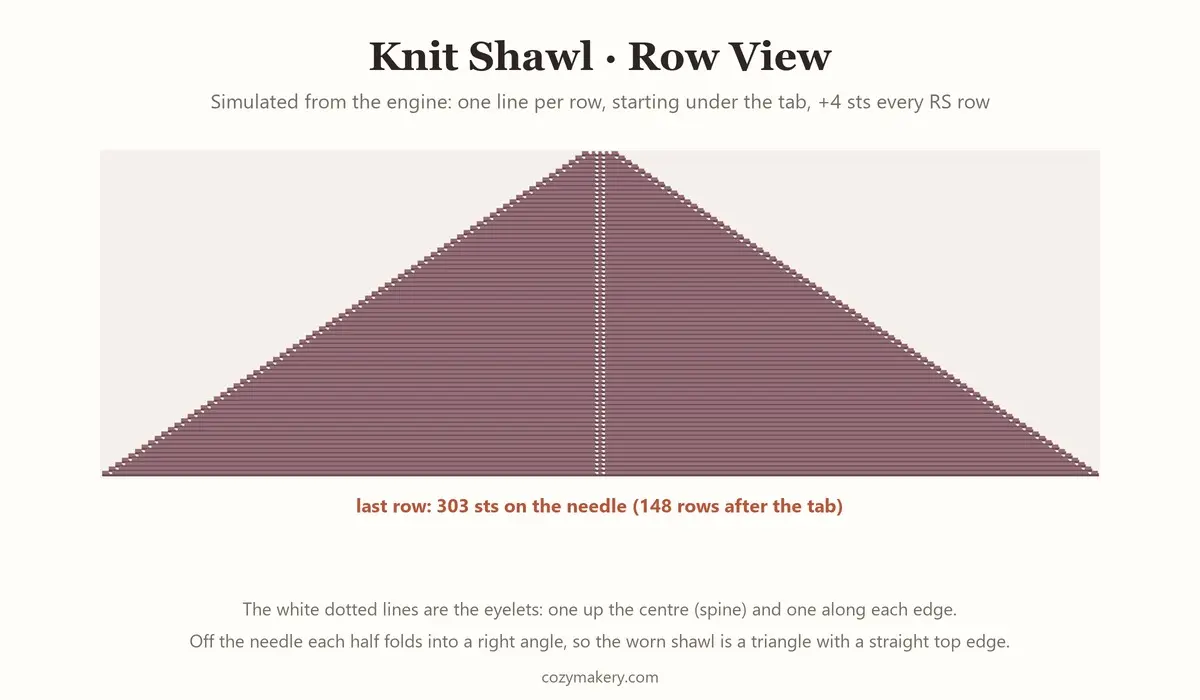
- Row view
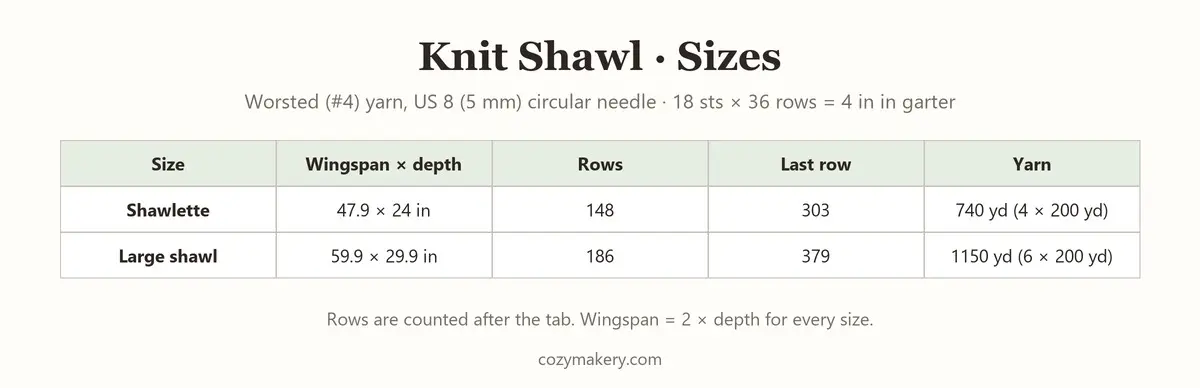
- Sizes
- Pattern: shawlette (47.9 × 24 in (122 × 61 cm))
- Pattern: large shawl (59.9 × 29.9 in (152 × 76 cm))
- Tips
- What's exact, what's calculated
- Frequently asked questions
- Save it for later
Pattern at a glance
- Skill levelEasy
- Sizes47.9 × 24 in (122 × 61 cm), 59.9 × 29.9 in (152 × 76 cm)
- YarnWorsted (#4)
- NeedlesUS 8 (5 mm) circular
- StitchesKnit, yarn over
- TimeAbout 12–18 hours
Free printable pattern
The PDF has both sizes, the first-rows chart, the shape diagram, the row view and the size table.
The Easy Knit Shawl Pattern PDF has 6 pages and prints on US Letter paper; on A4, choose “Fit to page” in the print dialog.
Materials
- Worsted (#4) yarn, wool or a soft blend: 740 yd for the shawlette (about 4 skeins of 200 yd), 1150 yd for the large shawl (6 skeins)
- US 8 (5 mm) circular needle, 32 in (81 cm) long. You knit back and forth; the cable holds the stitches as the shawl grows.
- A removable stitch marker and a tapestry needle
Abbreviations
| Abbreviation | Meaning |
|---|---|
| k | knit |
| yo | yarn over: wrap the yarn over the needle once, makes a new stitch and an eyelet |
| st(s) | stitch(es) |
| RS / WS | right side / wrong side |
Gauge
18 sts × 36 rows = 4 in in garter stitch (that’s 18 ridges). The shape works at any gauge as long as it’s garter: just knit until the top edge is long enough.
The garter tab
A top-down shawl starts with a tiny strip called a garter tab, so the top edge has no hole or bump at the centre. Cast on 2, knit 6 rows (3 ridges), turn the strip sideways, pick up 1 stitch in each of the 3 ridges and 2 from the cast-on edge: 2 + 3 + 2 = 7 stitches. That’s it.
First rows chart
Why the top edge is straight
Each half of the shawl grows by one stitch at both of its edges, on every row. In garter stitch a row is half as tall as a stitch is wide, so each half becomes a triangle with a right angle at the neck. Two right angles side by side make a straight line: that’s the top edge, and the wingspan is always twice the depth.
Row view
Sizes
Pattern: shawlette (47.9 × 24 in (122 × 61 cm))
- Tab: Cast on 2 sts. Knit 6 rows (3 garter ridges). Do not turn: rotate the piece 90 degrees, pick up and knit 3 sts along the side (1 in each ridge), then pick up and knit 2 sts from the cast-on edge. (7)
- Row 1 (RS): K2, yo, k1, yo, k1 (centre st: place a marker on it), yo, k1, yo, k2. (11)
- Row 2 (WS): Knit across. (11)
- Row 3 (RS): K2, yo, knit to the centre st, yo, k1 (centre st), yo, knit to the last 2 sts, yo, k2. (4 sts increased) (15)
- Row 4 (WS): Knit across. (15)
- Rows 5–148: Repeat Rows 3–4 until you have worked 148 rows and have 303 sts. (Every RS row adds 4 sts.) (303)
- Bind off: With the RS facing, bind off very loosely knitwise (use a needle 2 sizes larger, or the stretchy bind-off). Weave in the ends and block. (0)
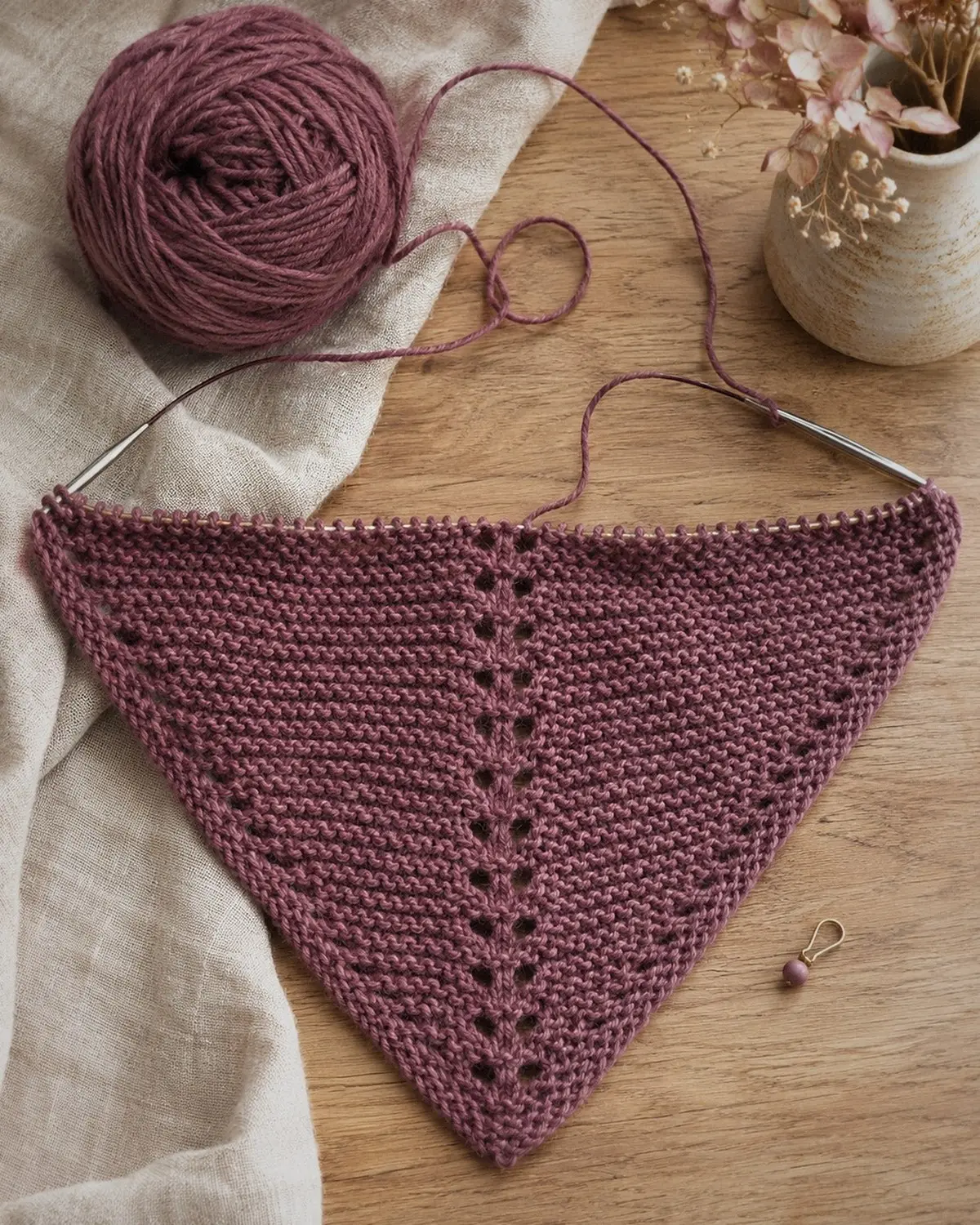
Checkpoints
| Where | On the needle |
|---|---|
| After Row 10 | 27 sts, about 5 in (13 cm) wide |
| After Row 40 | 87 sts, about 14 in (36 cm) wide |
| After Row 80 | 167 sts, about 27 in (69 cm) wide |
| After Row 120 | 247 sts, about 39 in (99 cm) wide |
| After Row 148 | 303 sts, about 48 in (122 cm) wide |
Pattern: large shawl (59.9 × 29.9 in (152 × 76 cm))
- Tab: Cast on 2 sts. Knit 6 rows (3 garter ridges). Do not turn: rotate the piece 90 degrees, pick up and knit 3 sts along the side (1 in each ridge), then pick up and knit 2 sts from the cast-on edge. (7)
- Row 1 (RS): K2, yo, k1, yo, k1 (centre st: place a marker on it), yo, k1, yo, k2. (11)
- Row 2 (WS): Knit across. (11)
- Row 3 (RS): K2, yo, knit to the centre st, yo, k1 (centre st), yo, knit to the last 2 sts, yo, k2. (4 sts increased) (15)
- Row 4 (WS): Knit across. (15)
- Rows 5–186: Repeat Rows 3–4 until you have worked 186 rows and have 379 sts. (Every RS row adds 4 sts.) (379)
- Bind off: With the RS facing, bind off very loosely knitwise (use a needle 2 sizes larger, or the stretchy bind-off). Weave in the ends and block. (0)
Tips
- Mark the centre stitch with a removable marker and move it up every few rows.
- Bind off loosely: the bottom edges need to stretch for blocking. Use a needle 2 sizes larger or see how to bind off knitting.
- Block it: soak, squeeze out the water and pin it flat. The eyelets open up and the triangle straightens.
- Running out of yarn? Weigh it: the last rows are the longest, so stop when you have about 10% of the yarn left for the last rows and the bind-off.
What's exact, what's calculated
- Exact: Every row was worked stitch by stitch in the engine: +4 sts on every RS row (4 yarn overs), the same count on every WS row.
- Exact: The tab gives 3 + 2 + 2 = 7 sts (1 st per garter ridge, 2 from the cast-on, 2 live sts).
- Exact: Each RS row leaves 4 eyelets: two along the top edge and two along the spine, so the holes line up on all three lines.
- Calculated: Size: each half grows 1 st and 1 row at a time, so its base is twice its height when the garter row gauge is twice the stitch gauge. Then the apex angle of each half is 90 degrees, the top edge is straight and the wingspan is twice the depth (checked in code).
- Calculated: Yarn: about 2.6 cm of worsted per stitch at this gauge, + 10% spare.
- Assumed: Gauge 18 sts × 36 rows (18 ridges) = 4 in in garter stitch with worsted on US 8 needles. Size follows your gauge: knit until the top edge is long enough, ending with a WS row.
Frequently asked questions
What is the easiest shawl to knit?
A top-down garter triangle like this one: knit stitches and yarn overs only, and the shape takes care of itself.
How many stitches do I cast on for a shawl?
Just 2 for this one. The garter tab turns them into 7, and the shawl grows by 4 stitches every other row.
How much yarn do I need for a knit shawl?
About 740 yd of worsted for the 47.9 in shawlette and 1150 yd for the 59.9 in wrap.
Can I use a different yarn?
Yes. Any weight works: thinner yarn makes a lighter, smaller shawl for the same number of rows. Keep knitting until it’s as wide as you want.
How many pages is the knit shawl PDF?
6 pages on US Letter paper, with every step of the knit shawl written out. On A4 paper, pick Fit to page when you print the knit shawl PDF so the charts aren’t cropped.
Save it for later
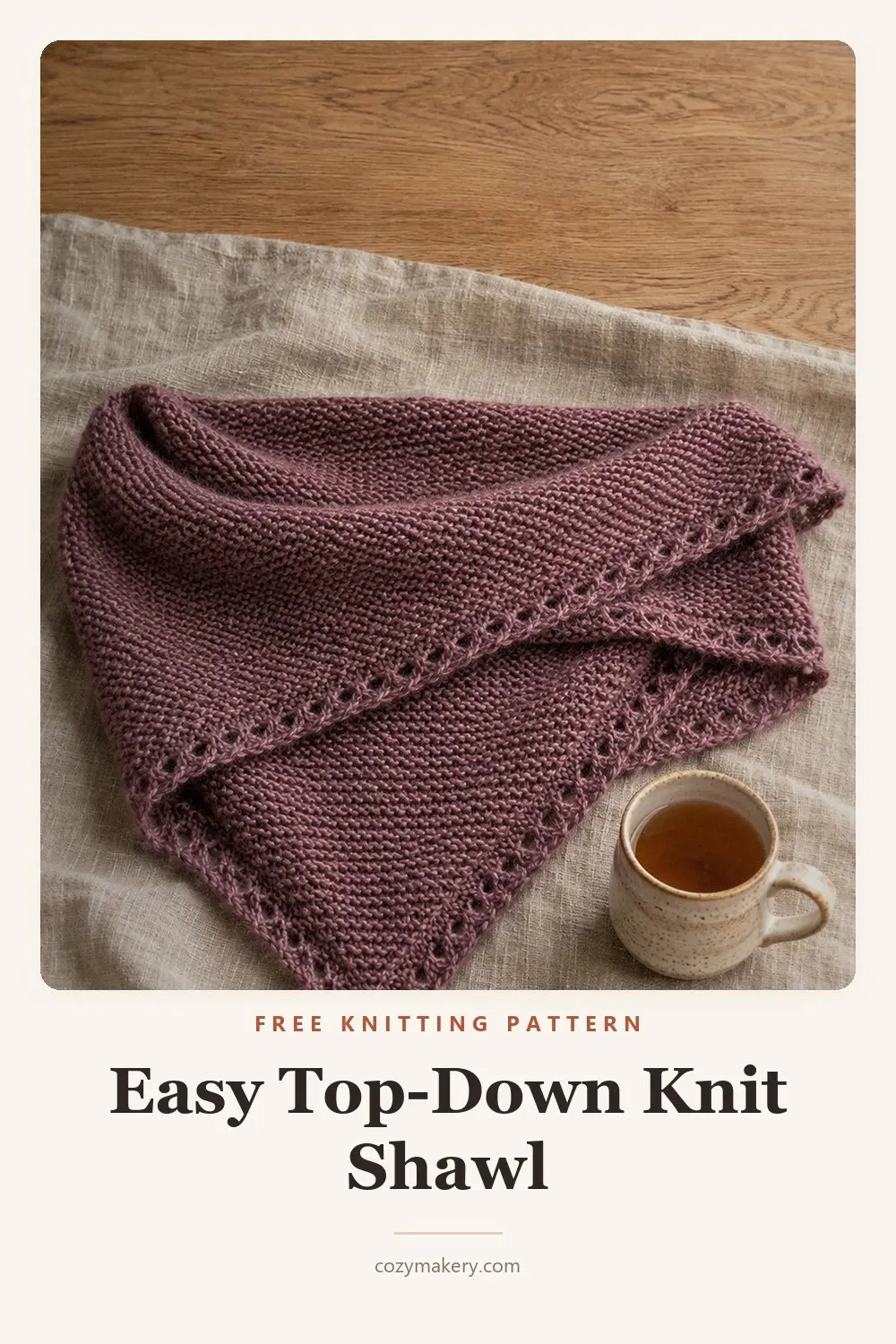
Pin the image below to keep the knit shawl pattern on your Pinterest board. Made the knit shawl? I’d love to see your version: send a photo to info@cozymakery.com.
More knitting: the basketweave knit blanket, the chunky knit cowl and 12 easy knitting patterns for beginners. Prefer crochet? Try the crochet triangle shawl.