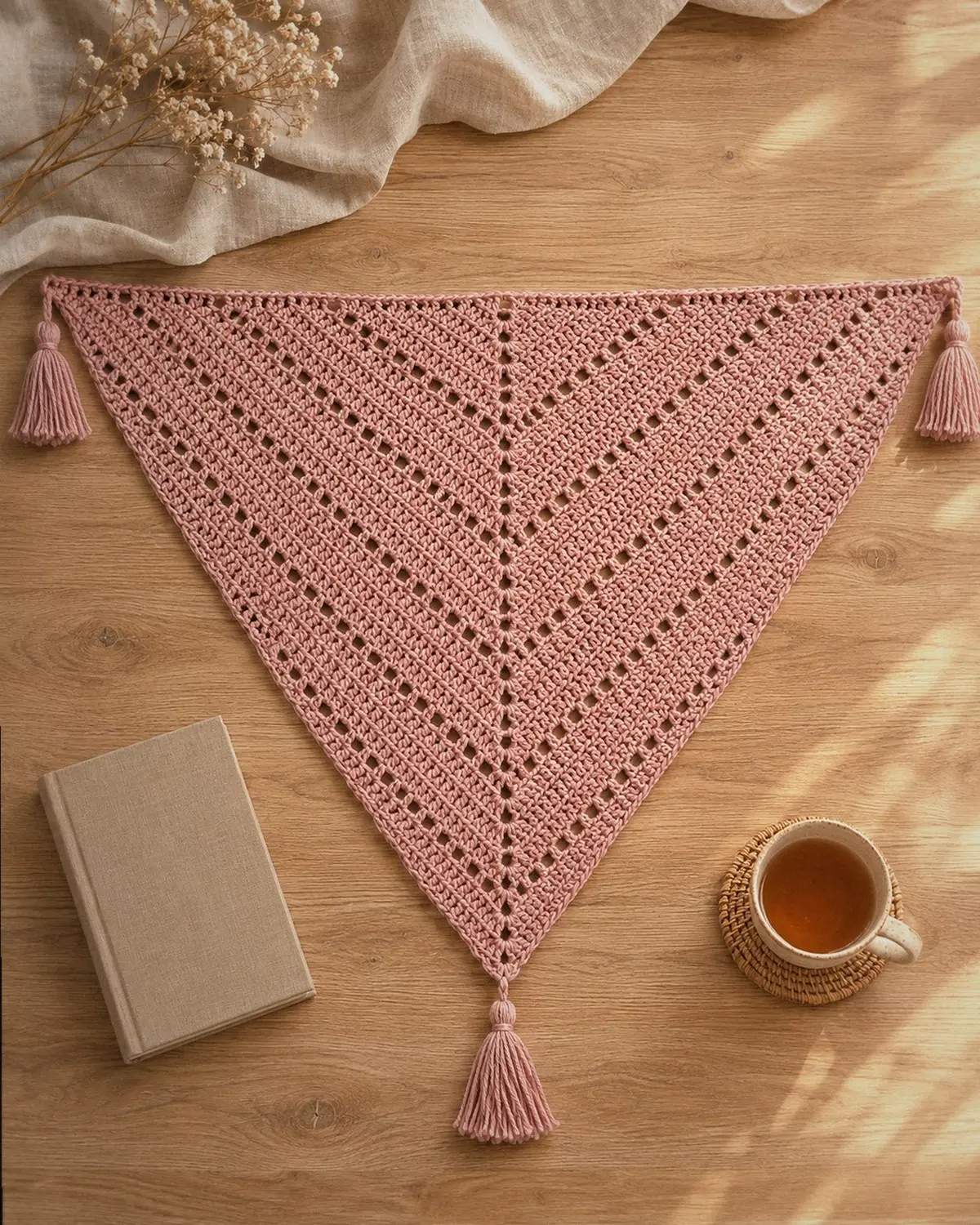
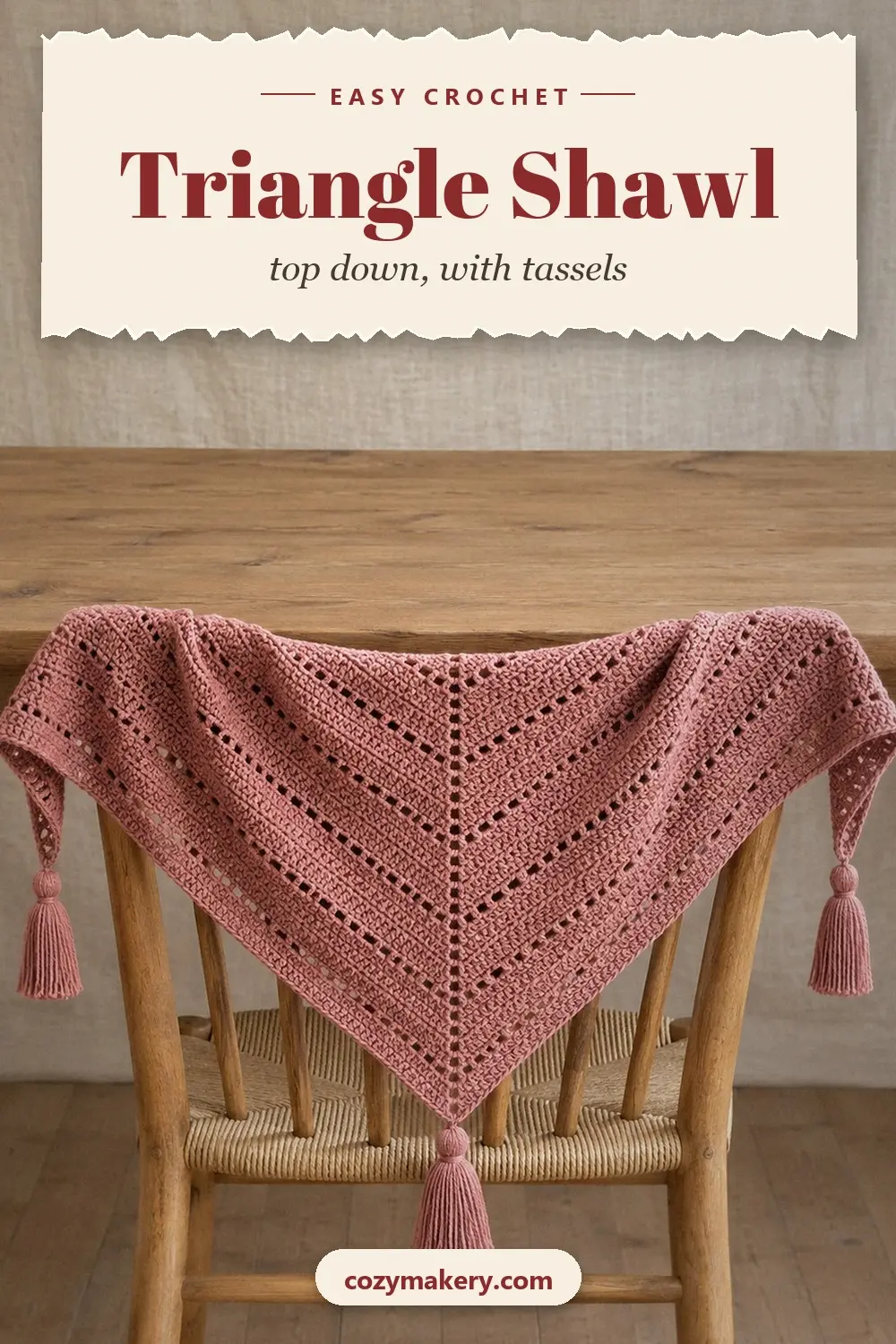
This easy crochet shawl pattern is a classic triangle worked from the top down: you start with a few stitches at the neck and every row grows by 3 stitches on each side. Rows of double crochet with an eyelet row every fourth row make soft chevron lines towards the centre, and a tassel finishes each point. Make the 40 in shawlette or the 60 in shawl; the only difference is how long you keep going.
In this post
Pattern at a glance
- Skill levelEasy
- Sizes40 in (102 cm) and 60 in (152 cm) wingspan
- YarnDK (#3)
- Hook4.5 mm (US 7)
- Stitchesch, sl st, sc, dc
- Time1–2 weeks of evenings
Free printable pattern
The PDF has both sizes, the growth diagram and the stitch chart.
The Easy Crochet Shawl Pattern PDF has 4 pages and prints on US Letter paper; on A4, choose “Fit to page” in the print dialog.
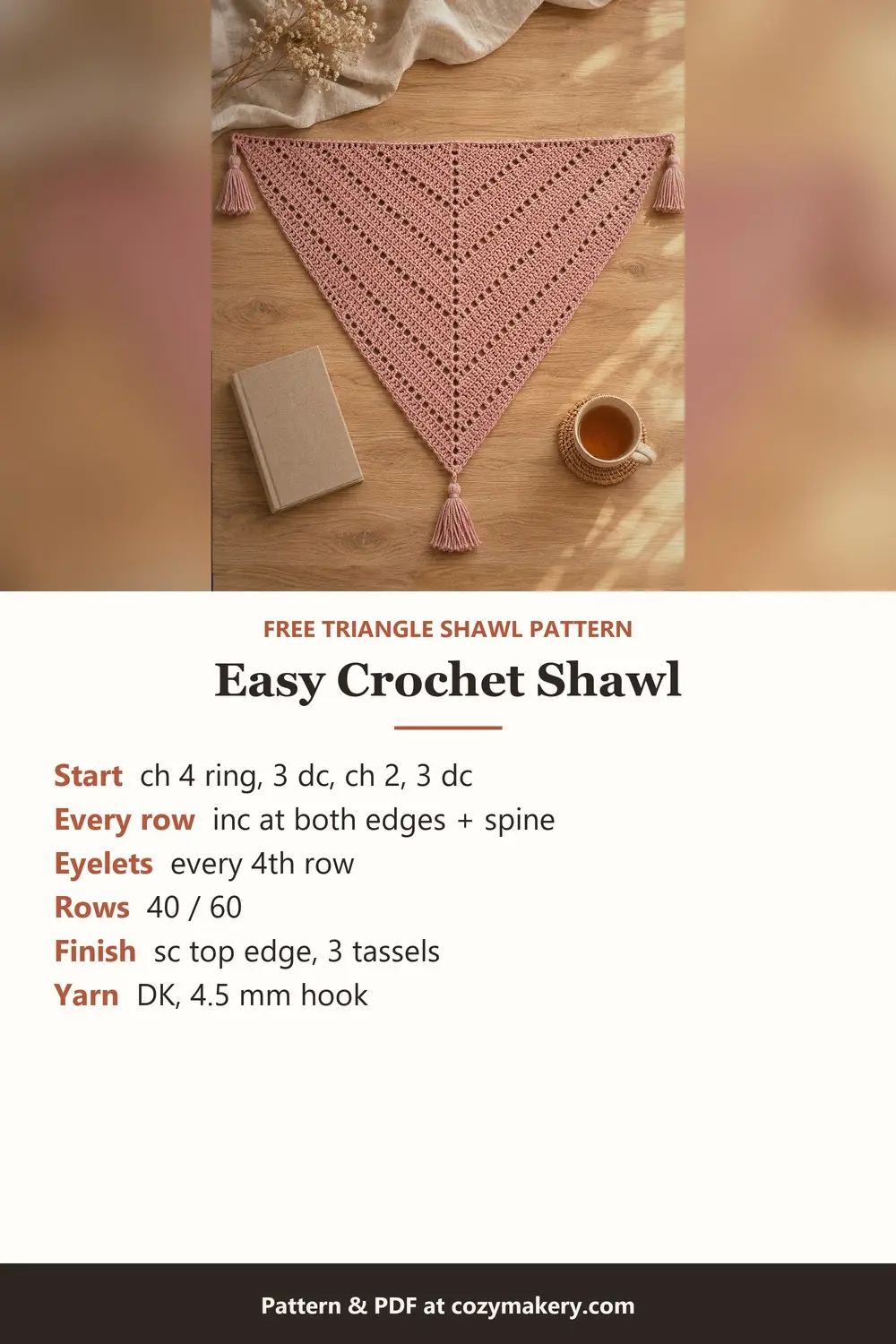
Materials
- DK (#3) yarn, soft wool or an acrylic blend: shawlette 350 yd, shawl 725 yd
- 4.5 mm (US 7) hook, a stitch marker for the spine and a 5 in (13 cm) piece of card for the tassels
Abbreviations
| US | Meaning | UK |
|---|---|---|
| ch | chain | ch |
| dc | double crochet | tr |
| sc | single crochet | dc |
| sl st | slip stitch | ss |
| sp | space | sp |
How it grows
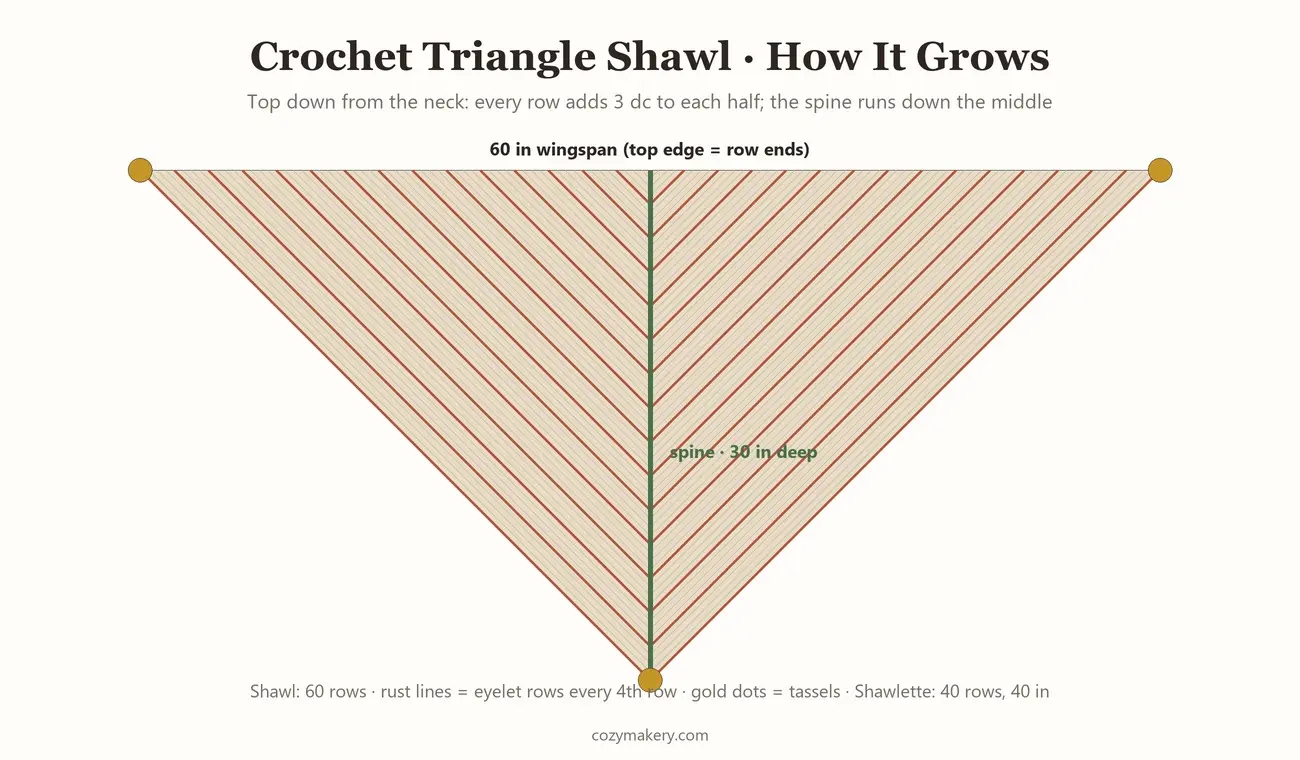
Each row is a wide V: half on each side of the ch-2 spine. Because you add 3 stitches per half on every row, the shawl stays a flat triangle that is twice as wide as it is deep.
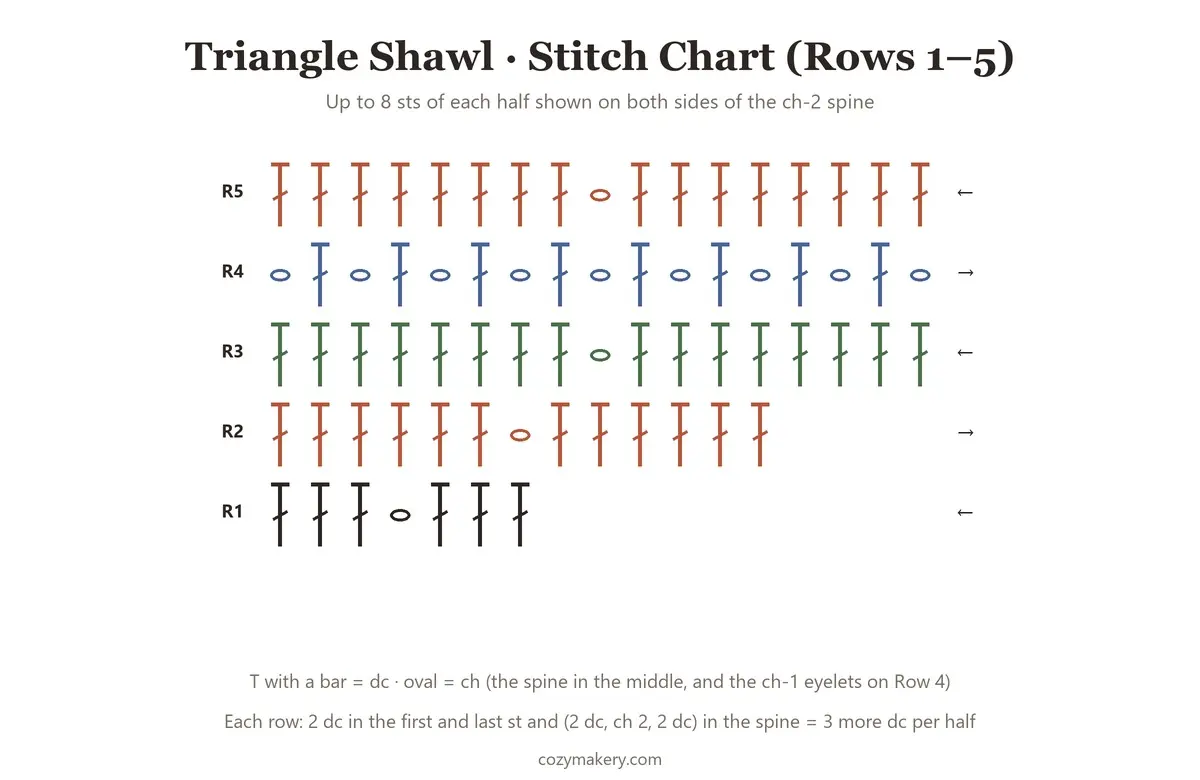
Stitch chart
Pattern: shawlette (40 in wingspan, 20 in (51 cm) deep)
- Start: Ch 4 and join with a sl st to make a ring.
- Row 1: Ch 3 (counts as dc), 2 dc in the ring, ch 2 (the spine), 3 dc in the ring. Turn. (3 + 3)
- Row 2: Ch 3 (counts as dc), dc in the first st, dc in each st to the ch-2 space, (2 dc, ch 2, 2 dc) in the space, dc in each st to the last st, 2 dc in the top of the turning ch. Turn. (6 + 6)
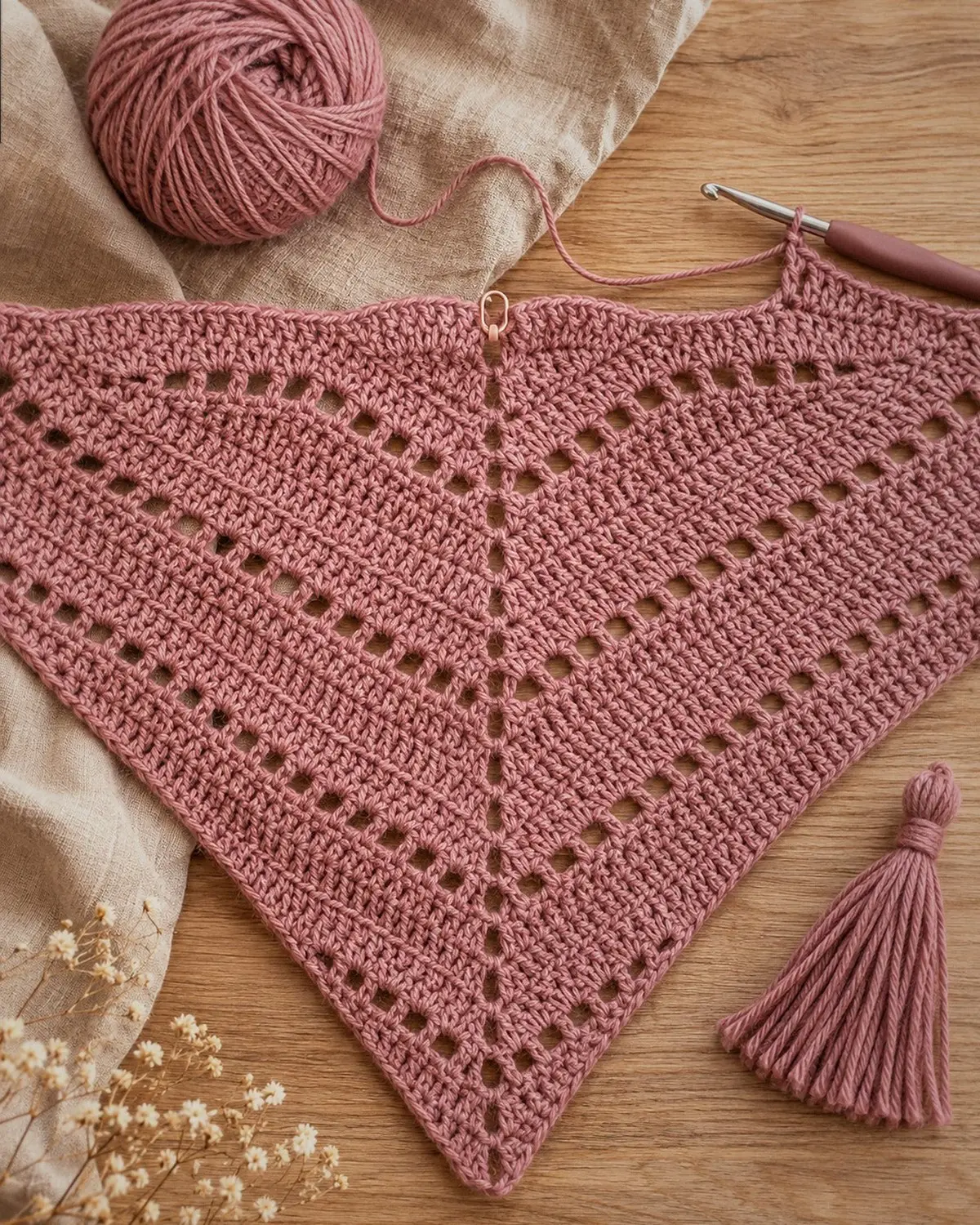
- Rows 3–40: Repeat Row 2 (3 sts more on each half every row). Every 4th row (Rows 4, 8, 12 …) is an eyelet row: work it like Row 2, but between the increases work *ch 1, skip 1 st, dc in the next st* instead of plain dc; if one st is left before the spine or the last increase, dc in it. On the next row, dc in each st and in each ch-1 space. (120 + 120)
- Edging: Do not turn. Ch 1, sc evenly along the top straight edge (2 sc per dc row-end). Fasten off.
- Tassels: Make 3 tassels: wrap yarn 25 times around a 5 in card, tie the top, cut the bottom, wrap the neck. Tie one to each point.
Pattern: shawl (60 in wingspan, 30 in (76 cm) deep)
- Start: Ch 4 and join with a sl st to make a ring.
- Row 1: Ch 3 (counts as dc), 2 dc in the ring, ch 2 (the spine), 3 dc in the ring. Turn. (3 + 3)
- Row 2: Ch 3 (counts as dc), dc in the first st, dc in each st to the ch-2 space, (2 dc, ch 2, 2 dc) in the space, dc in each st to the last st, 2 dc in the top of the turning ch. Turn. (6 + 6)
- Rows 3–60: Repeat Row 2 (3 sts more on each half every row). Every 4th row (Rows 4, 8, 12 …) is an eyelet row: work it like Row 2, but between the increases work *ch 1, skip 1 st, dc in the next st* instead of plain dc; if one st is left before the spine or the last increase, dc in it. On the next row, dc in each st and in each ch-1 space. (180 + 180)
- Edging: Do not turn. Ch 1, sc evenly along the top straight edge (2 sc per dc row-end). Fasten off.
- Tassels: Make 3 tassels: wrap yarn 25 times around a 5 in card, tie the top, cut the bottom, wrap the neck. Tie one to each point.
Frequently asked questions
How do I make the shawl bigger?
Keep repeating the rows. Each row adds about 1 in to the wingspan; buy about 30 yd more per extra 2 in (5.1 cm).
Why does my shawl curl at the top?
The top edge may be tight. Work the 2 dc increases loosely, and block the shawl flat when it is done.
Can I skip the eyelets?
Yes: work every row in plain dc for a solid shawl. It uses a little more yarn.
Does gauge matter for the crochet shawl?
Only a little: the crochet shawl isn’t fitted, so a tighter or looser tension just makes it slightly smaller or bigger and changes the yarn amount. For the size in the pattern, make a 4 in (10 cm) swatch for the crochet shawl with the 4.5 mm (US 7) hook first and compare.
How many pages is the crochet shawl PDF?
4 pages on US Letter paper, with every step of the crochet shawl written out. On A4 paper, pick Fit to page when you print the crochet shawl PDF so the charts aren’t cropped.
Save it for later
Pin the image below to keep the crochet shawl pattern on your Pinterest board. Made the crochet shawl? I’d love to see your version: send a photo to info@cozymakery.com.
More wraps: the easy crochet scarf, the ribbed cowl and the alpine stitch scarf.
For something you can pull over your head, see the easy two-rectangle crochet poncho.
Prefer knitting? The easy top-down garter knit shawl uses only knit stitches and yarn overs.