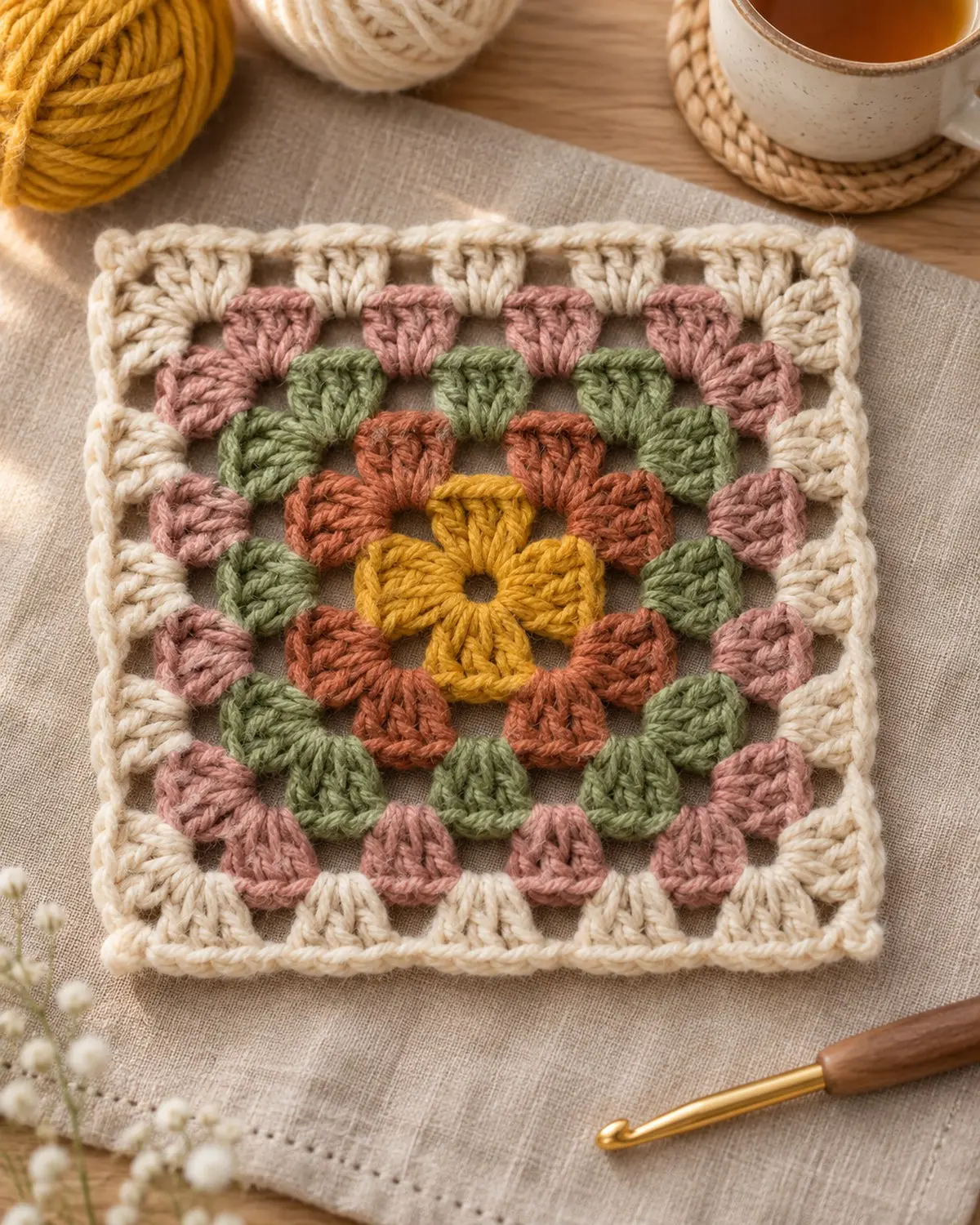
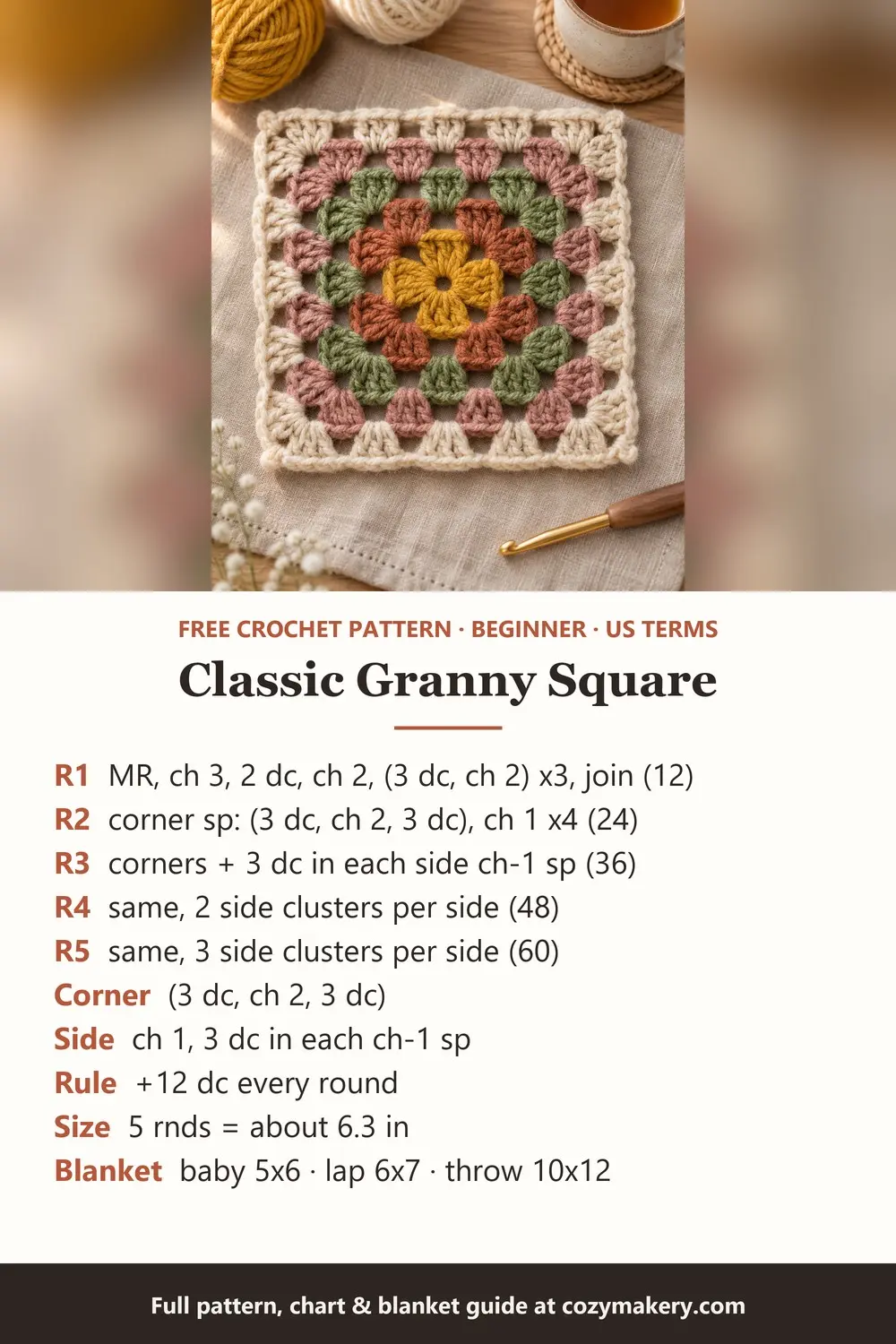
If you only ever learn one crochet pattern, make it this one. The classic granny square is the little block behind countless blankets, bags, cardigans and cushions, and once your hands know the rhythm you can make one almost without looking.
This granny square crochet pattern walks you through five rounds, one step at a time, with the stitch count for every round, a chart, and tables for sizing and yarn. It uses just two stitches: the chain and the double crochet.
In this post
- Pattern at a glance
- Free printable pattern
- How a granny square works
- Materials
- Abbreviations (US terms)
- Granny square crochet pattern
- Granny square chart
- Size and yarn by number of rounds
- How many granny squares for a blanket?
- Common granny square problems (and fixes)
- Frequently asked questions
- Save it for later
Pattern at a glance
- Skill levelBeginner
- Finished sizeAbout 6 in (15 cm) after 5 rounds
- YarnWorsted weight (#4), about 19 yd per square
- Hook5 mm (US H-8)
- StitchesChain, double crochet, slip stitch
- TermsUS crochet terms
Free printable pattern
Prefer to crochet from paper? The printable PDF has all five rounds, the size and yarn table, the blanket guide and the chart, on 3 pages.
How a granny square works
Every granny square is built from clusters: groups of three double crochet worked into the same space. The clusters are separated by little chain spaces, and those spaces are where the next round goes.
- Corner spaces (ch 2) always get two clusters: 3 dc, ch 2, 3 dc. That’s what turns the corner.
- Side spaces (ch 1) always get one cluster: 3 dc.
- Every round adds one more cluster to each side, so each round has 12 more double crochet than the one before: 12, 24, 36, 48, 60.
Keep those three ideas in your head and you’ll never need the written pattern after round 3.
Materials
- Worsted weight yarn in one to five colours. A five-round square takes about 19 yd (17 m) in total; the outer round alone uses roughly a third of that.
- 5 mm (US H-8) crochet hook, or whatever hook gives you a fabric you like with your yarn
- Tapestry needle for weaving in ends
- Scissors
For a first square I’d pick a smooth, light-coloured acrylic or cotton blend. Dark, fluffy or variegated yarn makes the spaces between clusters much harder to see.
Abbreviations (US terms)
| US | Meaning | UK equivalent |
|---|---|---|
| ch | chain | ch |
| dc | double crochet | tr (treble crochet) |
| sl st | slip stitch | ss |
| sp(s) | space(s) | sp(s) |
| st(s) | stitch(es) | st(s) |
Patterns written in UK terms call this exact square a “treble” granny square, so don’t panic if you see that name elsewhere. The Craft Yarn Council’s abbreviation list is a good reference if you meet a term you don’t recognise.
Granny square crochet pattern
Work with the right side facing you throughout. The ch 3 at the start of each round counts as the first dc. The numbers in brackets are the total double crochet at the end of the round.
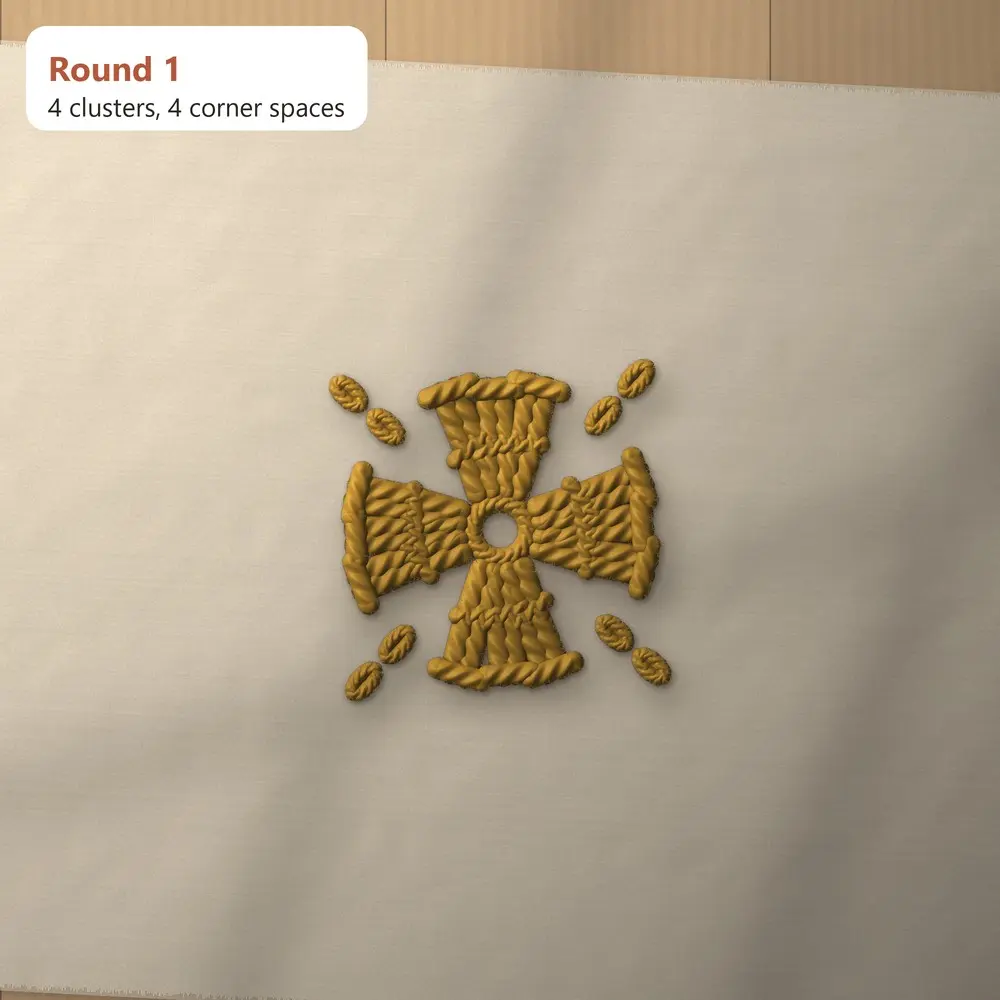
Round 1
Make a magic ring (or ch 4 and join with a sl st to the first ch to form a ring). Ch 3, work 2 dc into the ring, ch 2. *Work 3 dc into the ring, ch 2. Repeat from * 2 more times. Pull the ring closed and join with a sl st to the top of the beginning ch 3. (12 dc: 4 clusters and 4 ch-2 corner spaces)
Round 2
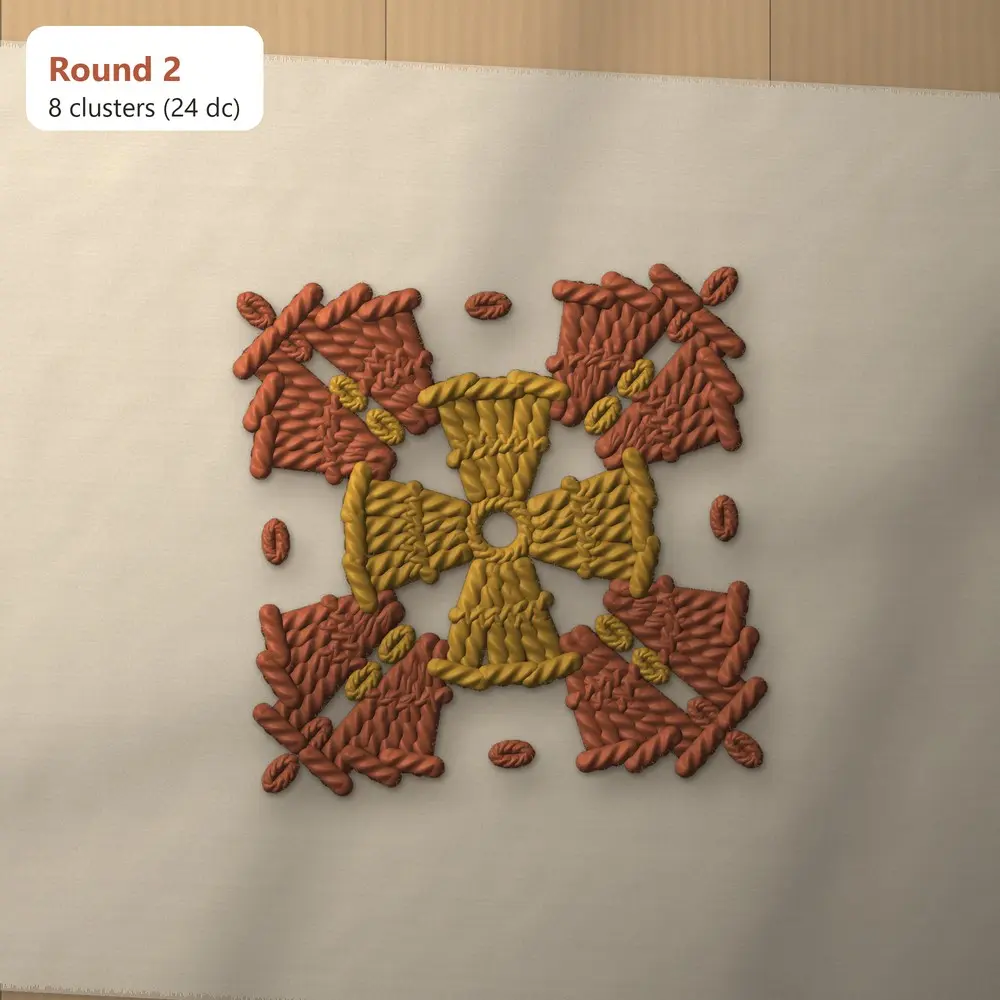
If you’re changing colour, fasten off and join the new colour with a sl st in any ch-2 corner space. If you’re keeping the same colour, sl st in the next 2 dc and into the corner space instead.
Ch 3, work (2 dc, ch 2, 3 dc) in the same corner space. *Ch 1, work (3 dc, ch 2, 3 dc) in the next corner space. Repeat from * 2 more times. Ch 1 and join with a sl st to the top of the ch 3. (24 dc: 8 clusters, 4 corner spaces, 4 ch-1 spaces)
Round 3
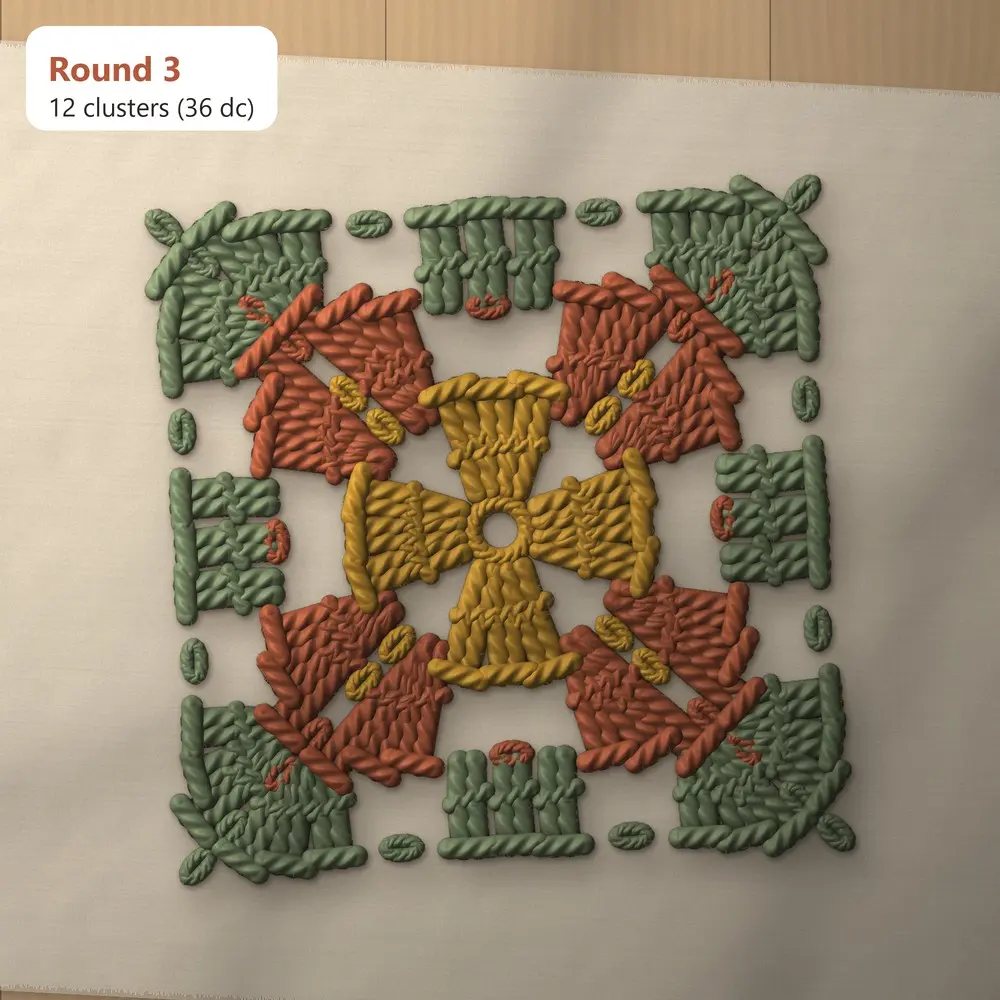
Join in any corner space (or sl st across to it). Ch 3, work (2 dc, ch 2, 3 dc) in the same corner space. *Ch 1, work 3 dc in the next ch-1 space, ch 1, work (3 dc, ch 2, 3 dc) in the next corner space. Repeat from * 2 more times. Ch 1, work 3 dc in the last ch-1 space, ch 1, and join. (36 dc: 12 clusters)
Rounds 4 and 5
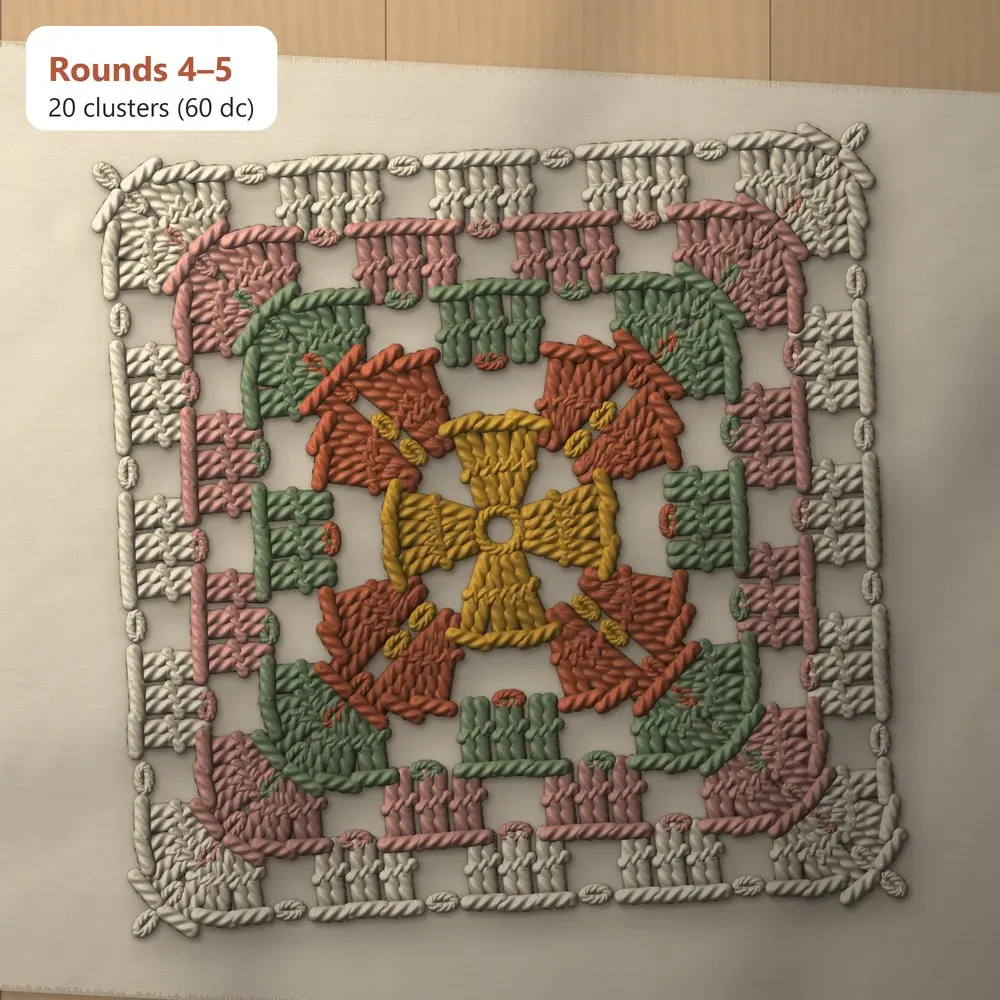
Join in any corner space. Ch 3, work (2 dc, ch 2, 3 dc) in the same corner space. Along each side, work ch 1, 3 dc in every ch-1 space, then ch 1, (3 dc, ch 2, 3 dc) in the next corner. Finish the last side with ch 1 and join to the top of the ch 3.
- Round 4: 2 side clusters per side. (48 dc: 16 clusters)
- Round 5: 3 side clusters per side. (60 dc: 20 clusters)
Fasten off and weave in all the ends. Weave each end through the back of a cluster of the same colour so it doesn’t peek through on the front.
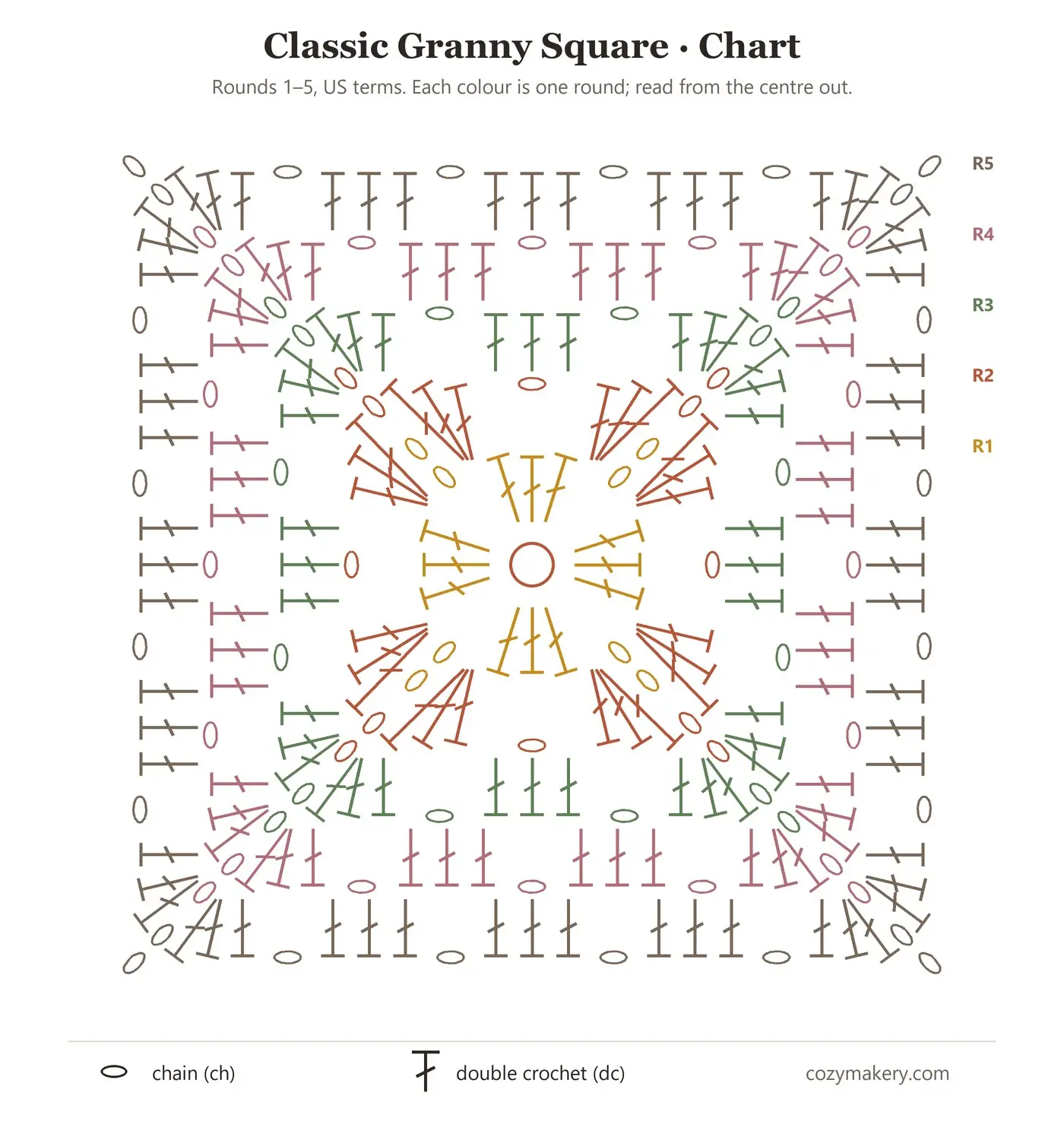
Granny square chart
Each colour on the chart is one round. Start at the ring in the middle and work outwards. Every “T” with a little slash is a double crochet, and every oval is a chain. Notice how each corner always has two groups of three, while each side gains one more group per round.
Size and yarn by number of rounds
Keep going with the same rhythm for as many rounds as you like. Sizes are approximate for worsted yarn and a 5 mm hook. Your own tension decides the final number, so measure your first square before planning a big project.
| Rounds | Clusters | Double crochet | Approx. size | Approx. yarn |
|---|---|---|---|---|
| 3 | 12 | 36 | 3.9 in (10 cm) | 8 yd |
| 4 | 16 | 48 | 5.1 in (13 cm) | 13 yd |
| 5 | 20 | 60 | 6.3 in (16 cm) | 19 yd |
| 6 | 24 | 72 | 7.5 in (19 cm) | 26 yd |
| 7 | 28 | 84 | 8.7 in (22 cm) | 34 yd |
| 8 | 32 | 96 | 9.9 in (25 cm) | 44 yd |
How many granny squares for a blanket?
Using the 5-round square from this pattern (about 6.3 in each), here’s a quick guide. The yarn totals include an extra 10% for joining and a simple border.
| Project | Layout | Squares | Approx. size | Approx. yarn |
|---|---|---|---|---|
| Baby blanket | 5 × 6 | 30 | 32 × 38 in | 630 yd |
| Lap blanket | 6 × 7 | 42 | 38 × 44 in | 880 yd |
| Throw | 10 × 12 | 120 | 63 × 76 in | 2,520 yd |
Joining a pile of squares is a whole topic of its own. The two easiest methods are whip stitching them together with a tapestry needle, or slip stitching them together on the wrong side with your hook.
Common granny square problems (and fixes)
- The square is twisting. Working every round with the same side facing makes the square spiral slightly. Joining each new round in a different corner helps, and blocking fixes the rest. Some people also turn the work at the end of every round.
- The edges are wavy. Your chains are probably too loose, or you’ve added an extra ch 1 somewhere. Count the clusters along one side, including the two corner clusters: after round 3 there should be 3, after round 4 there should be 4, and so on.
- The middle is cupping. Your corner chains are too tight. Try ch 3 in the corners instead of ch 2 for the first two rounds.
- One side has more clusters. You’ve missed a ch-1 space or doubled one up. Compare the sides before you start the next round; it’s much easier to fix now than later.
- The ch 3 leaves a gap. Pull the ch 3 snug, or replace it with a “standing double crochet” when you join a new colour.
Frequently asked questions
How long does it take to make one granny square?
A five-round square has 180 double crochet in total. A beginner usually needs 30 to 45 minutes for the first one, including colour changes and weaving in ends. After a few squares, most people get that down to 15 or 20 minutes.
What’s the best yarn for granny squares?
Worsted weight acrylic is the classic choice: cheap, washable and available in every colour. Cotton gives crisp, defined squares that are great for bags and summer tops. Wool blends make the softest blankets but need gentler washing.
Do I have to change colour every round?
No. A solid granny square in one colour looks lovely too. Instead of fastening off, slip stitch across the top of the first two dc and into the corner space at the end of each round, then start the next round there.
Can I use a different yarn weight?
Yes. The stitch counts never change, only the size. DK yarn with a 4 mm hook gives a smaller, neater square; chunky yarn with a 6–8 mm hook makes a big square very quickly.
Save it for later
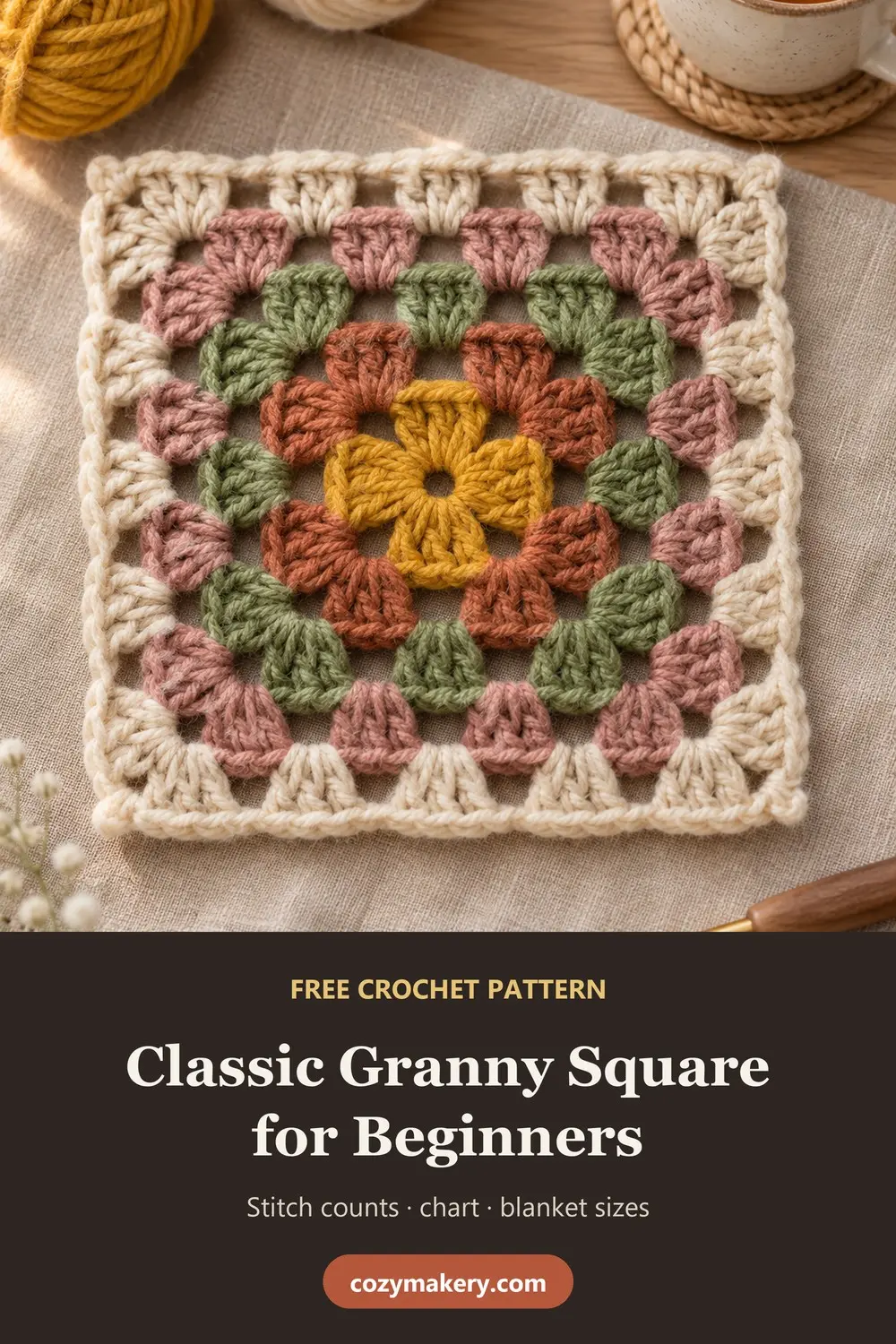
Pin the image below so the pattern is there when you’re ready for your first blanket. If you make a square, I’d love to see your colour combination. Send it to info@cozymakery.com, and if anything in the pattern doesn’t add up, tell me and I’ll fix it.
Want something festive next? Try the crochet Christmas tree ornament, a quick single crochet project that’s perfect for scraps. You’ll find more beginner-friendly makes in Crochet, and you can read how every pattern here is written and checked on the editorial policy page.