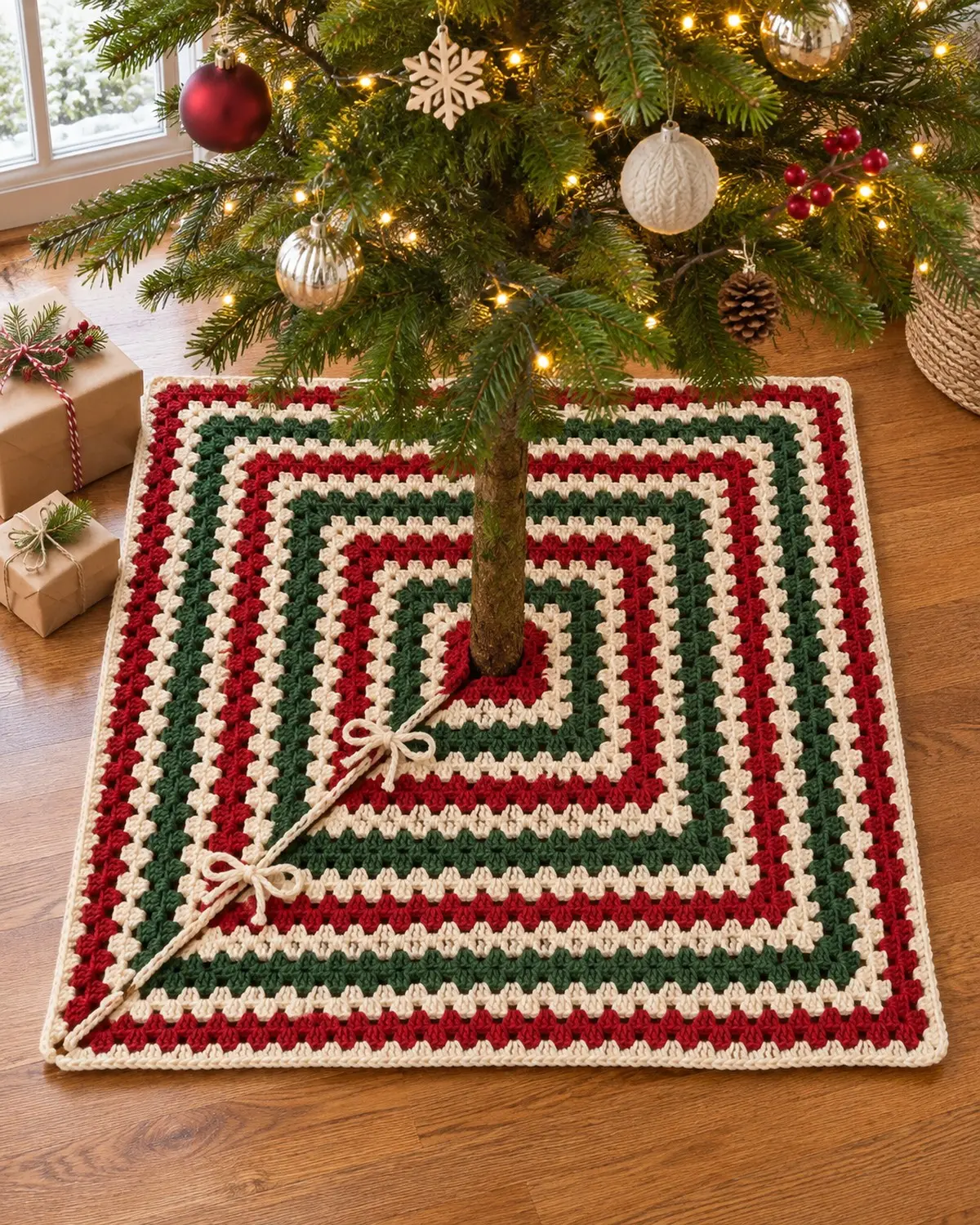
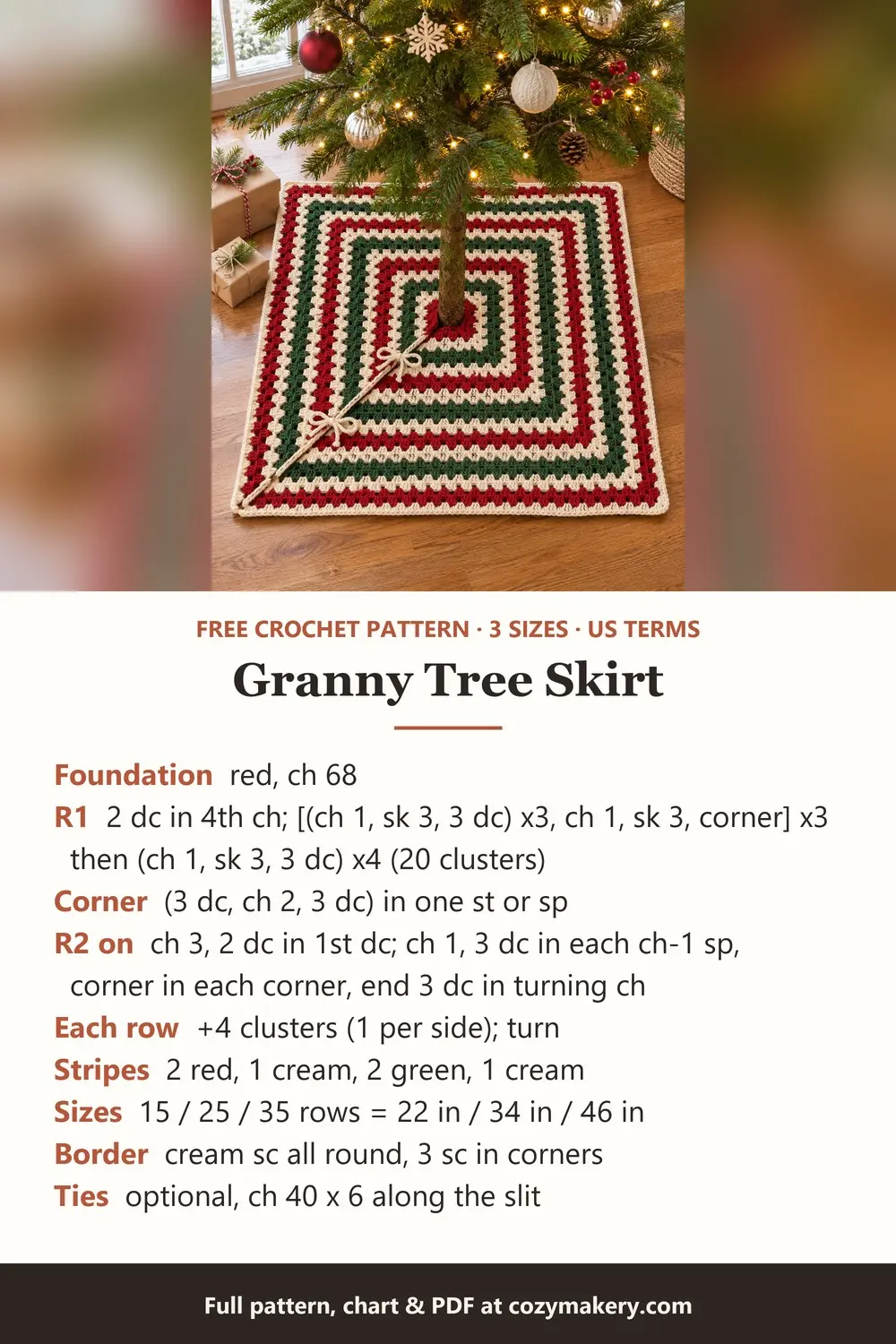
A crochet Christmas tree skirt is one of those makes you’ll pull out every December for years. This one is pure granny style: clusters of three double crochets in red, cream and green stripes, worked around a small opening so it builds into a big, flat square.
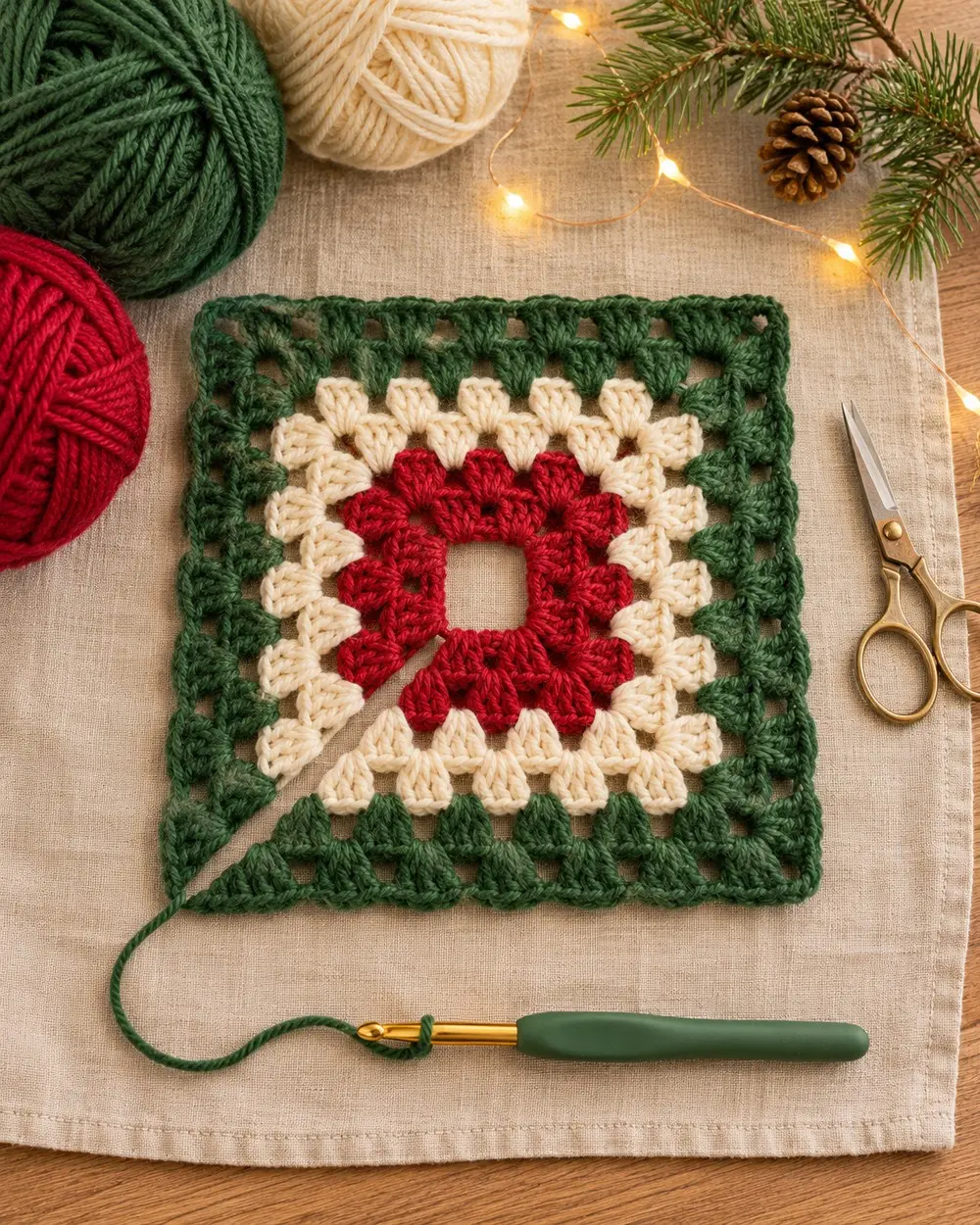
The trick is that it’s worked in turned rows instead of joined rounds. Each row goes along all four sides, so you end up with a slit along one diagonal, which means you can wrap the skirt around a tree that’s already standing. If you can crochet a classic granny square, you can make this.
In this post
Pattern at a glance
- Skill levelEasy
- Sizes22 in, 34 in, 46 in square
- Stitchesch, dc, sc
- YarnWorsted weight (#4)
- Hook5.5 mm (US I-9)
- TermsUS crochet terms
Free printable pattern
The PDF has the written rows, the stitch chart, the stripe order, the border and all three sizes on four pages. Print it, or keep it on your phone next to your yarn.
Materials
| Yarn (worsted #4) | Tabletop 22 in | Medium 34 in | Large 46 in |
|---|---|---|---|
| Red | 89 yd | 182 yd | 306 yd |
| Green | 58 yd | 173 yd | 347 yd |
| Cream (stripes, border, ties) | 99 yd | 200 yd | 333 yd |
- 5.5 mm (US I-9) crochet hook. A slightly bigger hook than usual keeps the skirt soft and drapey.
- Tapestry needle and scissors
The amounts include about 10% extra. For the large size, one big 364-yard skein of each colour is enough. Acrylic is the practical choice for something that lives on the floor for a month: it’s cheap, it washes well, and pine needles brush off it easily.
Gauge and sizes
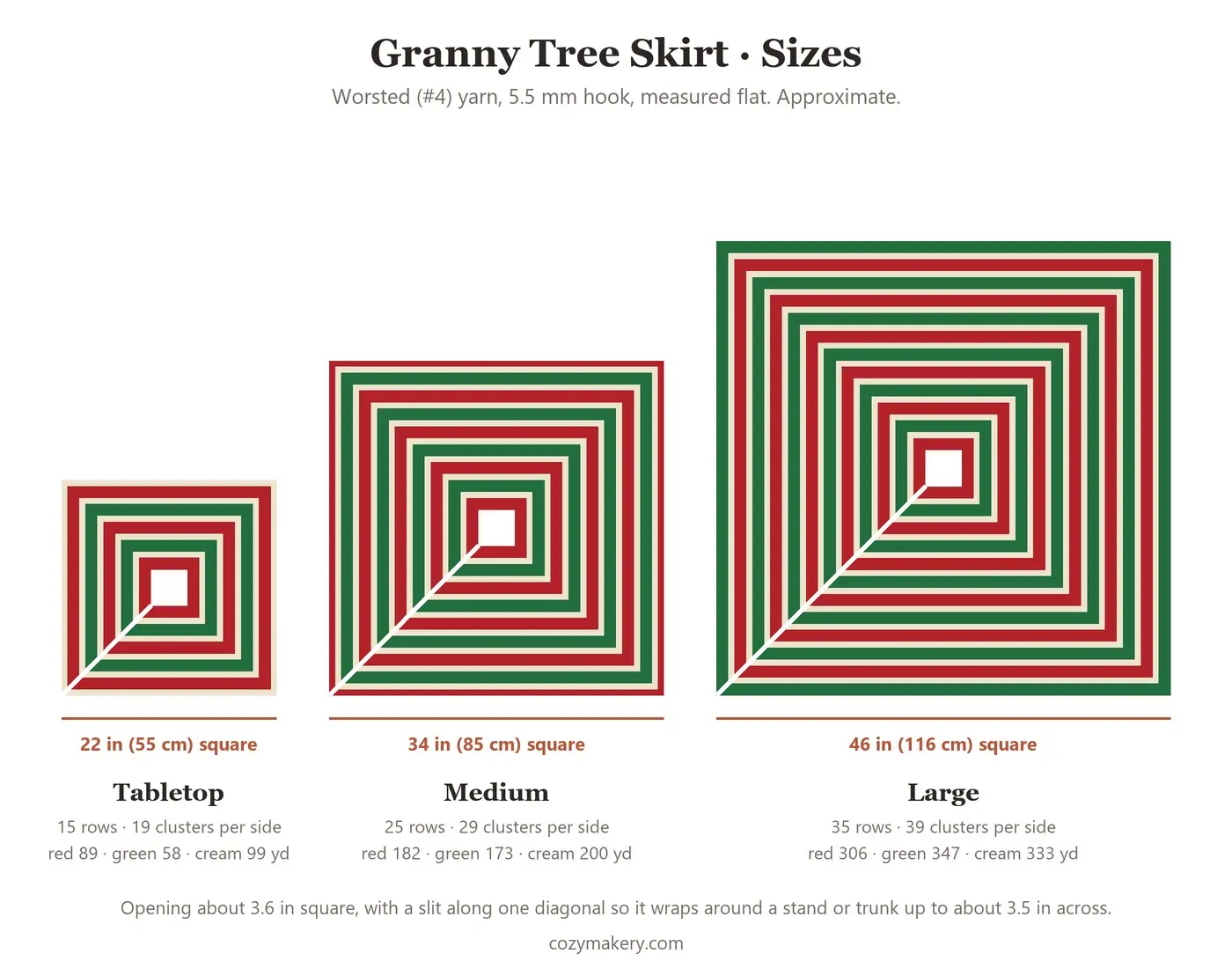
Gauge: one cluster plus its ch-1 space = about 1.2 in, and each row adds about 0.6 in to every side. Gauge isn’t critical for a tree skirt, but it changes how much yarn you need, and you can simply keep adding rows until it’s the size you want.
| Size | Rows | Clusters per side (last row) | Finished size | Good for |
|---|---|---|---|---|
| Tabletop | 15 | 19 | 22 in (55 cm) | Tabletop or 3–4 ft trees |
| Medium | 25 | 29 | 34 in (85 cm) | 5–6 ft trees |
| Large | 35 | 39 | 46 in (116 cm) | 7 ft trees and up |
Abbreviations (US terms)
| US | Meaning | UK equivalent |
|---|---|---|
| ch | chain | ch |
| dc | double crochet | tr |
| sc | single crochet | dc |
| sl st | slip stitch | ss |
| sp | space | sp |
| cluster | 3 dc in the same stitch or space | 3 tr in the same st or sp |
Crochet Christmas tree skirt pattern
How it works: the foundation chain goes around the four sides of the opening. Every row then travels along side A, round a corner, along side B, round a corner, along side C, round a corner and along side D, and you turn. The two ends of each row meet at the slit, which is why the slit runs neatly along one diagonal. Every row adds one cluster to every side, exactly like the rounds of a granny square.
Stripe order: Rows 1–2 red, Row 3 cream, Rows 4–5 green, Row 6 cream, then repeat from Row 1. To change colour, work the last yarn-over of the last dc of a row with the new colour, then turn. Because the colours change at the slit edge, the tails are easy to hide in the border later.
- Foundation: With red, ch 68.
- Row 1 (right side): 2 dc in the 4th ch from the hook (the skipped 3 ch count as a dc). *(Ch 1, skip 3 ch, 3 dc in the next ch) 3 times, ch 1, skip 3 ch, then (3 dc, ch 2, 3 dc) in the next ch for the corner; repeat from * 2 more times. Then (ch 1, skip 3 ch, 3 dc in the next ch) 4 times; the last cluster goes into the last ch. Turn. (20 clusters: 5 on each side, 3 corners)
- Row 2: Ch 3 (counts as a dc), 2 dc in the first dc. *Ch 1, 3 dc in the next ch-1 sp; repeat from * to the corner, then ch 1, (3 dc, ch 2, 3 dc) in the ch-2 corner sp. Work the next two sides and corners the same way. Along the last side, work *ch 1, 3 dc in the next ch-1 sp* to the end, then ch 1 and 3 dc in the top of the turning ch. Turn. (24 clusters)
- Row 3 onwards: Repeat Row 2, following the stripe order. Each row has 4 more clusters than the row before.
Stop after 15 rows for the tabletop size (76 clusters, ending on a cream row), 25 rows for the medium (116 clusters, ending on a red row) or 35 rows for the large (156 clusters, ending on a green row). If your last row isn’t cream, change to cream at the end of it for the border.
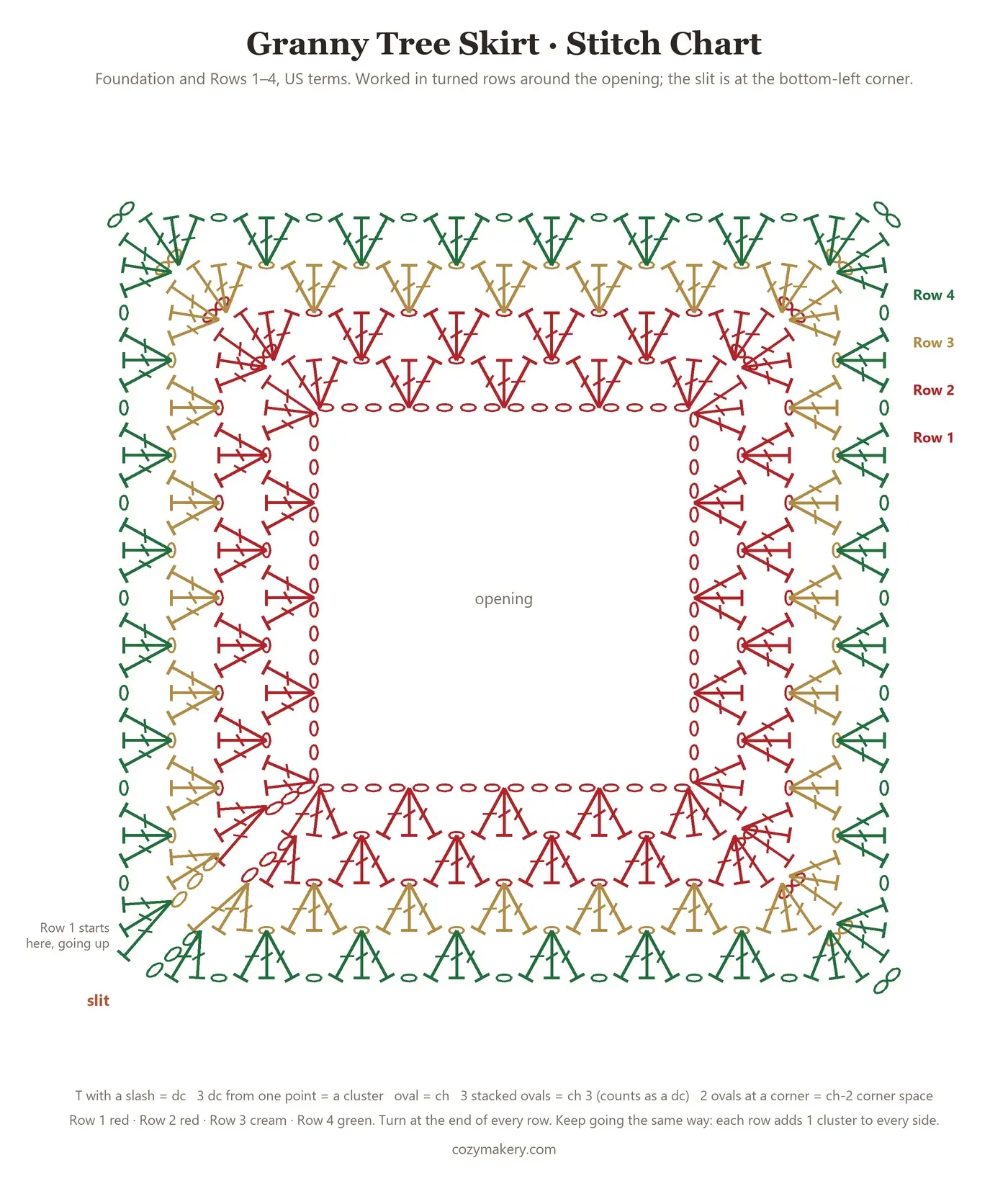
Stitch chart
The chart shows the foundation chain and the first four rows around the opening. Each T with a slash is a double crochet, three of them fanning out of one point make a cluster, the small ovals are chains, and the two ovals at each corner are the ch-2 corner spaces. The three stacked ovals mark the ch 3 at the start of each row. Notice how it swaps sides every row as you turn.
Border and ties
- Border: With cream, ch 1 and sc evenly around everything. Along the outer edge, work 1 sc in each dc and each ch-1 sp, and 3 sc in each ch-2 corner and at the two outer slit corners. Along both slit edges, work 2 sc around each row end. Around the opening, work 1 sc in each foundation ch. Sl st to the first sc and fasten off.
- Ties (optional): With cream, join yarn at three points along each slit edge (at the opening, halfway and at the outer corner), ch 40 and fasten off. Tie the pairs into bows once the skirt is under the tree.
- Finish: Weave in all the ends. Lay the skirt flat, pin it square, mist it with water and let it dry. Ten minutes of blocking makes the stripes and corners look so much neater.
Tips for a flat, square skirt
- Count your clusters every few rows. Each side should have one more cluster than in the previous row. If a side is short, you’ve probably skipped a ch-1 space.
- Keep the ch-1 spaces loose and even. Tight chains make the skirt cup; loose ones make it ripple.
- Don’t skip the corner chains. The ch 2 in each corner is what lets the skirt lie flat.
- Weave in ends as you go. A large skirt has more than 20 colour changes, and weaving in all those tails at the end is no fun.
- Need a bigger opening? Add 4 chains per side (16 in total) and one more cluster on every side of Row 1. All the cluster counts then go up by 4.
Colour ideas
- Scandi: cream, grey and a soft red.
- Woodland: forest green, mustard and oatmeal.
- Scrap-happy: a different colour every row, with a cream row in between to tie it together.
- All white: one colour throughout lets the granny texture shine, like fresh snow under the tree.
Frequently asked questions
How long does a crochet tree skirt take?
Granny clusters grow quickly. The tabletop size is a weekend project, the medium takes most people a week or two of evenings, and the large is a bigger commitment. Each row is longer than the one before, so the last few rows take the most time.
Why is my tree skirt wavy or cupping?
Ruffles usually mean the chain spaces are too loose or you’re adding extra clusters; cupping means the chains are too tight or a corner was missed. Count the clusters on each side against the pattern, and block the finished skirt flat. Granny stitch relaxes a lot with a little water.
Can I make it round instead of square?
This pattern is designed as a square because the granny corners keep it perfectly flat without any maths. A square skirt also sits nicely in a corner of the room. If you’d like a round look, add a scalloped border of 5 dc shells to soften the corners.
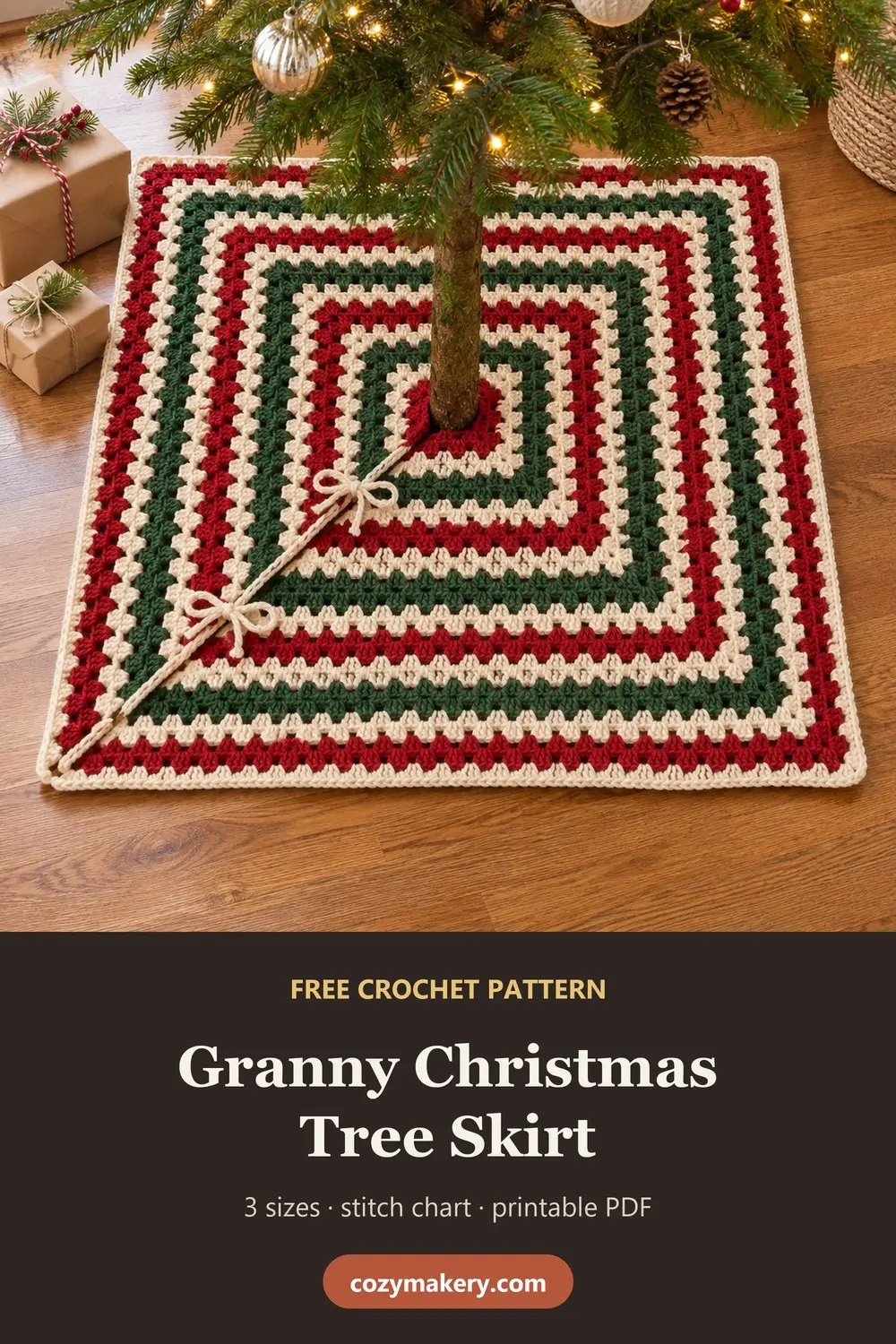
Save it for later
Pin the image below so the pattern is easy to find when you’re ready to start. If you make one, I’d love to see it under your tree: send a photo to info@cozymakery.com.
More festive makes: the Christmas ripple blanket, the crochet Christmas hat for the whole family, the crochet Christmas stocking and the star garland. Browse everything in Christmas Crafts.