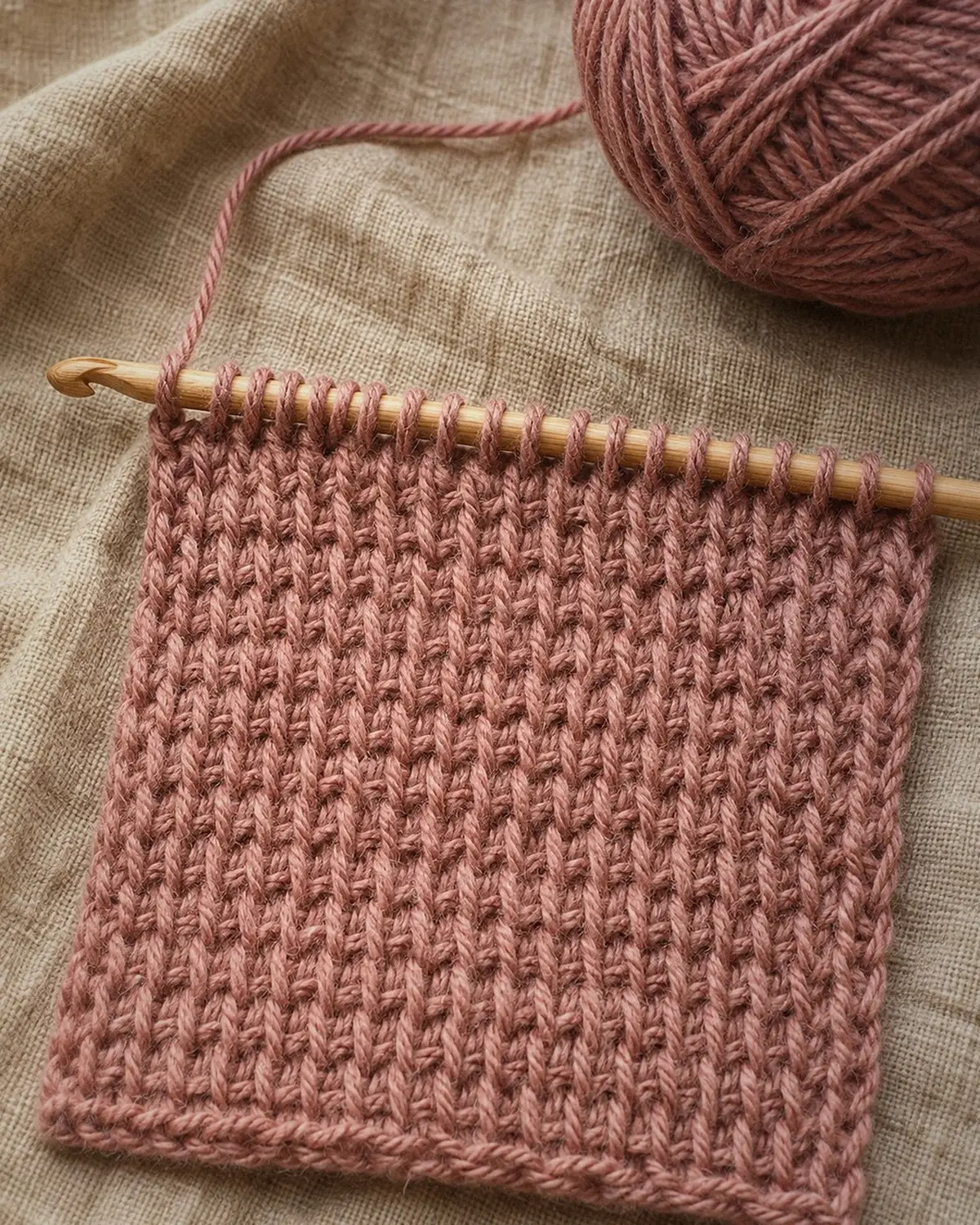
Tunisian crochet sits halfway between knitting and crochet. You work with a hook, but like knitting you keep a whole row of loops on it, then work them off again on the way back. The fabric is dense, firm and looks woven, which is why it’s loved for bags, pot holders and cushions. This tutorial teaches the Tunisian simple stitch (TSS): the forward pass, the return pass, neat edges and how to stop it curling, with a practice project you can finish in an evening: a stuffed pincushion made of 2 small squares.
In this post
Pattern at a glance
- Skill levelBeginner
- PracticePincushion, 2 sizes
- YarnWorsted (#4)
- Hook5.5 mm (US I-9), straight shaft
- Gauge16 sts × 14 rows = 4 in (10 cm)
- TimeAbout 1–2 hours
Free printable pattern
The PDF has the TSS steps, the fabric diagram, the size table and both pincushion sizes row by row. The Tunisian Crochet PDF has 5 pages and prints on US Letter paper; on A4, choose “Fit to page” in the print dialog.
What you need for Tunisian crochet
- A hook with a straight shaft long enough to hold all your loops. For small pieces like the pincushion, a normal 5.5 mm hook with no thumb rest is enough; for wider pieces use a Tunisian (afghan) hook or one with a cable.
- A hook 1–2 sizes bigger than for normal crochet: Tunisian fabric is dense, and a bigger hook keeps it soft.
- Smooth worsted yarn in a light colour, so you can see the vertical bars.
How to do the Tunisian simple stitch
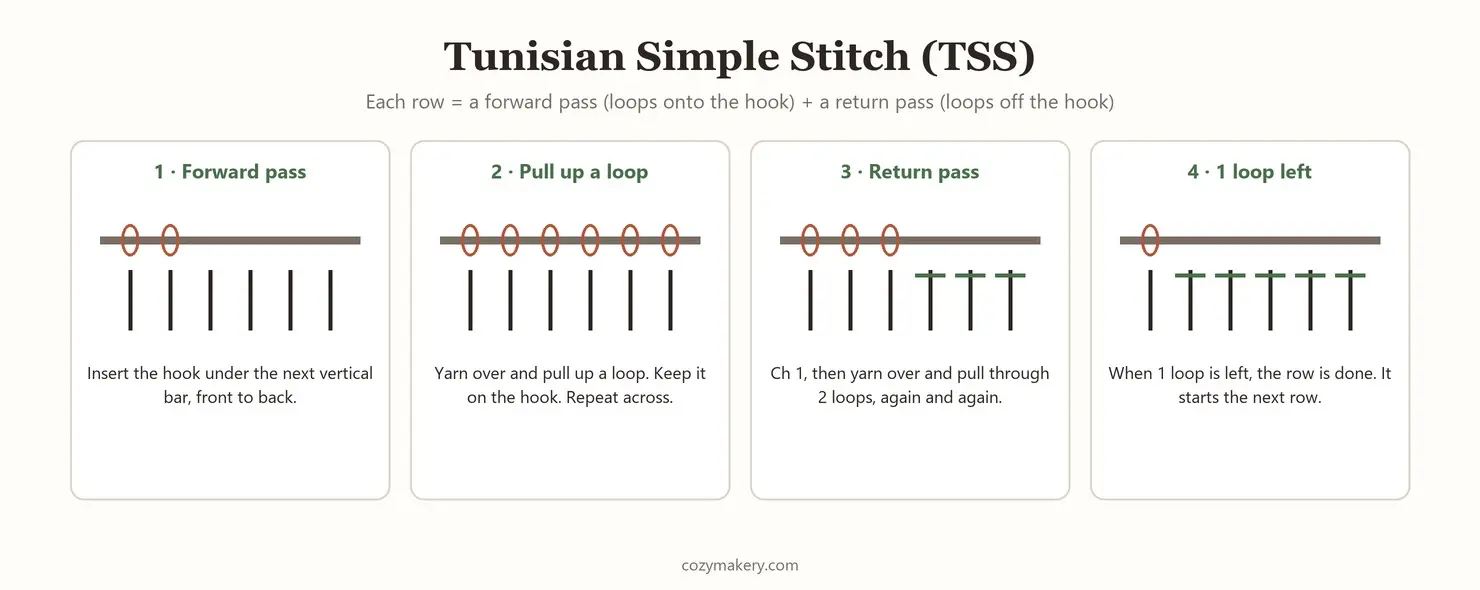
Every row has 2 halves and you never turn the work. The forward pass picks up loops from right to left and keeps them on the hook; the return pass works them off again from left to right.
- Forward pass: Skip the first vertical bar. Insert the hook from right to left under the next vertical bar, front to back.
- Pull up a loop: Yarn over and pull up a loop. Leave it on the hook. Repeat in each bar across.
- Return pass: Ch 1 (yarn over, pull through 1 loop), then *yarn over and pull through 2 loops*; repeat.
- 1 loop left: When 1 loop is left on the hook, the row is done. That loop is the first stitch of the next row.
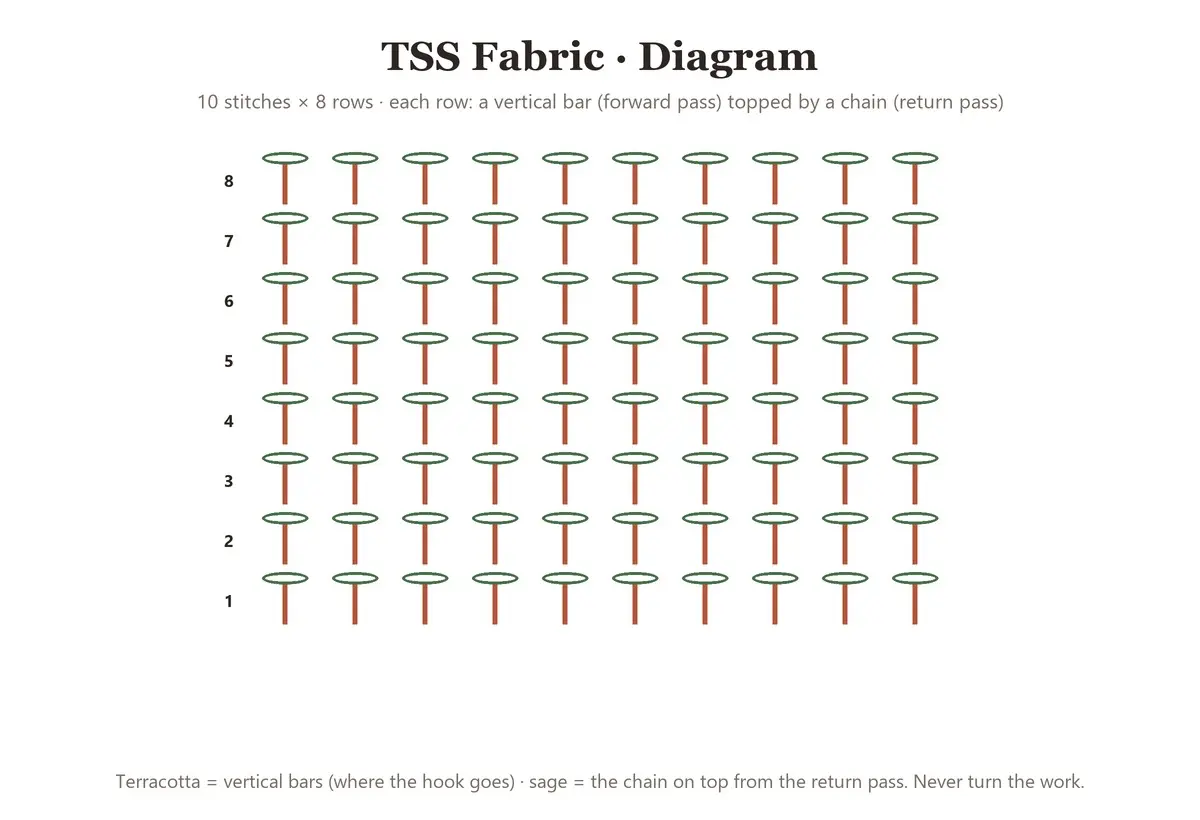
The vertical bars are the ‘stitches’ of Tunisian crochet: each forward pass makes a new row of them, and the return pass ties them together with a little chain along the top.
Neat edges and no curling
- Last stitch: on every forward pass, put the hook under both strands of the last edge stitch, not just the front bar. It gives a firm, straight left edge.
- Count the loops at the end of each forward pass. If you have 1 too few, you’ve skipped the last stitch; 1 too many, you worked into the first bar.
- Curling is normal in TSS. A bigger hook, a loose return pass and a single crochet edging all help; a pincushion, being stuffed, doesn’t mind at all.
- Keep the return pass relaxed: if it’s tight, the fabric gets short and stiff.
Practice project: Tunisian pincushion
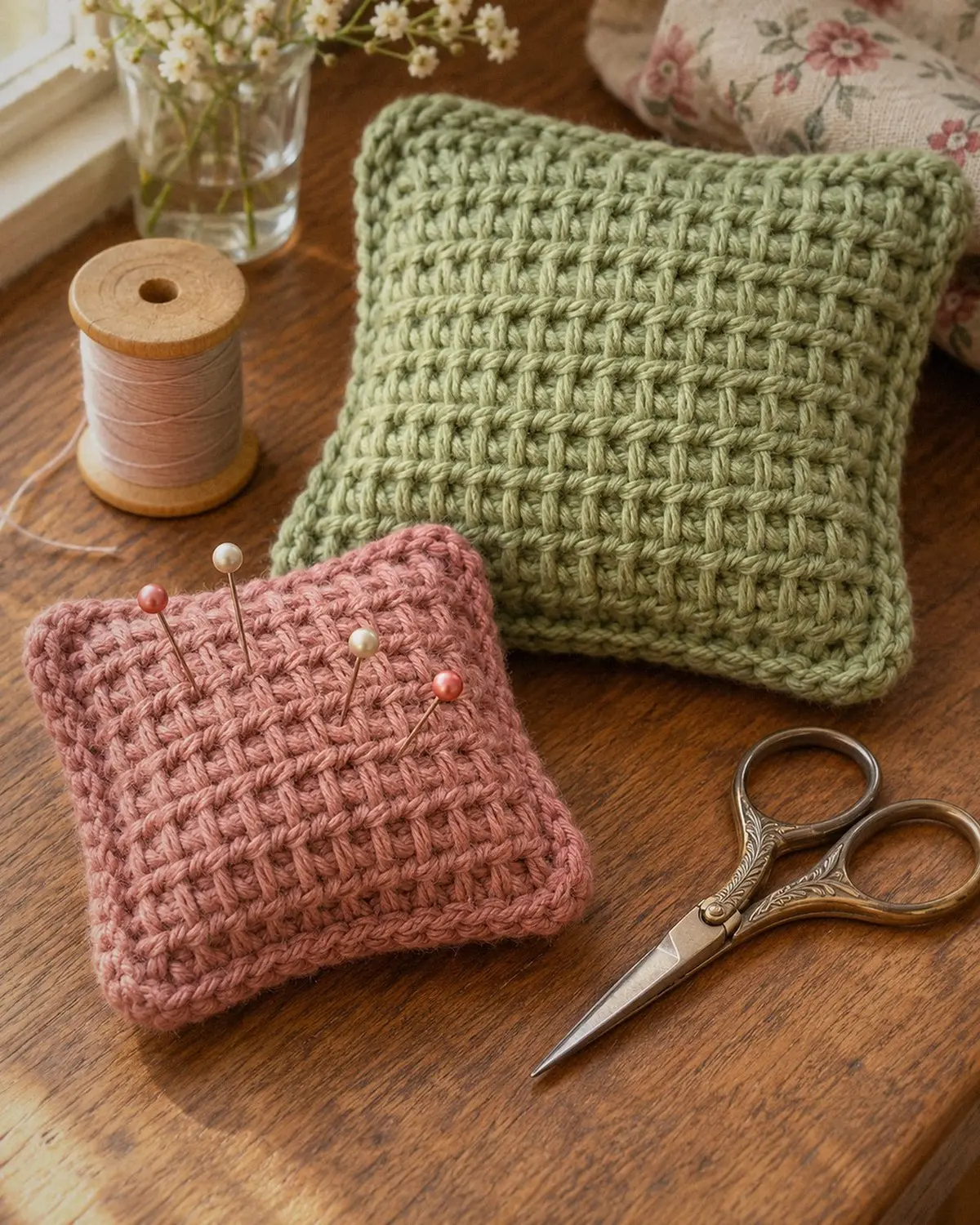
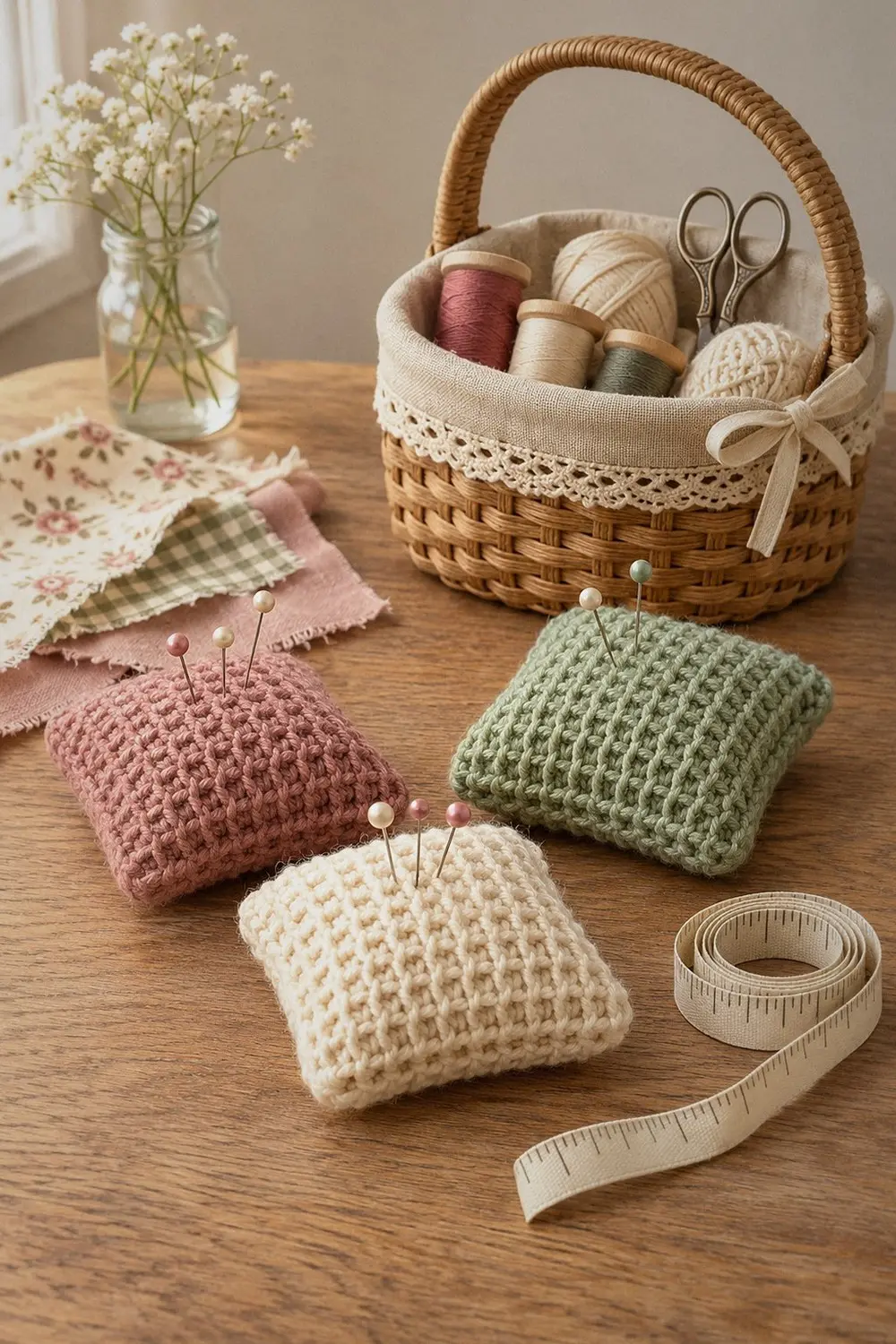
2 small TSS squares, held together and joined with a single crochet edging all round, stuffed firmly before you close the last side. It’s small enough to learn the stitch without a long hook, and dense TSS is exactly what a pincushion needs: the stuffing never shows through.
You'll need
- Worsted (#4) yarn: 50 yd (small) or 80 yd (large)
- 5.5 mm (US I-9) hook with a straight shaft, tapestry needle
- Stuffing: polyester fibrefill, or wool roving or crushed walnut shells, which keep pins sharp
Gauge: 16 sts and 14 rows = 4 in (10 cm) in TSS. This is a typical worsted value, not one we measured on a particular yarn; for a pincushion it only changes the size a little.
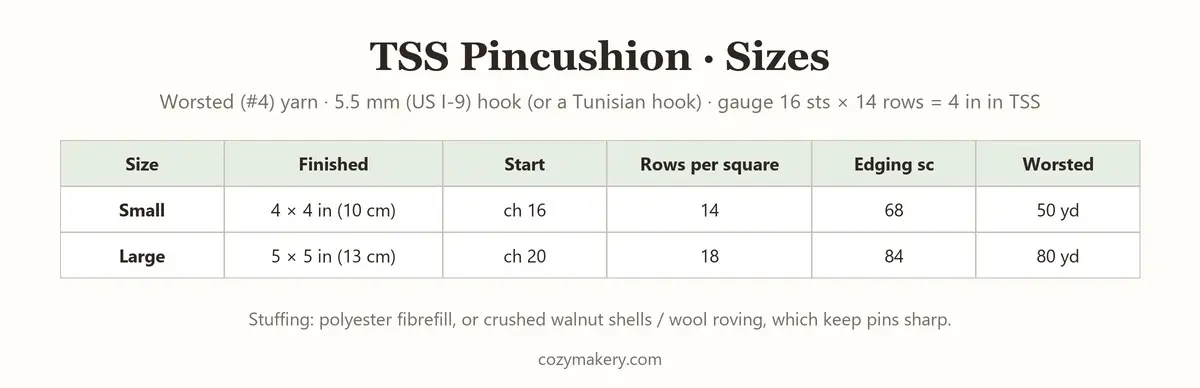
Pincushion, Small (4 in (10 cm) square)
- Foundation: Ch 16. (16)
- Row 1 forward: Insert the hook in the 2nd ch from the hook, yarn over, pull up a loop; repeat in each ch across. You have 16 loops on the hook. (16)
- Row 1 return: Ch 1, then *yarn over, pull through 2 loops; repeat from * until 1 loop is left. (1)
- Rows 2–14 forward: Skip the first vertical bar; *insert the hook under the next vertical bar from front to back, yarn over, pull up a loop*; repeat across. For a neat edge, work the last st under both strands of the edge stitch. 16 loops. (16)
- Rows 2–14 return: As row 1 return. (1)
- Bind off: Sl st under each vertical bar across. Fasten off. Make a second square the same. (0)
- Join: Hold the squares together, wrong sides in. Sc through both layers all round: 1 sc per stitch or row, 3 sc in each corner (68 sc). Stuff firmly before closing the last side. (68)
Large (5 in (13 cm) square): ch 20, work 18 rows per square and 84 sc in the edging.
We modelled every pass of both sizes: after each forward pass there are exactly as many loops on the hook as stitches in the row, and after each return pass exactly 1. The edging count is 1 sc per stitch or row plus 3 in each corner. Stitches, rows and yarn come from the gauge. For the edging, our weaving in ends guide helps hide the tails, and more small makes are in small crochet projects.
Frequently asked questions
Is Tunisian crochet knitting or crochet?
Crochet: you use a hook and the stitches are made with yarn overs. But like knitting, you hold a row of loops at once.
Do I need a special Tunisian hook?
Not for small pieces. A straight-shafted hook works for up to about 20 stitches; wider pieces need a long or cabled Tunisian hook.
Why is my Tunisian crochet curling?
TSS naturally curls towards the front. Use a bigger hook, keep the return pass loose, and add an edging or block it.
Do you turn the work in Tunisian crochet?
No. The right side always faces you: forward pass to the left, return pass back to the right.
How many pages is the Tunisian Crochet PDF?
5 pages on US Letter, with the steps, the diagram and both pincushion sizes. On A4, print with “Fit to page”.
What else can I make with TSS?
Pot holders, washcloths, cushion covers and bags: anything that likes a firm fabric.
Save it for later
Pin the photo below to keep the Tunisian pincushion on your Pinterest board. Made the Tunisian pincushion? I’d love to see it: send a photo to info@cozymakery.com.
More crochet stitches: moss stitch, shell stitch and crochet patterns for beginners.