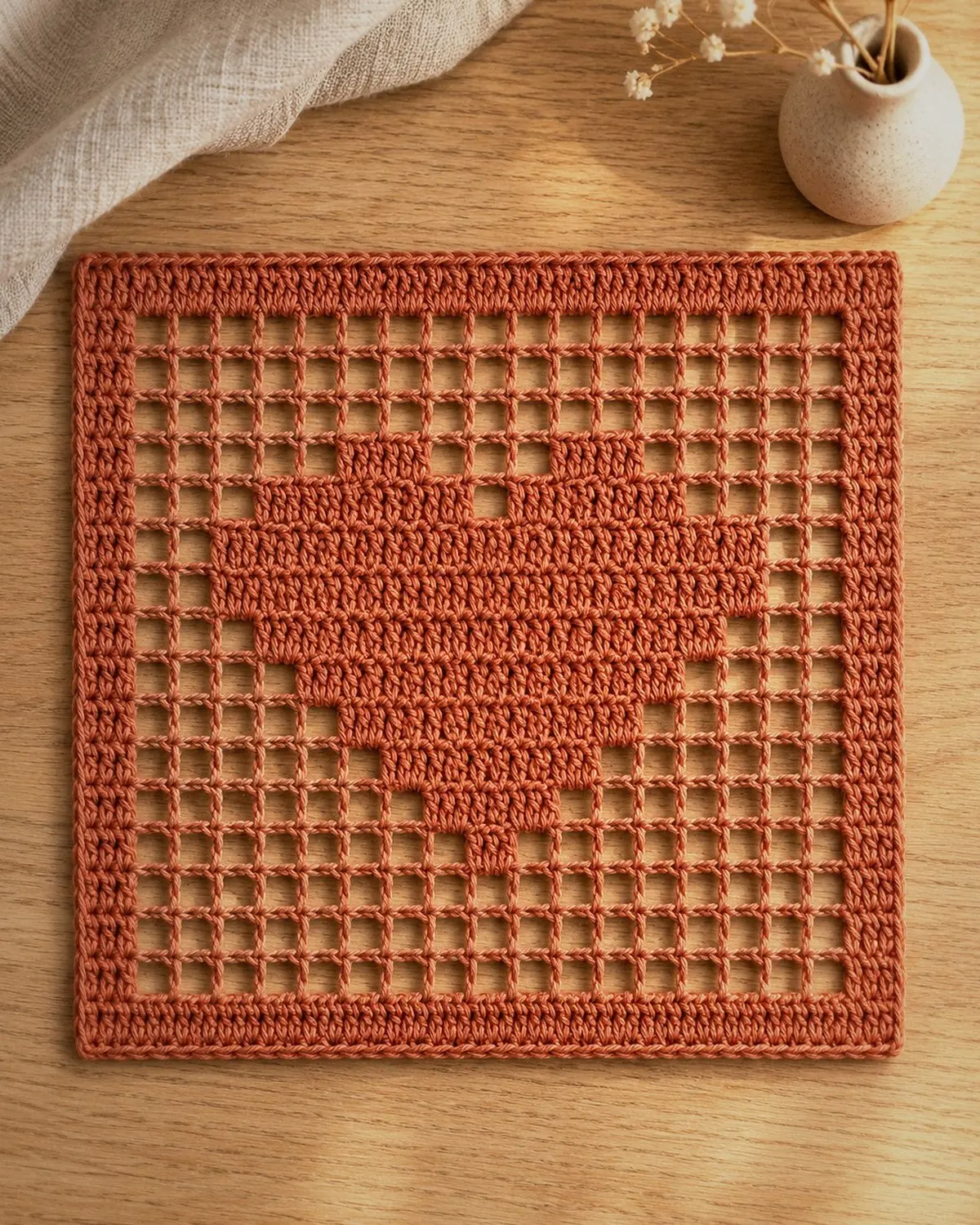
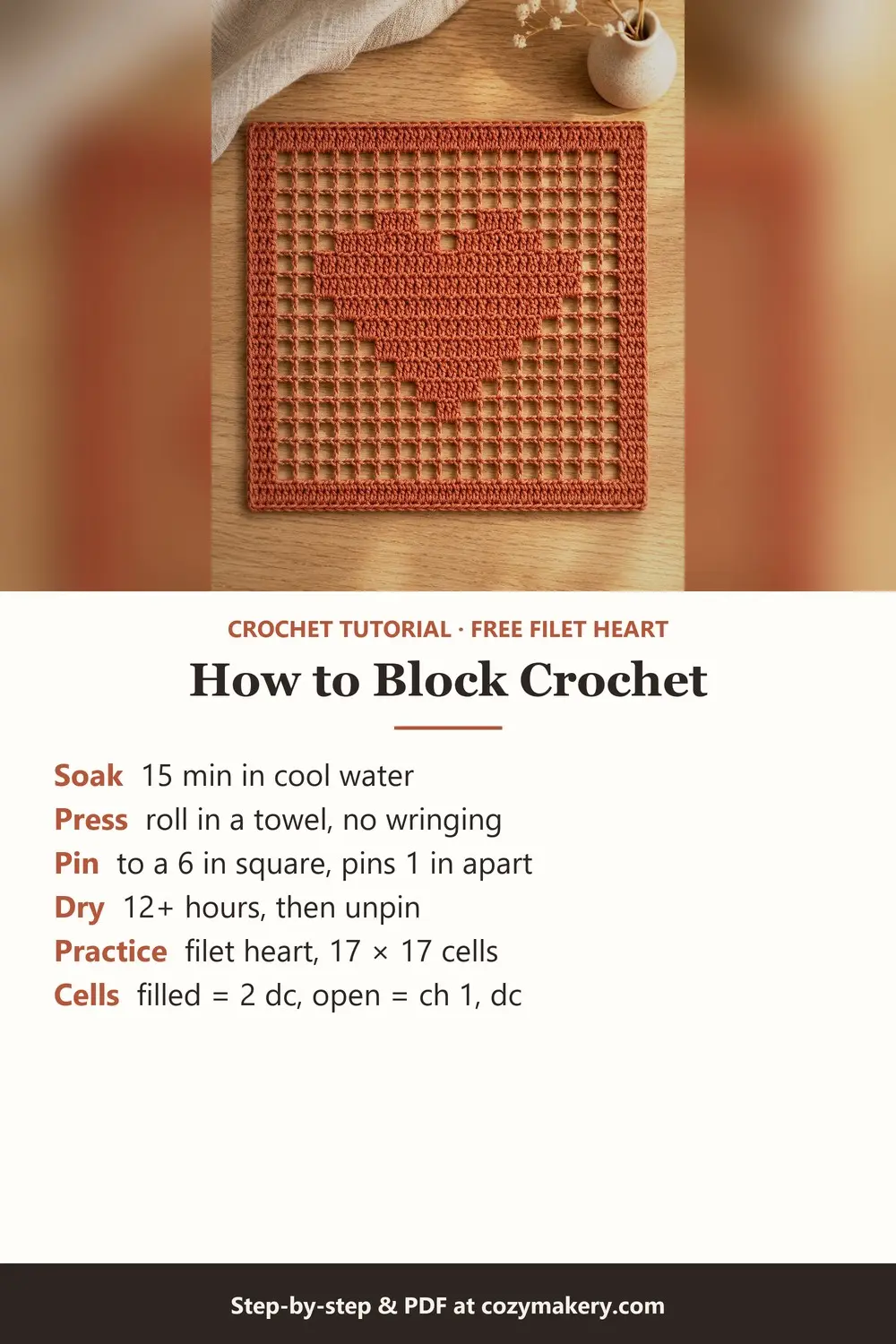
Blocking is the step that turns a lumpy, curling piece of crochet into something that looks finished. You wet (or steam) the work, pin it to the right shape and let it dry, and the stitches relax into place. This guide shows how to block crochet three ways (wet, spray and steam), which method suits which fibre, and gives you a quick lacy practice piece where you can really see the difference: a filet crochet heart square.
In this post
Pattern at a glance
- Skill levelEasy+
- Practice pieceFilet square, 6 × 6 in blocked
- YarnSport cotton, 43 yd
- Hook3 mm (US C/D)
- You needMat, pins, spray bottle
- Time2 hours + drying
Free printable pattern
The PDF has the blocking steps, all three methods, the filet chart and every row of the heart square written out.
The How to Block Crochet PDF has 4 pages and prints on US Letter paper; on A4, choose “Fit to page” in the print dialog.
Why block crochet?
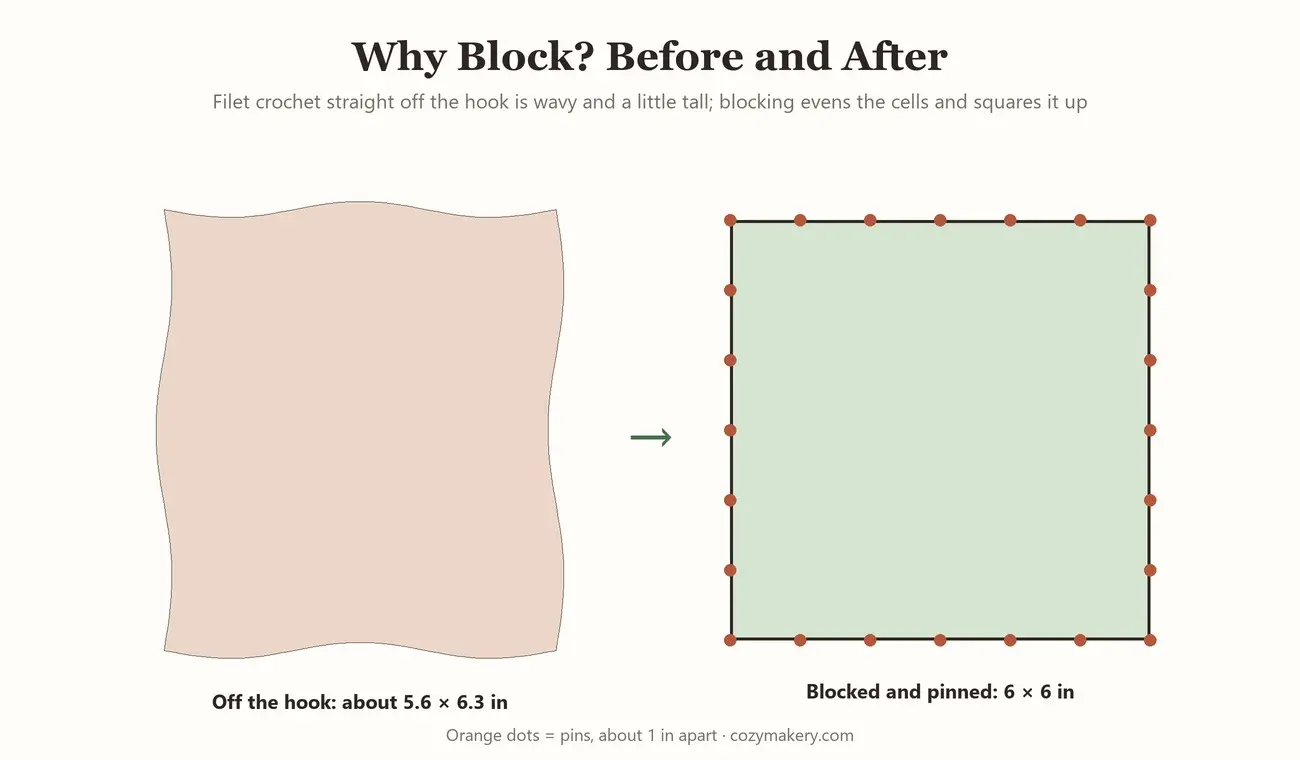
- Evens out the stitches and opens up lace and mesh.
- Squares up granny squares so they are easy to join.
- Flattens curling edges and gives garments their final size.
- On this practice square it stretches the width about 7.1% and eases the height about 4.8%: from 5.6 × 6.3 in to a true 6 in (15 cm) square.
What you need
- A blocking mat (or a folded towel on a bed or carpet)
- Rust-proof pins or blocking wires
- A spray bottle, a basin of cool water, a towel
- A tape measure
How to wet block, step by step
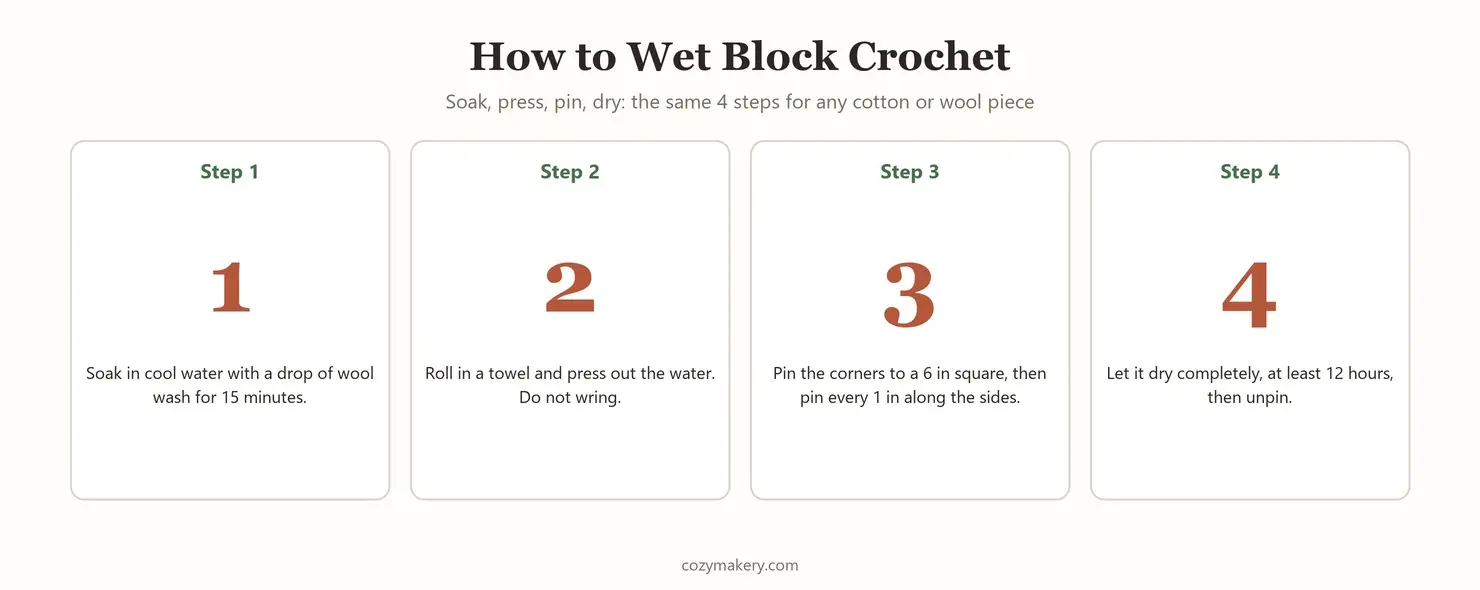
- Step 1: Soak in cool water with a drop of wool wash for 15 minutes.
- Step 2: Roll in a towel and press out the water. Do not wring.
- Step 3: Pin the corners to a 6 in (15 cm) square, then pin every 1 in along the sides.
- Step 4: Let it dry completely, at least 12 hours, then unpin.
Wet, spray or steam: which method?
- Wet blocking (cotton, wool): Soak the piece in cool water for 15 minutes, press the water out in a towel (don't wring), pin it to size and let it dry completely.
- Spray blocking (any fibre): Pin the dry piece to size on a blocking mat, spray it until damp all over and let it dry.
- Steam blocking (cotton, wool; acrylic with care): Pin it to size and hover a steam iron 1 in above the work; never press the iron down. Let it cool and dry before unpinning. On acrylic, light steam only: too much 'kills' the yarn and makes it limp.
| Fibre | Best method | Note |
|---|---|---|
| Cotton | Wet or steam | Can be pinned hard; holds the shape well |
| Wool | Wet or spray | Lace opens up beautifully |
| Acrylic | Spray, or light steam | Too much heat makes it limp for good |
| Blends | Spray | Safest choice for unknown fibres |
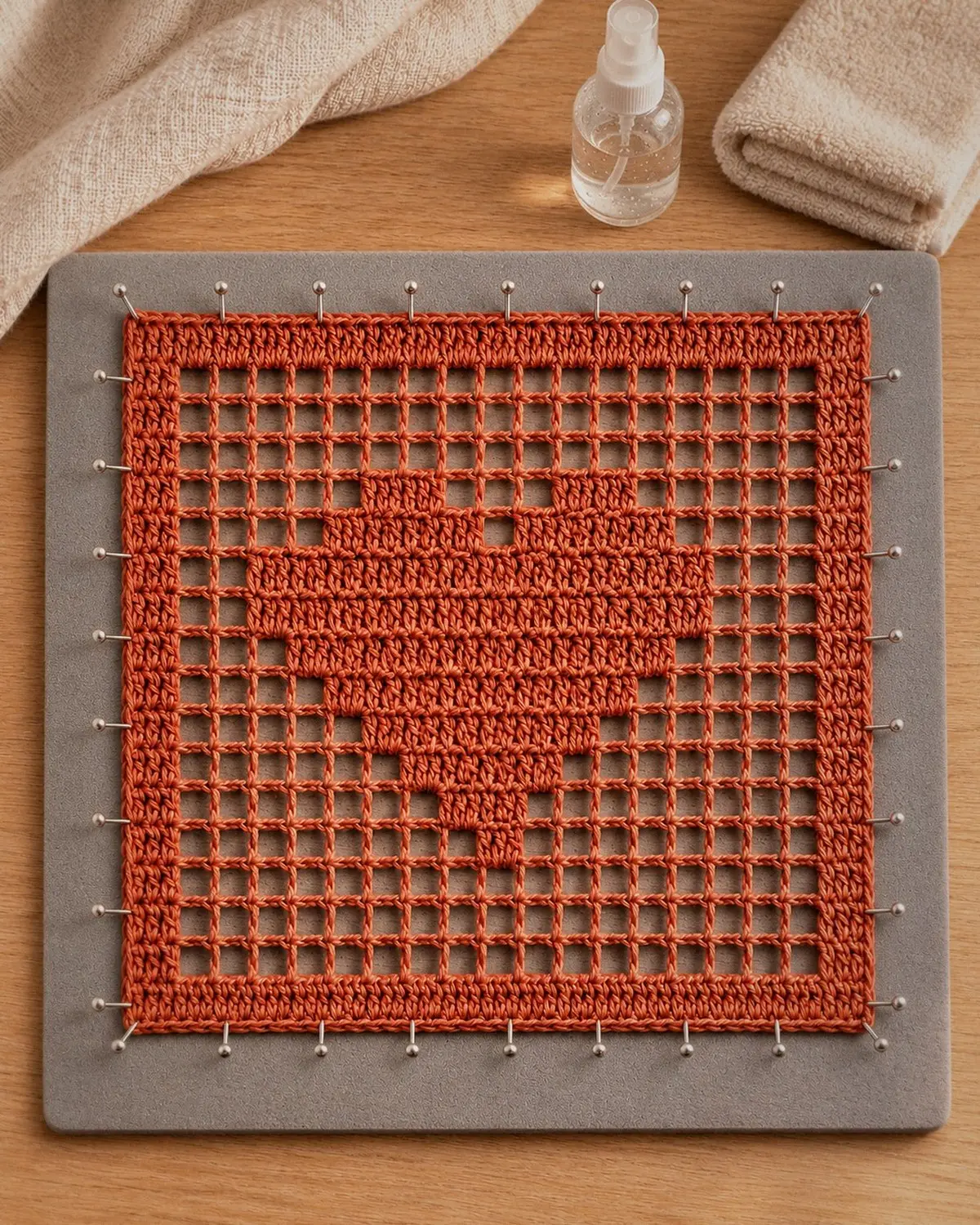
Practice pattern: filet crochet heart square
Materials
- Sport (#2) cotton, about 43 yd
- 3 mm (US C/D) hook and a tapestry needle
Abbreviations
| US | Meaning | UK |
|---|---|---|
| ch | chain | ch |
| dc | double crochet | tr |
| filled cell | 2 dc | 2 tr |
| open cell | ch 1, skip 1, dc | ch 1, skip 1, tr |
How the filet cells work
- Filled cell: Dc in the next 2 sts (over an open cell below, dc in the ch-1 space and in the next dc).
- Open cell: Ch 1, skip the next st, dc in the next dc.
Chart
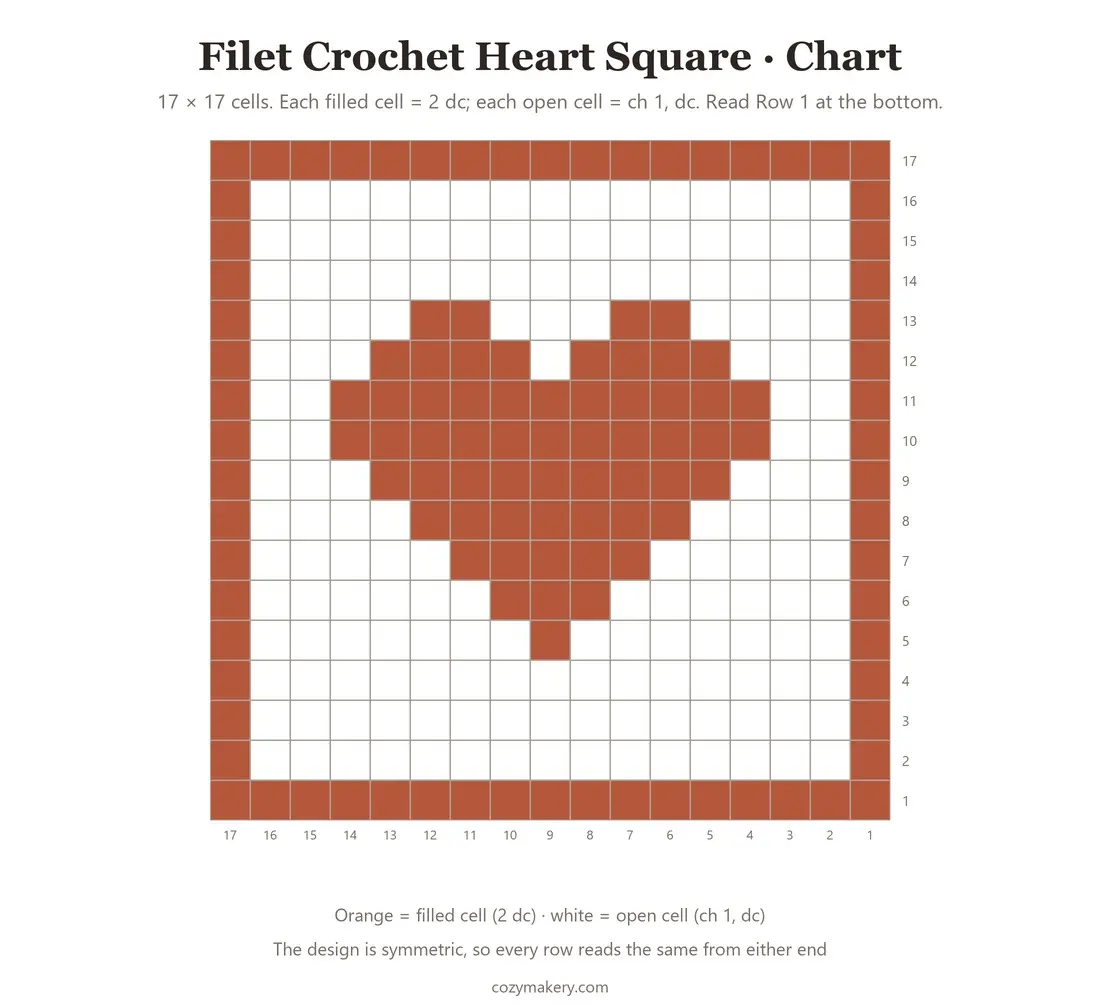
Heart square
- Chain: Ch 37.
- Row 1 (RS): Dc in the 4th ch from the hook (the skipped 3 ch count as the first dc) and in each ch across. Turn. (35 dc = 17 filled cells)
- Row 2: Ch 3 (counts as the first dc), then work the cells: 1 filled, 15 open, 1 filled. Turn. (35 sts)
- Row 3: Ch 3 (counts as the first dc), then work the cells: 1 filled, 15 open, 1 filled. Turn. (35 sts)
- Row 4: Ch 3 (counts as the first dc), then work the cells: 1 filled, 15 open, 1 filled. Turn. (35 sts)
- Row 5: Ch 3 (counts as the first dc), then work the cells: 1 filled, 7 open, 1 filled, 7 open, 1 filled. Turn. (35 sts)
- Row 6: Ch 3 (counts as the first dc), then work the cells: 1 filled, 6 open, 3 filled, 6 open, 1 filled. Turn. (35 sts)
- Row 7: Ch 3 (counts as the first dc), then work the cells: 1 filled, 5 open, 5 filled, 5 open, 1 filled. Turn. (35 sts)
- Row 8: Ch 3 (counts as the first dc), then work the cells: 1 filled, 4 open, 7 filled, 4 open, 1 filled. Turn. (35 sts)
- Row 9: Ch 3 (counts as the first dc), then work the cells: 1 filled, 3 open, 9 filled, 3 open, 1 filled. Turn. (35 sts)
- Row 10: Ch 3 (counts as the first dc), then work the cells: 1 filled, 2 open, 11 filled, 2 open, 1 filled. Turn. (35 sts)
- Row 11: Ch 3 (counts as the first dc), then work the cells: 1 filled, 2 open, 11 filled, 2 open, 1 filled. Turn. (35 sts)
- Row 12: Ch 3 (counts as the first dc), then work the cells: 1 filled, 3 open, 4 filled, 1 open, 4 filled, 3 open, 1 filled. Turn. (35 sts)
- Row 13: Ch 3 (counts as the first dc), then work the cells: 1 filled, 4 open, 2 filled, 3 open, 2 filled, 4 open, 1 filled. Turn. (35 sts)
- Row 14: Ch 3 (counts as the first dc), then work the cells: 1 filled, 15 open, 1 filled. Turn. (35 sts)
- Row 15: Ch 3 (counts as the first dc), then work the cells: 1 filled, 15 open, 1 filled. Turn. (35 sts)
- Row 16: Ch 3 (counts as the first dc), then work the cells: 1 filled, 15 open, 1 filled. Turn. (35 sts)
- Row 17: Ch 3, dc in each st and in each ch-1 space across. Fasten off. (35 sts)
Frequently asked questions
Do I need to block acrylic?
Usually only a light spray block. Steaming acrylic too much relaxes it permanently (it is called ‘killing’ the yarn), which is nice for drape but bad for shape.
Can I block without a mat?
Yes: pin into a folded towel on a bed or carpet, or onto a clean ironing board for small pieces.
Do I have to block again after washing?
Cotton and wool pieces may need a quick re-block after washing; lay them flat and pat them back into shape while damp.
Does gauge matter for the filet square?
Only a little: the filet square isn’t fitted, so a tighter or looser tension just makes it slightly smaller or bigger and changes the yarn amount. For the size in the pattern, make a 4 in (10 cm) swatch for the filet square with the 3 mm (US C/D) hook first and compare.
How many pages is the filet square PDF?
4 pages on US Letter paper, with every step of the filet square written out. On A4 paper, pick Fit to page when you print the filet square PDF so the charts aren’t cropped.
Save it for later
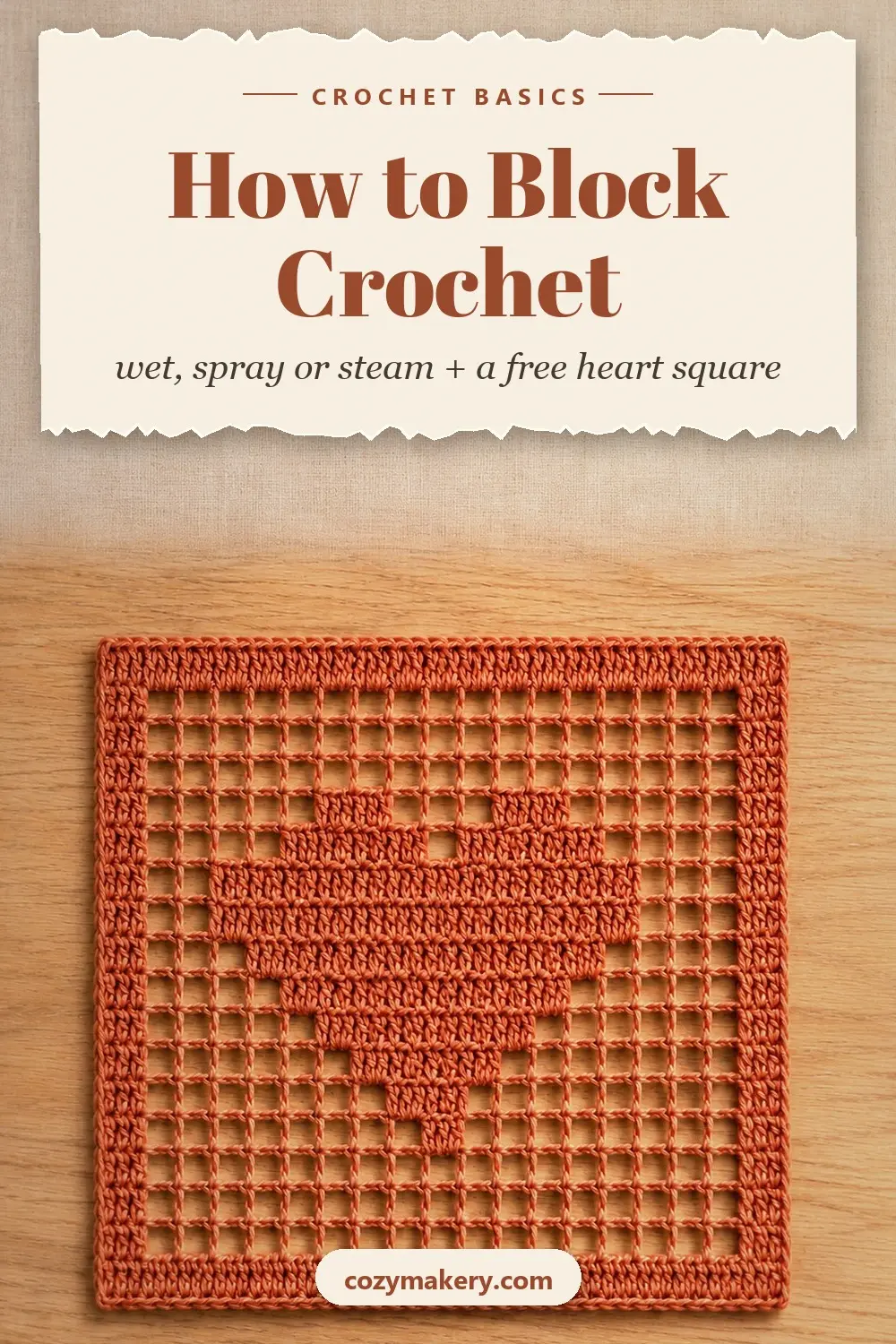
Pin the image below to keep the filet square pattern on your Pinterest board. Made the filet square? I’d love to see your version: send a photo to info@cozymakery.com.
More finishing skills: how to weave in ends, how to join granny squares and the 12 blanket borders.