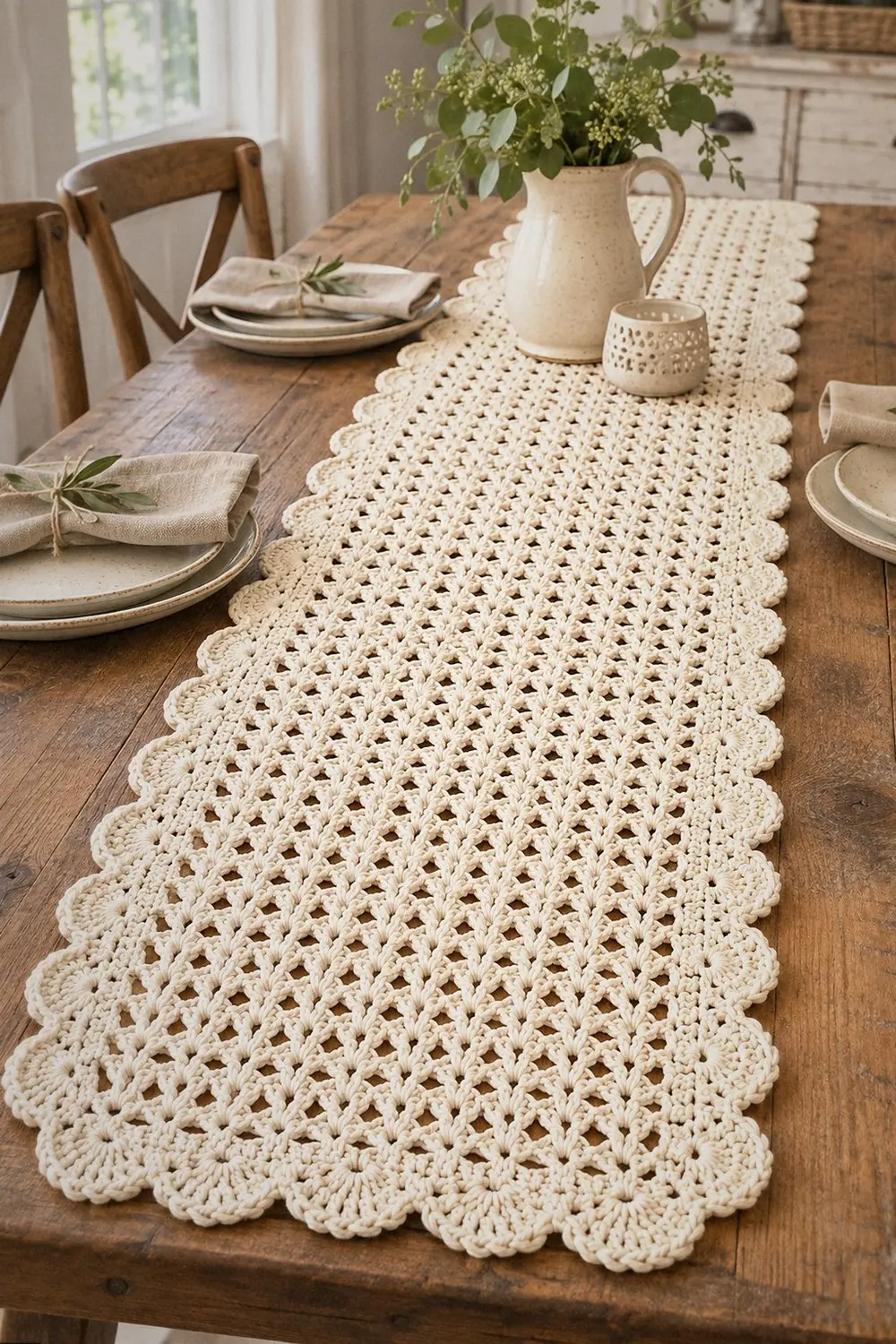
V-stitch crochet is 2 double crochets with a chain between them, worked into the same place so they open into a V. Row after row the V’s stack inside each other, and the fabric comes out light, open and quick to grow, with a lacy look that is still very easy to work. This tutorial covers the V-stitch, the foundation chain, how the rows fit, a shell edge, and a practice project: a V-stitch table runner in 2 lengths.
In this post
Pattern at a glance
- Skill levelBeginner
- PracticeTable runner, 2 sizes
- YarnWorsted (#4) cotton
- Hook5 mm (US H-8)
- Gauge5 V-stitches = 4 in (10 cm)
- TimeAbout 5 / 8 hours
Free printable pattern
The PDF has the V-stitch steps, the chart, the size table and both runners row by row. The V-Stitch Crochet PDF has 5 pages and prints on US Letter paper; on A4, choose “Fit to page” in the print dialog.
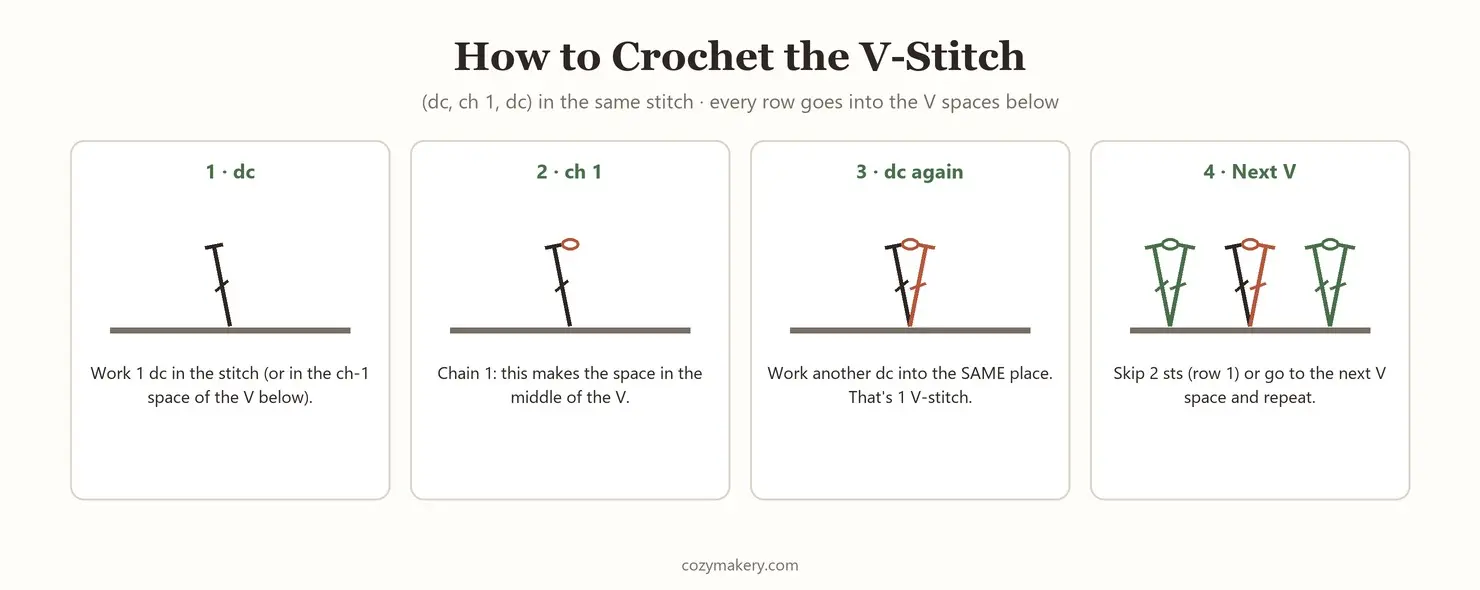
How to crochet the V-stitch
- dc: Work 1 double crochet into the stitch (in the first row) or into the ch-1 space in the middle of the V below.
- ch 1: Chain 1. This makes the little space at the centre of the V.
- dc again: Work another dc into the same place as the first. That's 1 V-stitch, written (dc, ch 1, dc).
- Next V: In the first row skip 2 chains; after that go straight to the next V space.
The foundation chain: 3 per V, plus 4
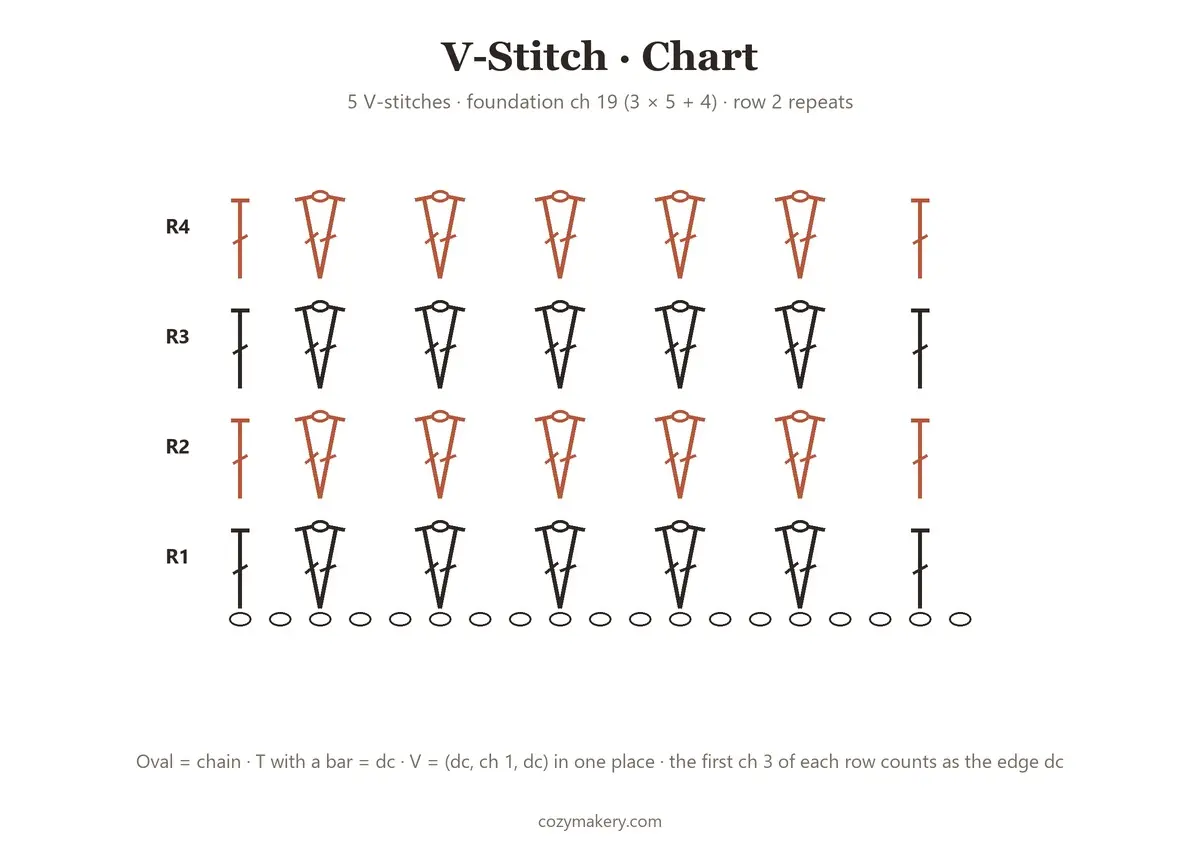
Each V takes 3 chains in the first row (the V’s own chain plus the 2 you skip), and the 2 edges take 4 more. So for 15 V’s you chain 3 × 15 + 4 = 49. We worked the first row through chain by chain in code, and this count uses every chain exactly once and ends on the last one.
How the rows fit together
From row 2 on, every V goes into the ch-1 space of the V right below it, so the V’s stack in straight columns. The chain 3 at the start of each row counts as the edge dc, and the last dc of each row goes into the top of the turning chain. With 1 V in each space and 1 dc at each edge, the count never changes.
Tips for neat V-stitch
- Into the space, not the stitch: from row 2, put the hook into the gap at the centre of the V, under the chain.
- Straight edges come from the edge dc: don’t forget the dc in the top of the turning chain at the end of each row.
- Too loose? V-stitch opens up a lot. Go down a hook size for a firmer runner or placemat.
- Block it. Pin it flat and mist it with water: the V’s line up and the shells open out.
Practice project: V-stitch table runner
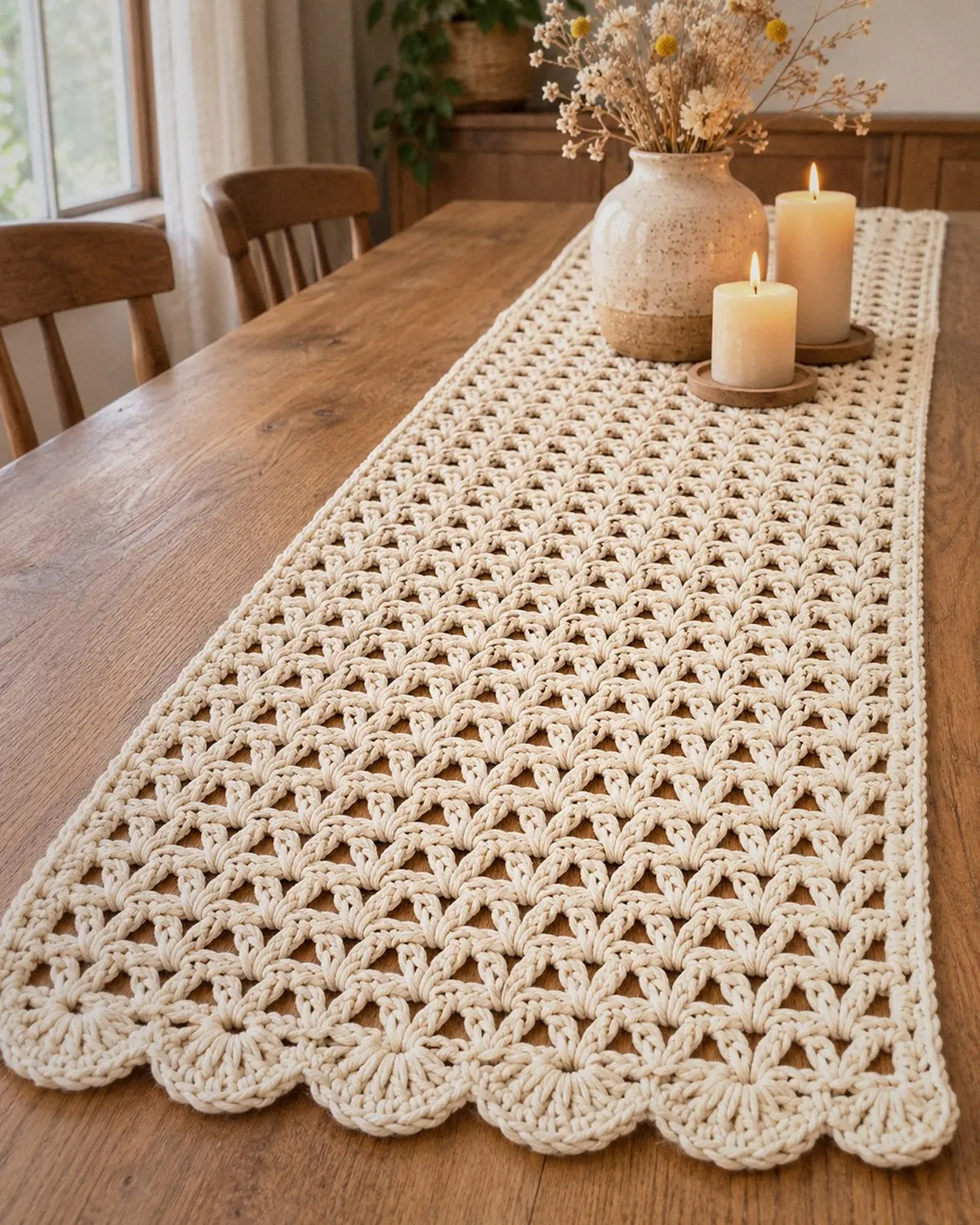
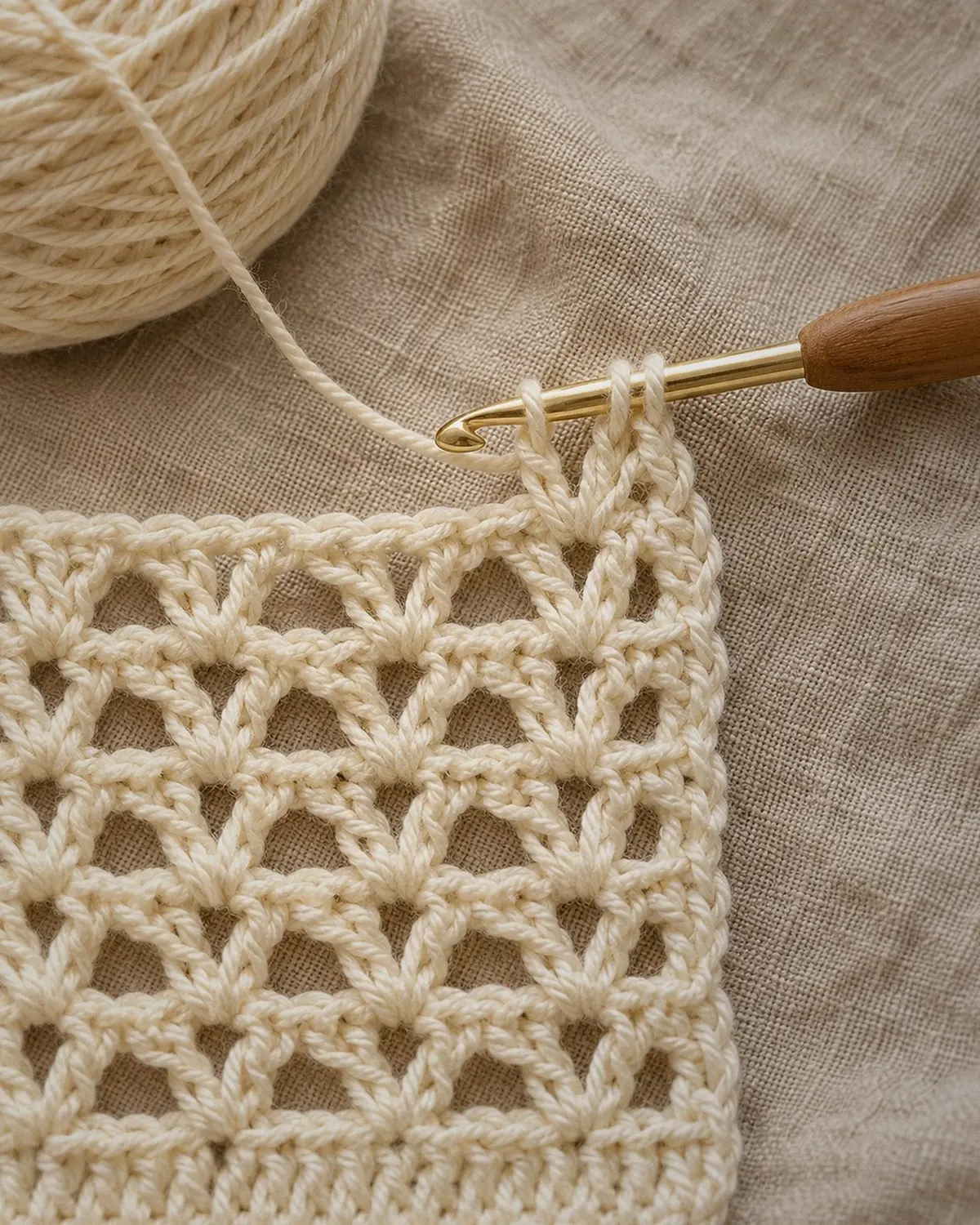
A table runner is the perfect first V-stitch project: a long rectangle, so all your attention goes to the stitch. Each short end gets a shell edge of 5 double crochets in every other V space, which turns the straight ends into scallops.
You'll need
- Worsted (#4) cotton: 260 yd (runner) or 430 yd (long runner)
- 5 mm (US H-8) hook, tapestry needle
Gauge: 5 V-stitches = 4 in (10 cm) and 1 row = 0.55 in. It’s a typical worsted cotton value, not one we measured on a particular yarn; if yours is wider or narrower, the runner just comes out a little different.
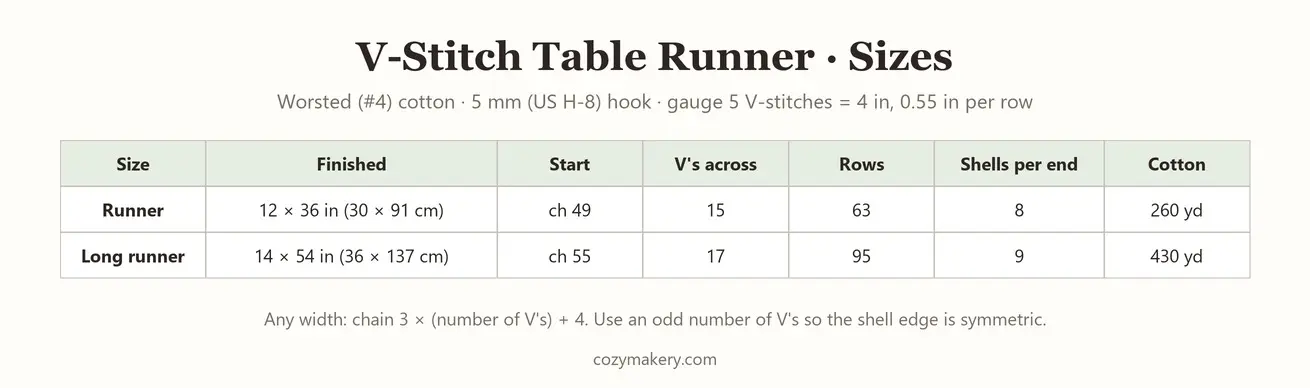
Table runner (12 × 36 in, 30 × 91 cm)
- Foundation: Ch 49.
- Row 1: (Dc, ch 1, dc) in 5th ch from hook (V-st made), *skip 2 ch, V-st in next ch; repeat from * to the last 2 ch, skip 1 ch, dc in last ch. Turn. (15 V)
- Row 2: Ch 3 (counts as dc), V-st in the ch-1 space of each V-st across, dc in the top of the turning ch. Turn. (15 V)
- Rows 3–63: Repeat row 2. The runner measures about 35 in (88 cm) before the edge. (15 V)
- Shell edge (both short ends): Ch 1, sc in the first dc, *5 dc in the next V space, sc in the next V space*; repeat, ending with 5 dc in the last V space and sc in the top of the turning ch. Fasten off. Join the yarn at the other short end and work the same along the foundation chain, putting each shell into the chain at the base of a V. (8 shells)
- Finish: Weave in the ends. Pin the runner flat, spray with water and leave it to dry.
Long runner (14 × 54 in, 36 × 137 cm): ch 55 for 17 V’s, work 95 rows, and 9 shells at each end.
We checked the pattern in code: the foundation uses exactly 3N + 4 chains, every row has the same number of V’s between 2 edge dc, each V sits in the V below, and the odd number of V’s makes the shell edge start and end with a shell. The V’s, rows and yarn come from the gauge. For other easy stitches, try moss stitch or browse our small crochet projects.
Frequently asked questions
What is a V-stitch in crochet?
(Dc, ch 1, dc) worked into the same stitch or space. The 2 dc lean apart and the chain sits between them.
How many chains do I need for V-stitch?
3 for each V, plus 4. For the runner’s 15 V’s that’s 49 chains.
Is V-stitch good for beginners?
Yes. It only uses chains and double crochet, and from row 2 you just work into the obvious V spaces.
Does V-stitch use a lot of yarn?
No: it’s an open stitch, so it uses less yarn than solid double crochet for the same size.
How many pages is the V-Stitch Crochet PDF?
5 pages on US Letter, with the chart and both runner sizes. On A4, print with “Fit to page”.
What else can I make with V-stitch?
Light scarves, shawls, market bags, summer tops and baby blankets.
Save it for later
Pin the photo below to keep the V-stitch table runner on your Pinterest board. Made the V-stitch table runner? I’d love to see it: send a photo to info@cozymakery.com.
More crochet: how to double crochet, shell stitch and how to weave in ends.