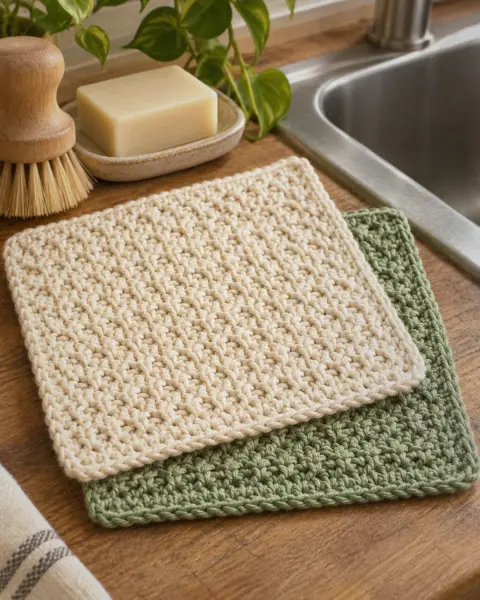
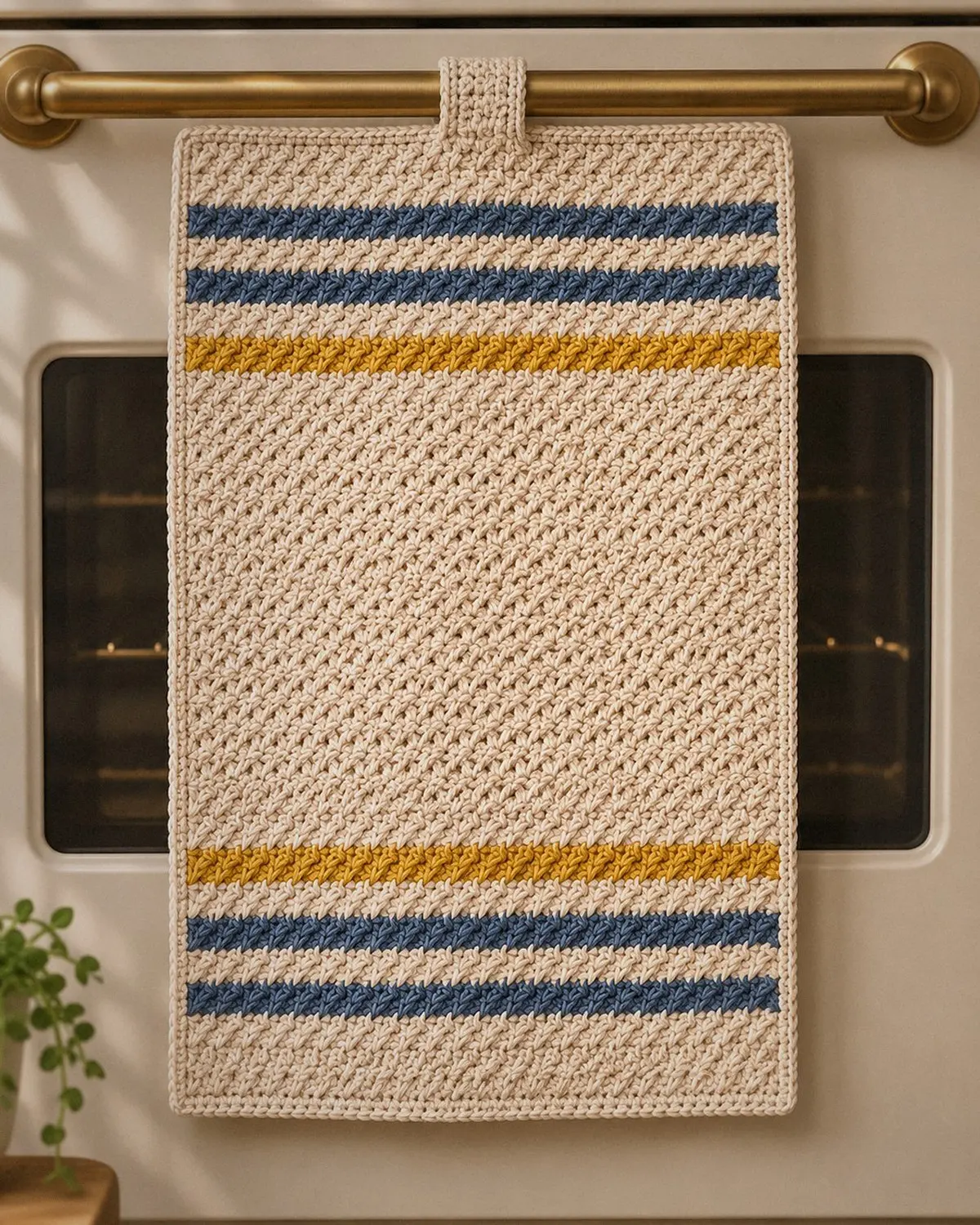
A kitchen towel made of plain single crochet looks tidy and then just pushes water around. Double crochet drinks better but it’s full of gaps. Sedge stitch crochet sits between the 2: every stitch group mixes a short, a medium and a tall stitch, so the fabric is bumpy, closed and thirsty, and the bumps give a cotton towel something to scrub with.
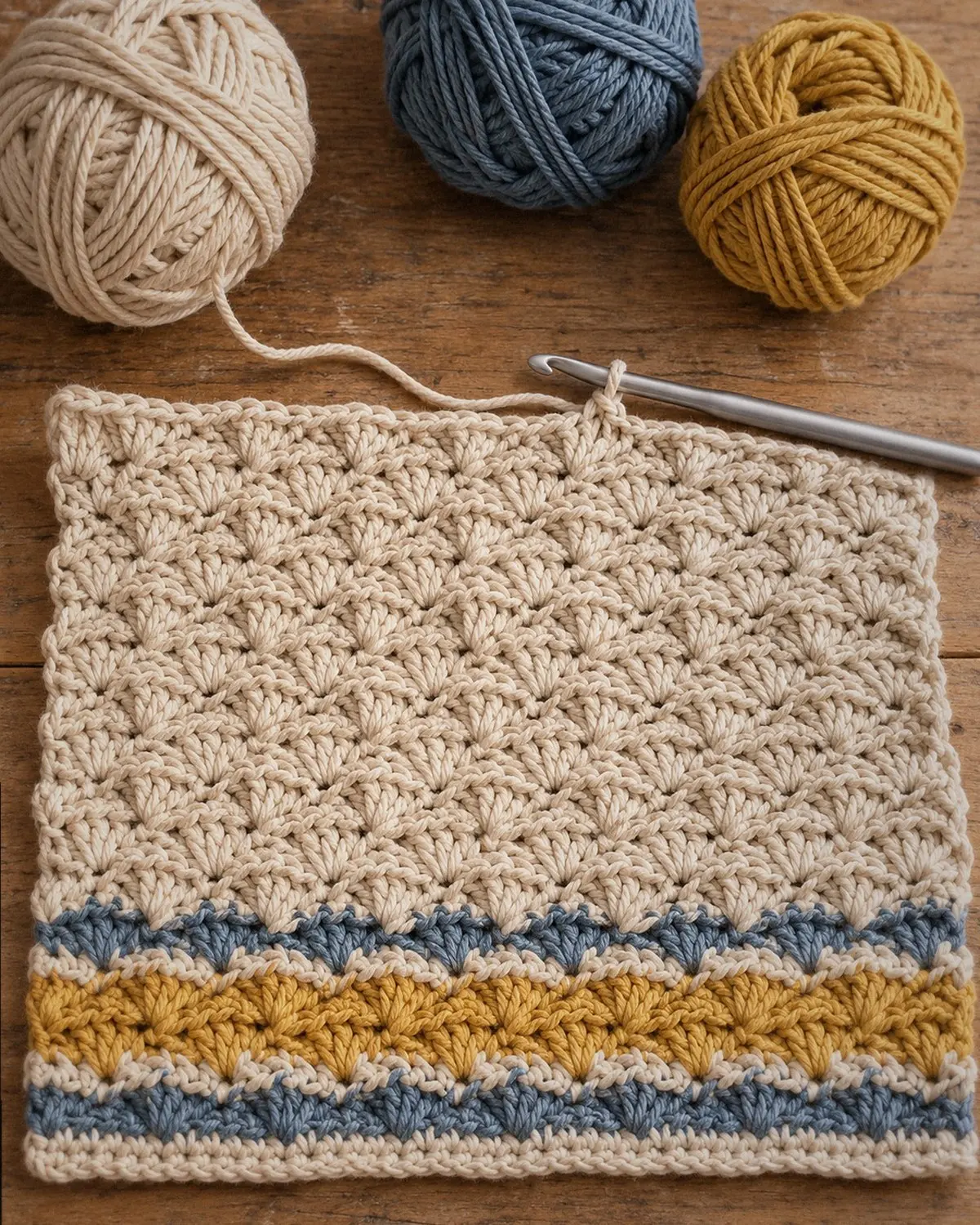
It’s an easy stitch to learn. You work a single crochet, a half double and a double into the same stitch, skip 2, and repeat. Each row looks like a line of little fans leaning the same way, and the next row tucks its fans into the dips. The name comes from that look: rows of short grassy tufts, like sedge in a wet field.
In this post
The short version
- Skill levelEasy
- PracticeKitchen towel, 2 sizes
- TimeAbout 6 / 10 hours
- YarnWorsted (#4) cotton, 3 colors
- Hook5 mm (US H-8)
- Gauge15 sts × 12 rows = 4 in (10 cm), assumed
- RepeatMultiple of 3 + 1 sts (ch a multiple of 3 + 2)
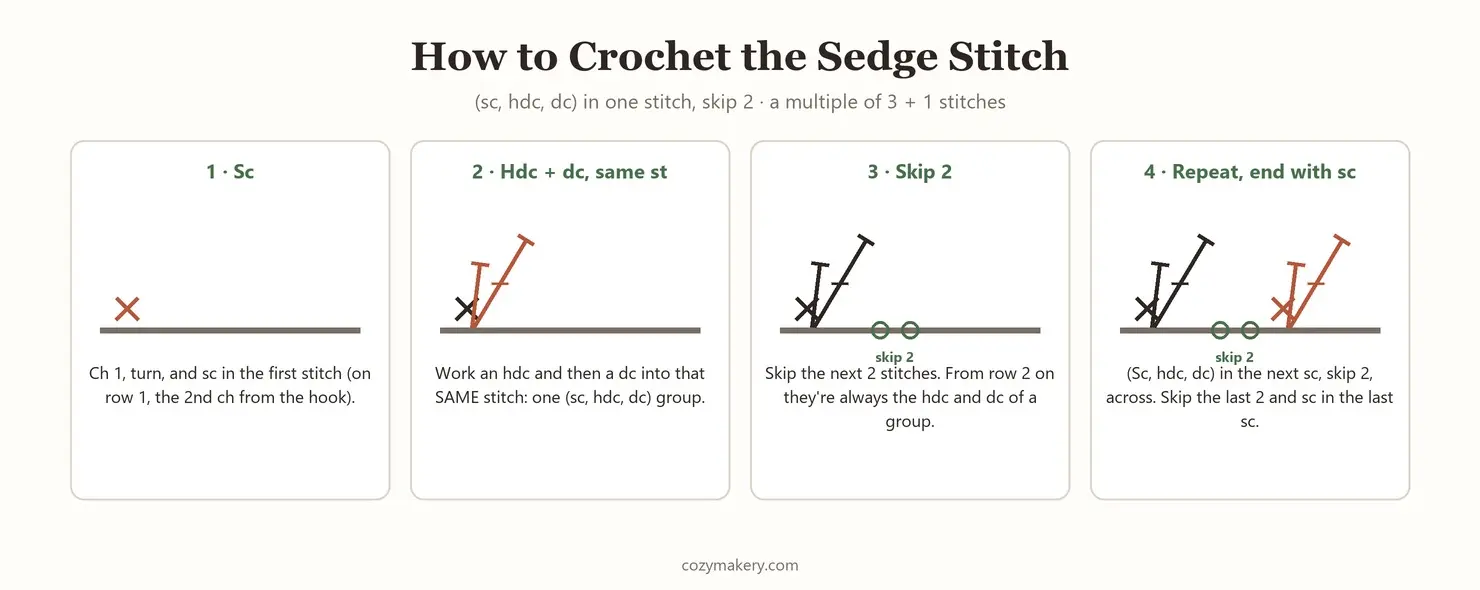
The sedge stitch in 4 moves
- Sc: Ch 1 and turn (on the first row, start in the 2nd chain from the hook). Work a single crochet in the first stitch.
- Hdc and dc in the same stitch: Without moving on, work a half double crochet and then a double crochet into that SAME stitch. That's 1 group.
- Skip 2: Skip the next 2 stitches. From row 2 on, those are always the hdc and dc of a group below.
- Repeat, then 1 sc: Work a group into the next stitch, which is always an sc. At the end, skip the last 2 stitches and sc in the last one.
Need a refresher on the 2 taller stitches? See half double crochet and double crochet.
Why the chain is a multiple of 3 + 2
Each group uses 3 stitches’ worth of width (itself plus the 2 you skip), and every row ends with a lone sc. So a row has a multiple of 3, plus 1 stitches. Add the chain you skip at the start of row 1 and the foundation is a multiple of 3, plus 2. For the hand towel that’s ch 47: 15 groups plus 1 sc gives 46 stitches.
If you chain the wrong number, you’ll find out at the end of row 1: you’ll either have 1 chain left over or not enough for the final skip 2 and sc. Chain a few extra and unpick them later, and place a marker every 30 chains.
How the rows stack
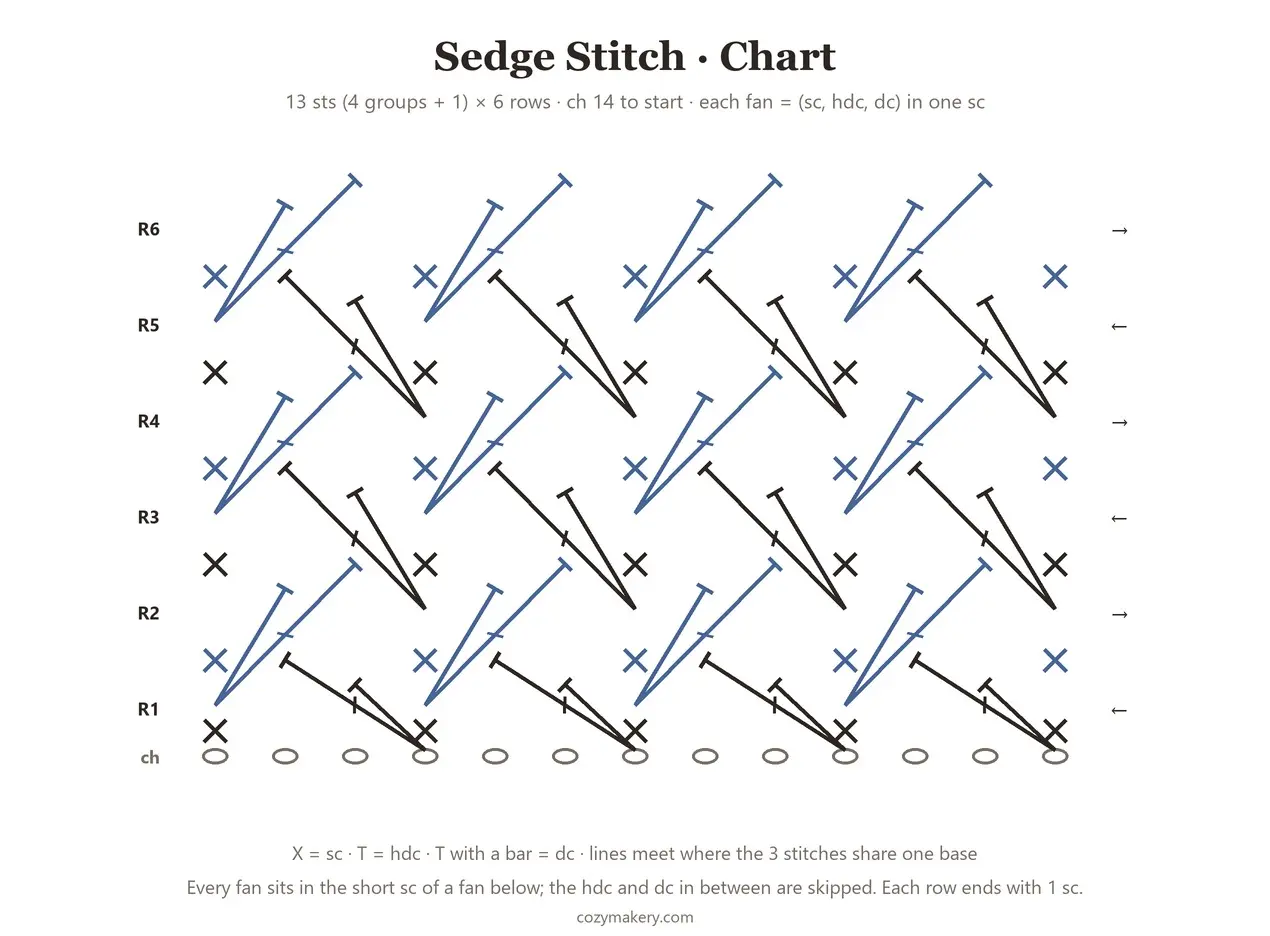
Turn the work and the last stitch you made, the lone sc, is now the first stitch. A group goes into it. Then you skip the dc and hdc of the group below and land in its sc. That’s the whole rhythm: groups always go into an sc, and the hdc and dc of the row below are always skipped. Because the sc is the shortest stitch in a group, each new fan sits down in a dip, which is what gives sedge its wavy texture.
Edges, counting and the usual slip-ups
- Count groups, not stitches. Each fan is 3 stitches; count fans and add the 1 sc at the end. The hand towel always has 15 fans.
- The towel gets wider. You worked a group into a dc or hdc instead of skipping it. Look for the sc: it’s the short stitch at the base of each fan.
- It gets narrower. Usually the last sc is missing, or the first group went into the 2nd stitch. The first group always goes in the very first stitch, right next to the ch 1.
- The edges look uneven. Both edge stitches are short sc’s in a row that’s mostly taller stitches, so the sides scallop slightly. Pull those edge sc’s up a little taller; the border straightens the rest.
Sedge, Suzette or lemon peel?
These 3 all work stitches of different heights into one base. Suzette stitch puts an sc and a dc in a stitch and skips 1, so it’s a little flatter and tighter. Lemon peel stitch alternates sc and dc across the row without skipping. Sedge has the biggest groups and the most texture, and it works up fastest of the 3 because a third of each row is double crochet. It also makes a lovely dishcloth or a blanket in a soft worsted.
Practice pattern: striped sedge stitch kitchen towel
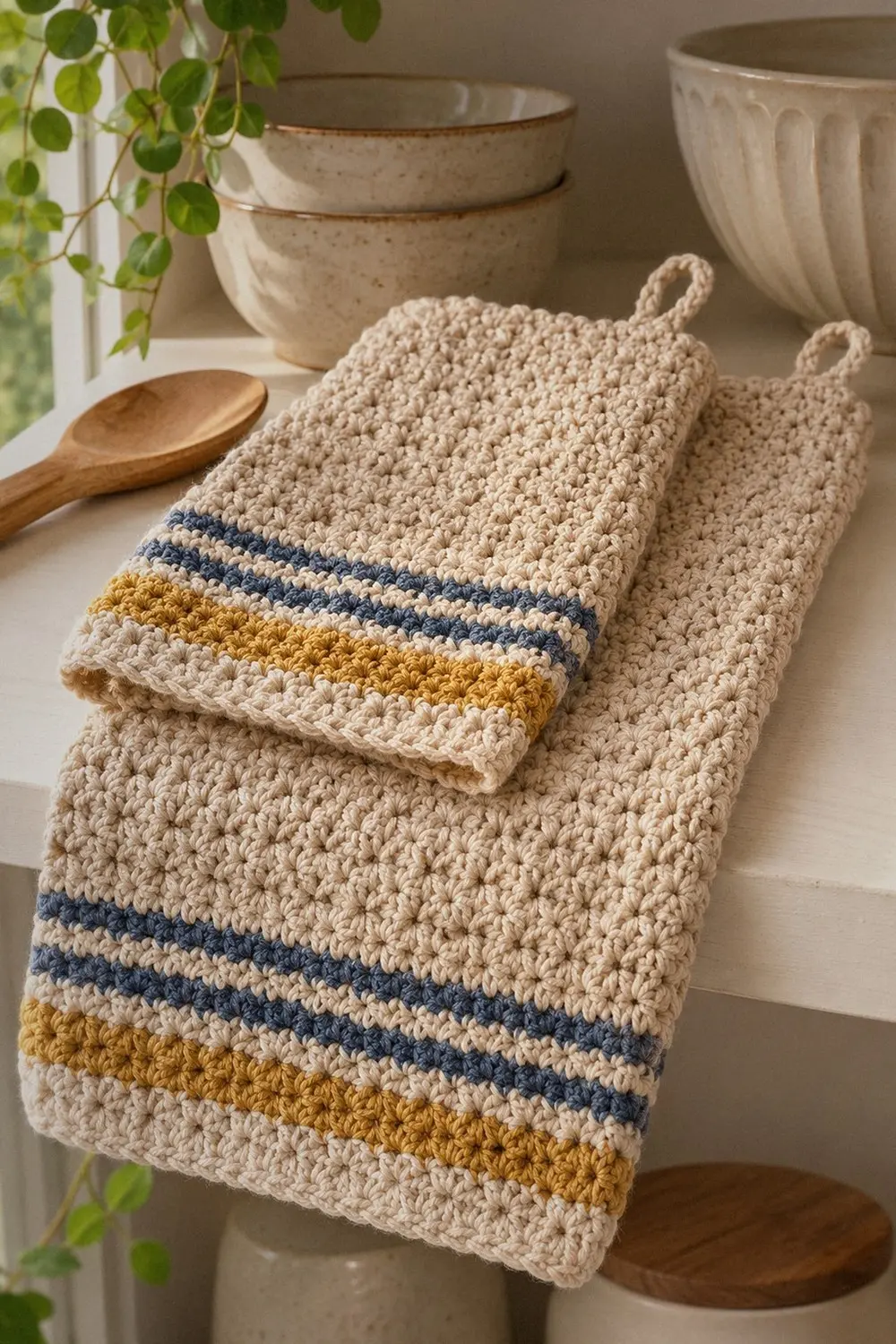
The towel is worked in rows from the bottom up in sedge stitch, mostly oatmeal, with stripe bands of denim and mustard near each end. I set every band to an even number of rows so each new color always starts from the same edge, and the top bands mirror the bottom ones. I chose worsted cotton because it’s absorbent and it stands up to hot washes.
Yarn, hook and gauge
- Worsted (#4) cotton, hand towel: 180 yd (yards) oatmeal, 35 yd denim, 20 yd mustard
- Tea towel: 325 yd oatmeal, 45 yd denim, 25 yd mustard
- 5 mm (US H-8) hook, tapestry needle, stitch markers
Gauge: 15 sts and 12 rows = 4 in (10 cm) in sedge stitch. That’s an assumed typical figure for worsted cotton, so swatch first: ch 20, work 14 rows and measure across the middle. More stitches per 4 in means a bigger hook.
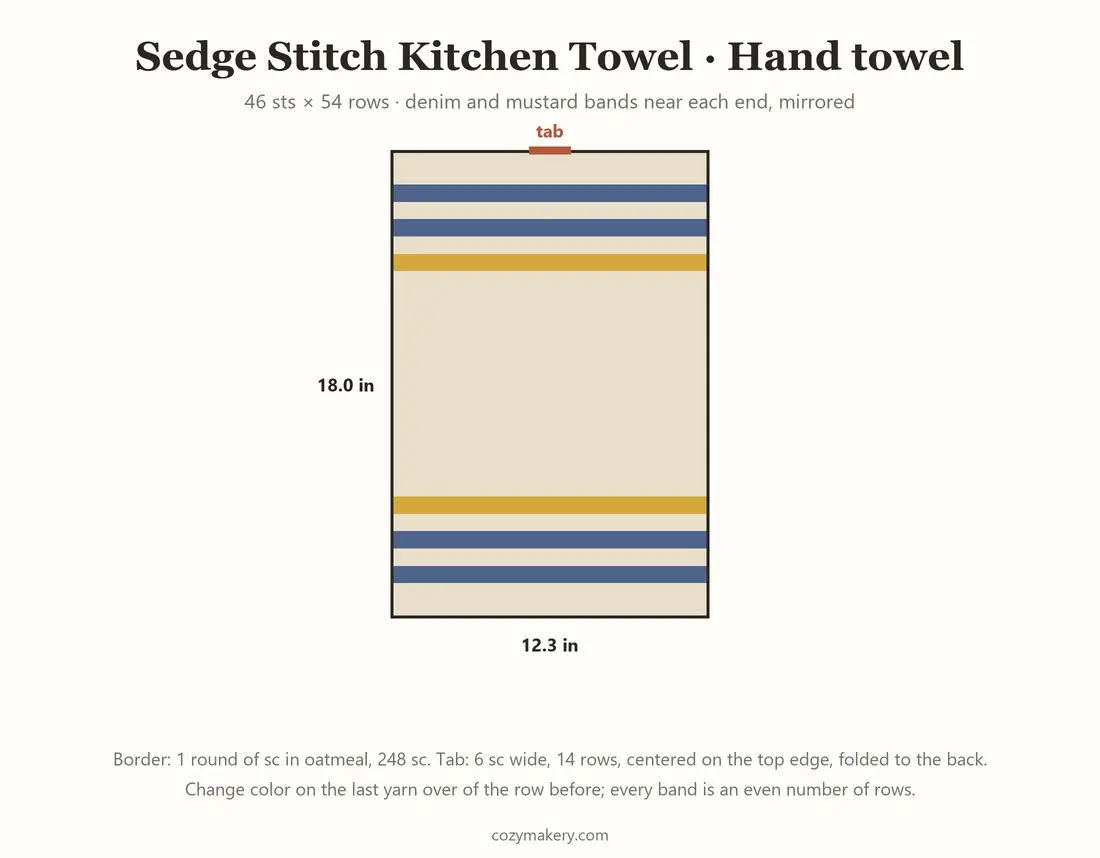
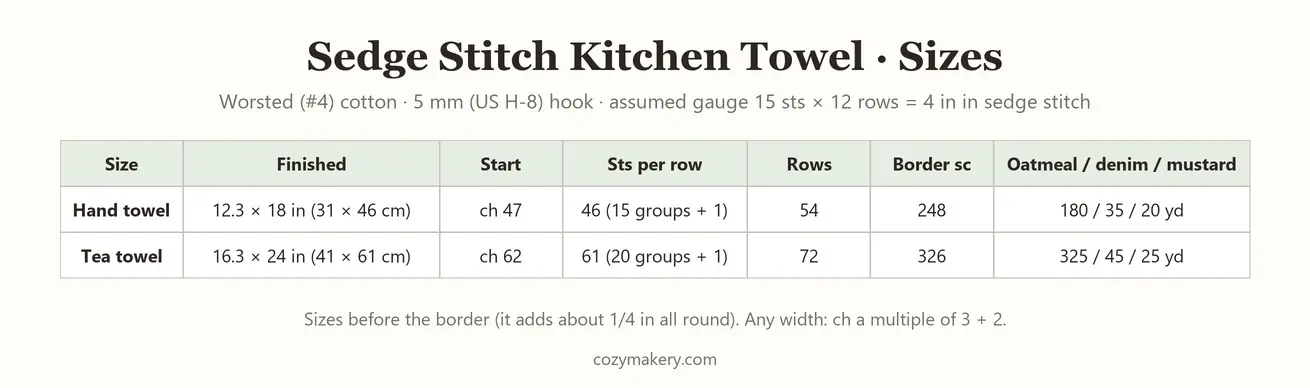
Hand towel, 12.3 × 18 in (31 × 46 cm) before the border
- Foundation: With oatmeal, ch 47.
- Row 1: (Sc, hdc, dc) in the 2nd ch from the hook, *skip 2 ch, (sc, hdc, dc) in the next ch*; repeat to the last 3 ch, skip 2 ch, sc in the last ch (15 groups + 1 sc). Ch 1, turn. (46)
- Row 2: (Sc, hdc, dc) in the first sc, *skip the next hdc and dc, (sc, hdc, dc) in the next sc*; repeat to the last 3 sts, skip the hdc and dc, sc in the last sc. Ch 1, turn. (46)
- Rows 3–14: Repeat row 2 for the bottom bands, counting from row 1: 4 rows oatmeal, 2 rows denim, 2 rows oatmeal, 2 rows denim, 2 rows oatmeal, 2 rows mustard. Change color on the last yarn over of the row before a new color. (46)
- Rows 15–40: Repeat row 2 in oatmeal (26 rows). (46)
- Rows 41–54: Repeat row 2, working the bands in reverse: 2 rows mustard, 2 rows oatmeal, 2 rows denim, 2 rows oatmeal, 2 rows denim, 4 rows oatmeal. Don't turn after the last row. (46)
- Border: With oatmeal, ch 1 and sc round: about 72 sc down each side (4 sc for every 3 rows), 46 sc along the bottom into the foundation chain, 46 sc along the top, plus 3 sc in each corner (248 sc). Join with a sl st. (248)
- Tab: On the top edge, skip the 3 corner sc and the next 20 sc, join oatmeal in the next sc, ch 1, sc in the same st and the next 5 sc (6 sc). Work 13 more rows of 6 sc. (6)
- Finish: Fold the tab to the back and sew its end to the top of the border to make a loop. Weave in the ends along the band edges, then wash and dry flat.
Tea towel, 16.3 × 24 in (41 × 61 cm) before the border
Ch 62 for 61 stitches (20 groups plus 1 sc). Work the same 14 rows of bands, then 44 rows of oatmeal, then the bands in reverse: 72 rows in all. The border has about 96 sc down each side and 61 along the top and bottom, plus 3 in each corner (326 sc). For the tab, skip the 3 corner sc and the next 27 sc, then work 7 sc wide for 14 rows.
Tab, ends and the first wash
Work the border before the tab so the tab sits on a clean edge. Along the sides, about 4 sc for every 3 rows keeps the edge flat; the sc at the end of each row is short, so put the stitches into the side of the fans too, not only into the row ends. Fold the 14-row tab to the back and sew its end to the top of the border with the yarn tail, making a loop that fits over an oven rail or a hook.
Weave the ends in along the stripe edges, where a color change already hides them; this guide shows a secure way for cotton. Cotton shrinks a little in the first hot wash.
Keep a paper copy
The PDF has the 4 steps, the fan chart, the band diagram, both towels row by row and the yarn amounts. 6 US Letter pages in all (for A4, tick “Fit to page”).
Good to know
Can I use acrylic or a cotton blend?
For a towel, stick to cotton or a cotton and linen blend. Acrylic doesn’t absorb water, so it smears rather than dries.
How do I make a sedge stitch blanket instead?
Chain any multiple of 3 + 2 and use a soft worsted. A throw 50 in (127 cm) wide needs 187 stitches at this gauge (62 groups + 1), so chain 188.
Why does my sedge stitch slant?
A slight diagonal look is normal because every fan leans the same way within a row. If the whole piece is turning into a parallelogram, check that each row starts in the very first stitch.
More textured stitches for the kitchen: moss stitch, waffle stitch and the pot holder pattern.