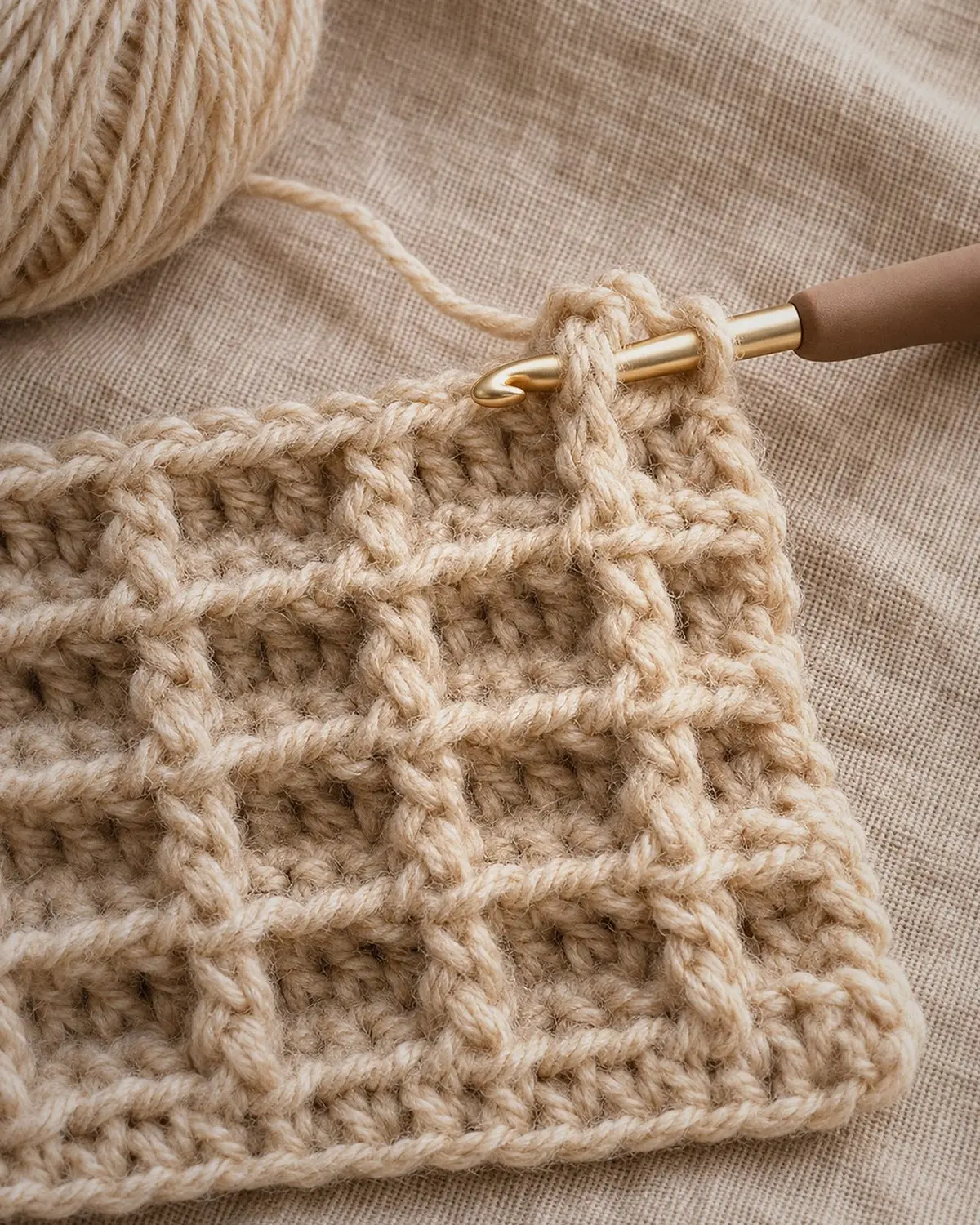
Waffle stitch crochet makes a thick, squishy fabric covered in little square cells, just like a waffle. It’s only 2 stitches, the double crochet and the front post double crochet, and they swap places on every row: the posts build a raised grid and the plain stitches sink into the cells. This tutorial covers the post stitch, the 2-row repeat, how to keep the edges straight and how to fix the most common mistakes, plus a practice project in 2 sizes: a waffle stitch baby blanket.
In this post
Pattern at a glance
- Skill levelAdvanced beginner
- PracticeBaby blanket, 2 sizes
- YarnWorsted (#4)
- Hook5.5 mm (US I-9)
- Gauge13 sts × 7 rows = 4 in (10 cm)
- TimeAbout 4 / 14 hours
Free printable pattern
The PDF has the waffle stitch steps, the chart, the texture map, the size table and both blanket sizes row by row. The Waffle Stitch Crochet PDF has 6 pages and prints on US Letter paper; on A4, choose “Fit to page” in the print dialog.
What you need to know first
Waffle stitch only uses 2 stitches. If double crochet is new to you, start there. The other stitch, the front post double crochet (fpdc), is a dc worked around the post (the “leg”) of the stitch below instead of into its top.
How to crochet the waffle stitch
- Yarn over: Yarn over as for a normal double crochet.
- Around the post: Insert the hook from the front, right to left, around the post of the next stitch in the row below, and out to the front again.
- Finish the stitch: Yarn over and pull up a loop, then (yarn over, pull through 2 loops) twice. That's 1 fpdc.
- Swap every row: On one row the fpdc go around 1 stitch in every 3; on the next, around the 2 stitches in between. The plain dc go into the tops of the posts below.
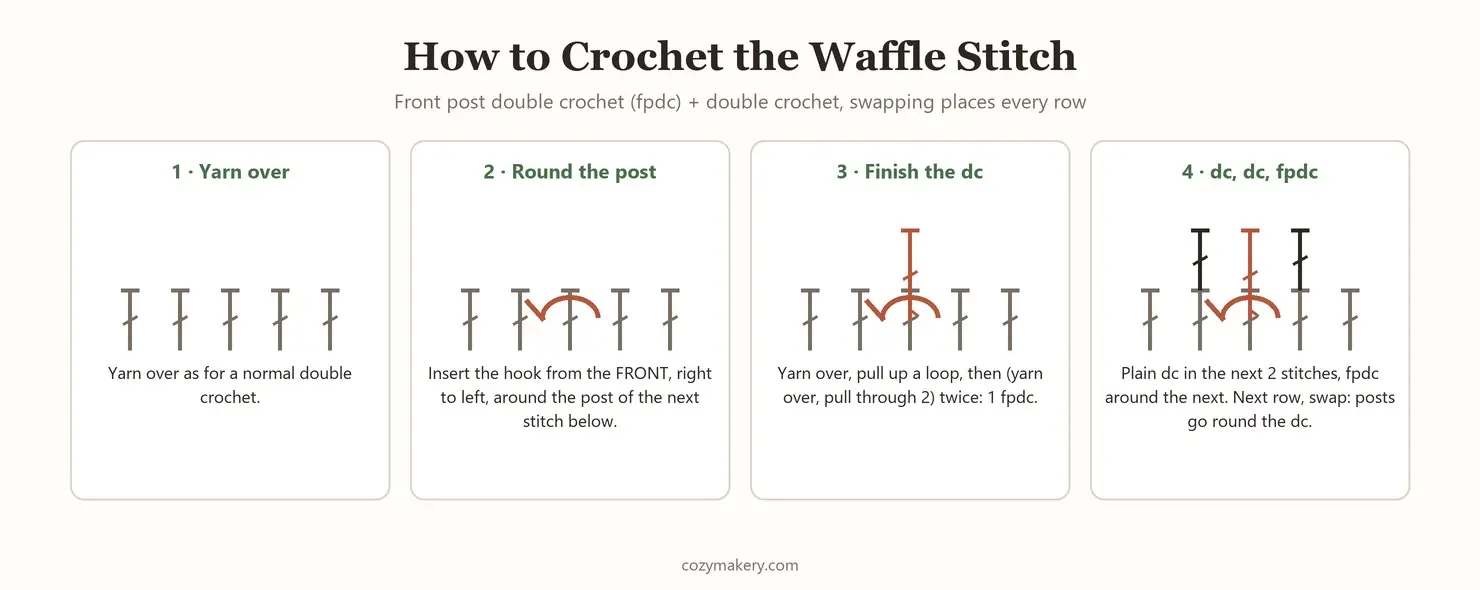
Count the stitches in a row as 3 per repeat plus 2 edge stitches. The edge stitches are always plain dc: they keep the sides straight. The chain 2 at the start of each row doesn’t count as a stitch, so you work the first dc into the very first stitch.
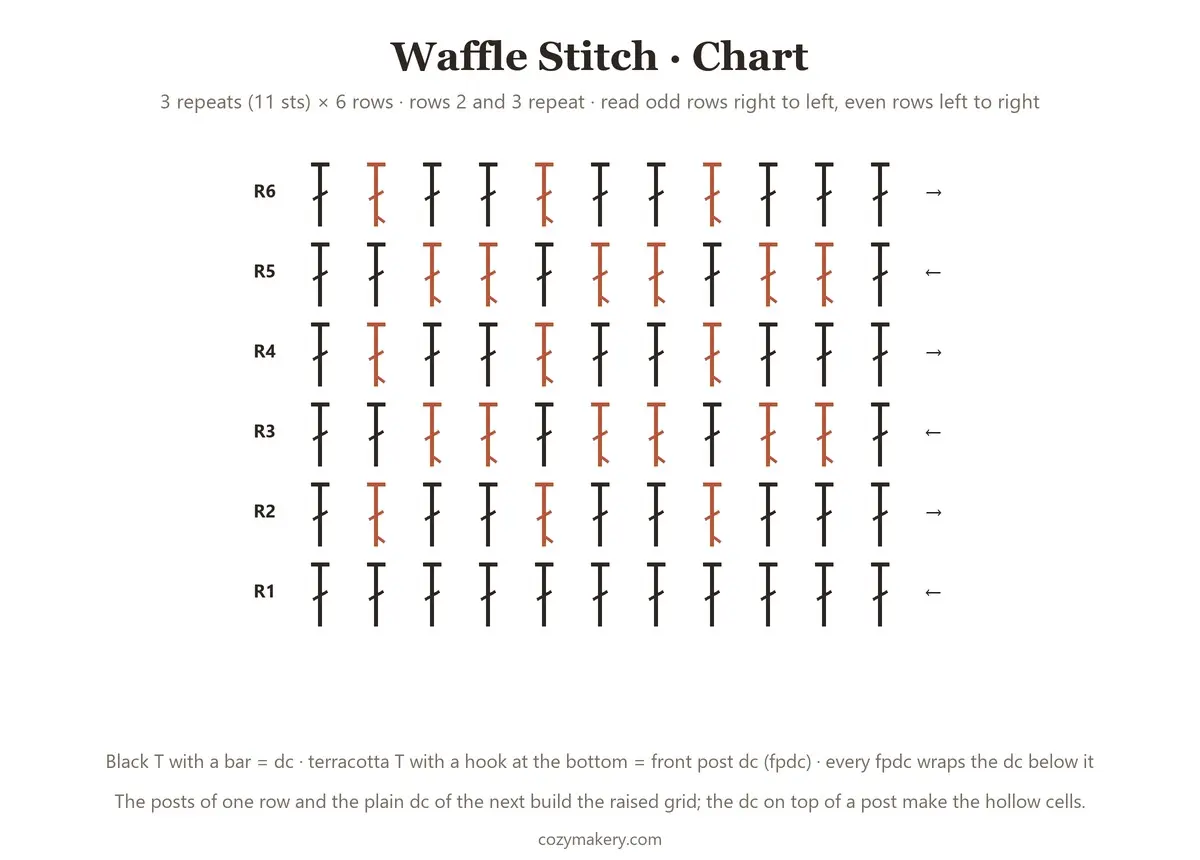
Why it looks like a waffle
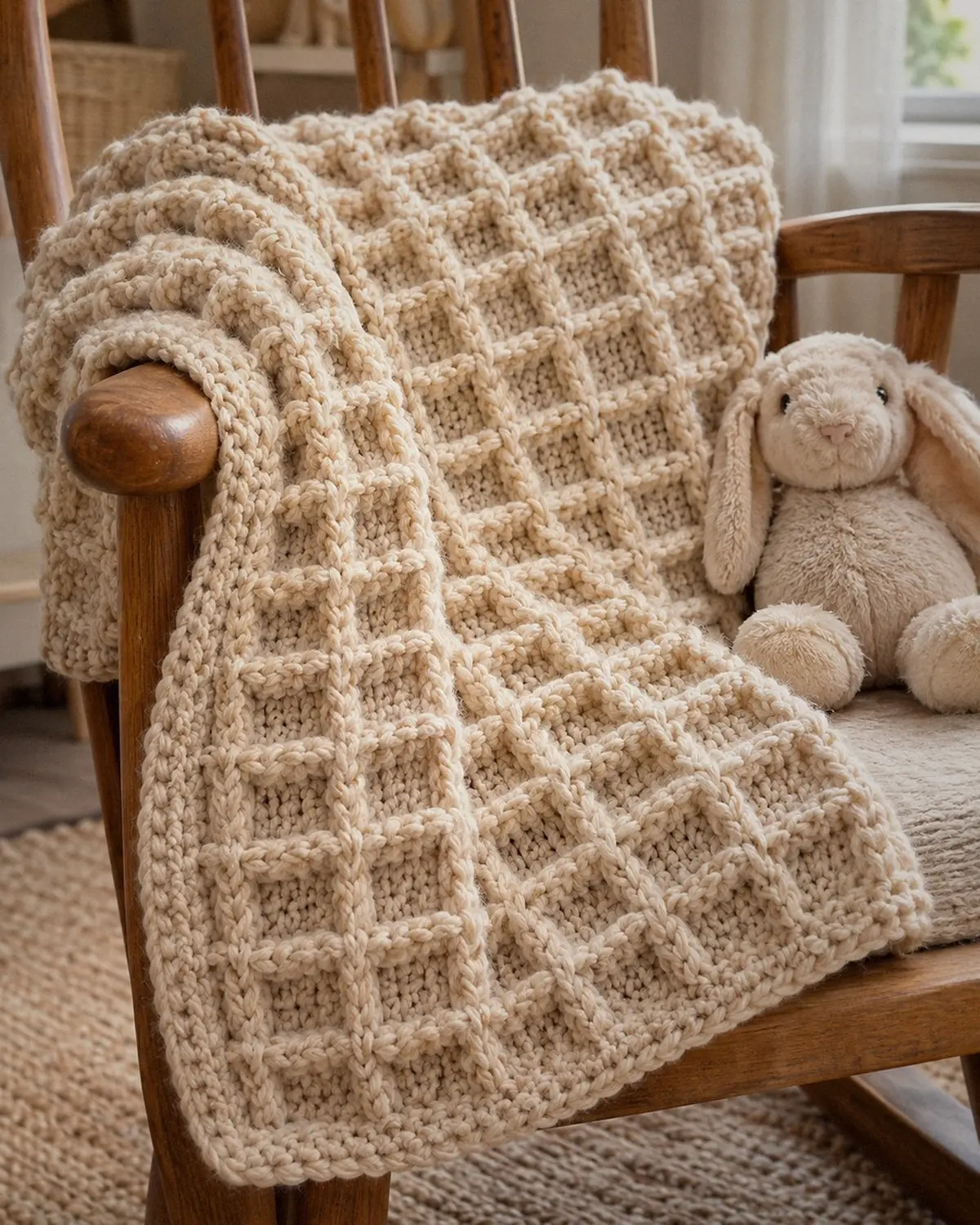
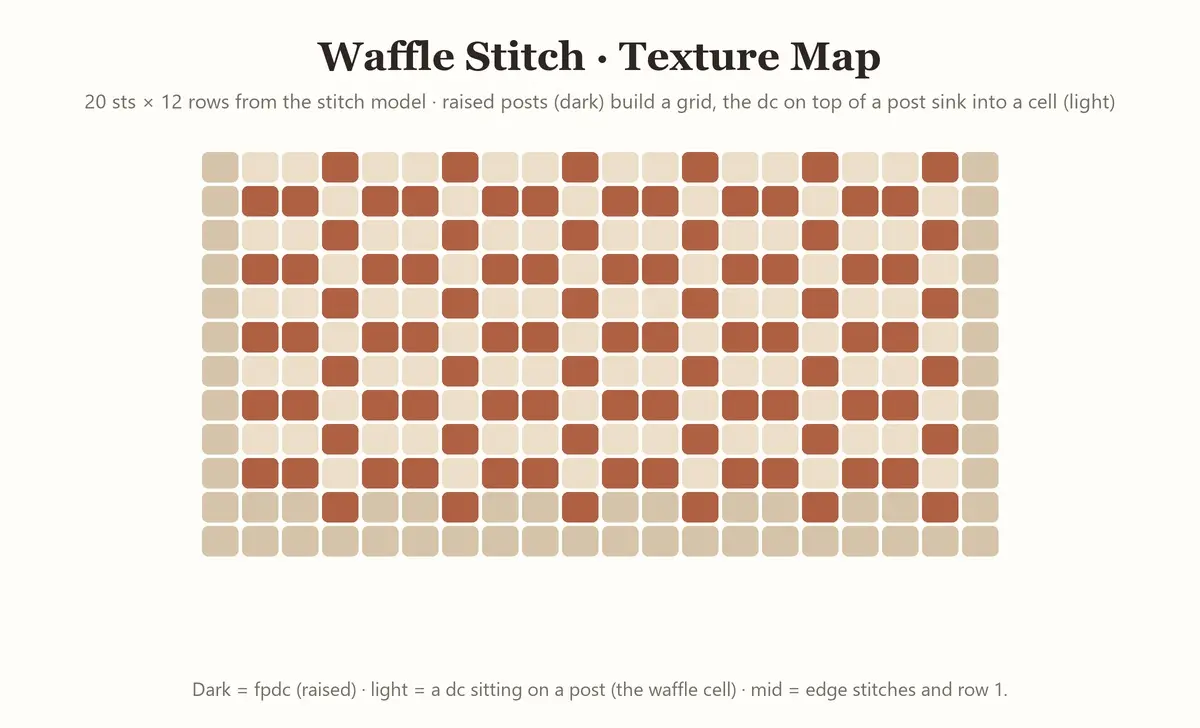
Every fpdc wraps a plain dc from the row below, and every plain dc sits on top of a post. The posts stand up in front of the fabric and line up into a grid; the dc on top of them sink back and form the cells. The texture map below shows a swatch from our stitch model: dark squares are posts, light ones are the cells.
Tips and common mistakes
- Posts on posts? If a post is around another post, the grid turns into ribs. Check that each fpdc wraps a plain dc.
- Too stiff? Waffle stitch is dense and pulls in. Go up 1 hook size or use a soft yarn.
- Count each row. It’s easy to skip the stitch behind a post. Every row has the same number of stitches.
- Uses more yarn than plain dc, because the posts are longer and the fabric is thicker, so buy an extra skein.
Practice project: waffle stitch baby blanket
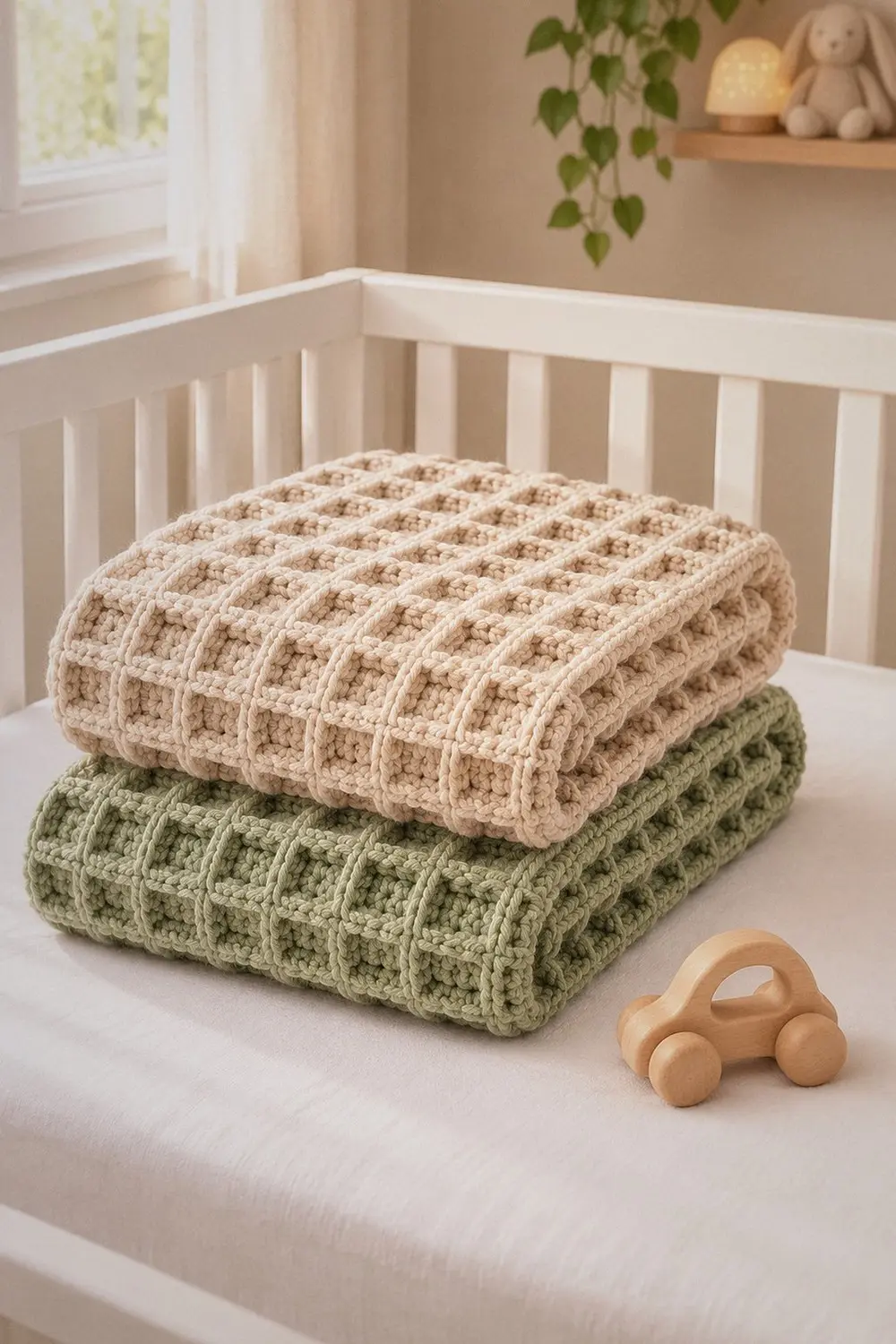
A baby blanket shows off waffle stitch best: the cells make it thick and cosy without being heavy. The lovey is a quick first try; the stroller size covers a car seat or a pram. Both finish with a simple single crochet border.
You'll need
- Worsted (#4) soft acrylic, cotton or a blend: 140 yd (lovey) or 610 yd (stroller)
- 5.5 mm (US I-9) hook, tapestry needle
Gauge: 13 sts and 7 rows = 4 in (10 cm) in waffle stitch. This is a typical worsted value, not one we measured on a particular yarn, and a blanket doesn’t need to be exact.
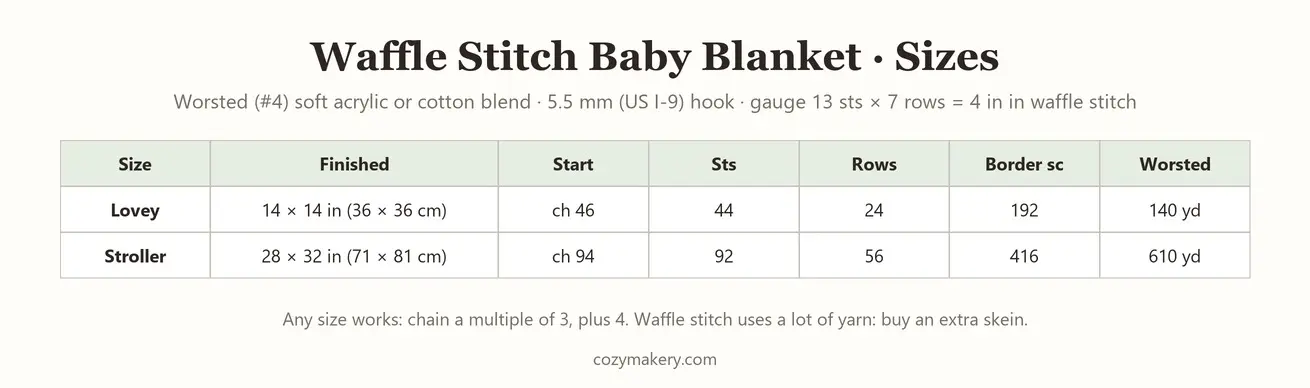
Waffle blanket, Lovey (14 × 14 in, 36 × 36 cm)
- Foundation: Ch 46.
- Row 1: Dc in 3rd ch from hook and in each ch across. Turn. (44 dc) (44)
- Row 2: Ch 2 (does not count as a st here and throughout), dc in first st, *dc in next 2 sts, fpdc around next st*; repeat from * to the last st, dc in last st. Turn. (44)
- Row 3: Ch 2, dc in first st, *dc in next st, fpdc around next 2 sts*; repeat from * to the last st, dc in last st. Turn. (44)
- Rows 4–24: Repeat rows 2 and 3. The blanket measures about 14 in (35 cm). (44)
- Border: Ch 1, sc all round: 1 sc in each st along the top and bottom, 2 sc in the side of each row, 3 sc in each corner (192 sc). Sl st to the first sc. Fasten off. (192)
Stroller (28 × 32 in, 71 × 81 cm): ch 94, work the same rows with 92 sts for 56 rows, then 416 sc in the border.
We modelled every stitch of both sizes: the stitch count is the same on every row, every fpdc wraps a plain dc and every inner dc sits on a post. The stitches, rows and yarn come from the gauge. For more ideas, see our crochet newborn blanket patterns and blanket border ideas.
Frequently asked questions
Is waffle stitch hard to crochet?
No. If you can double crochet, the only new thing is going around the post. Most people get the rhythm in 2 or 3 rows.
Is waffle stitch reversible?
Not quite: the front has the raised grid, the back is flatter with little ridges. Both sides look tidy for a blanket.
Why is my waffle stitch curling?
Post stitches pull the fabric in. Go up a hook size and keep the edge stitches as plain dc.
How much yarn does waffle stitch use?
More than plain double crochet, because it is thicker. The size table lists the yards for each blanket.
How many pages is the Waffle Stitch Crochet PDF?
6 pages on US Letter, with the chart, the texture map and both sizes. On A4, print with “Fit to page”.
What else can I make with waffle stitch?
Dishcloths, pot holders, cushion covers and scarves: anything that likes a thick, textured fabric.
Save it for later
Pin the photo below to keep the waffle stitch blanket on your Pinterest board. Made the waffle stitch blanket? I’d love to see it: send a photo to info@cozymakery.com.
More stitches: single crochet, shell stitch and crochet patterns for beginners.