Feather stitch embroidery makes a branching, zigzag line of open V’s, worked alternately to the left and the right of a line. It looks like a fern or a feather and is a favourite for crazy quilt seams, borders and little winter sprigs. This tutorial covers single and double feather stitch, keeping the V’s even, following a curve, and a free pattern: a winter sprigs hoop with French knot berries.
In this post
Pattern at a glance
- Skill levelBeginner
- Hoop5 in (13 cm)
- Design3 sprigs + berries
- Floss4 DMC colours
- StitchesFeather stitch (39), French knot
- TimeAbout 2 hours
Free printable pattern
The PDF has the feather stitch steps, the stitch plan, the floss table and a true-size template. The Feather Stitch Embroidery PDF has 5 pages and prints on US Letter paper; on A4, choose “Fit to page” in the print dialog.
How to do feather stitch
- Up at A: Bring the needle up at A, on the left of the line.
- Down at B, up at C: Go down at B, level with A on the right of the line, and come up at C, a little lower on the line, with the thread under the needle.
- Swap sides: Make the same stitch on the RIGHT side of the line, catching the loop below.
- Keep alternating: Left, right, left: the open V's zigzag down the line.
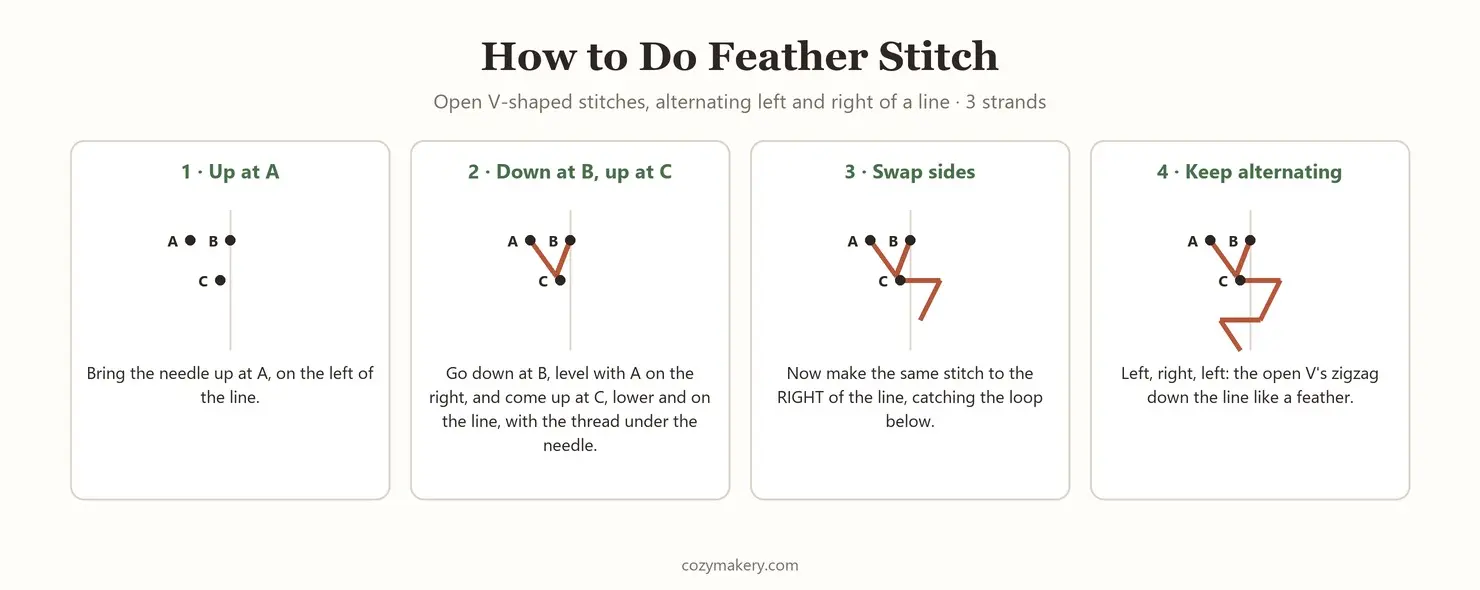
Feather stitch is a close relative of fly stitch (a single open V) and blanket stitch.
Single and double feather stitch
- Single feather stitch: one stitch each side, alternating, as in this pattern.
- Double feather stitch: 2 stitches to the left, then 2 to the right, for a wider, more branched line.
- Closed feather stitch: the V’s touch the line on both sides, making a ladder-like border.
- Curves: keep the catch points on the drawn line and the arms the same length; on the outside of a curve, open the V a little.
Feather stitch borders
Worked along a straight line, feather stitch makes a soft, lacy border for a napkin hem, a baby blanket or a pillowcase. Mark the centre line and 2 guide lines either side with a water-soluble pen, keep the catch points on the centre line, and work from top to bottom so the loop always sits under the needle. On crazy quilts it’s the classic way to cover a seam: the centre line follows the seam and the V’s land on the 2 fabrics either side.
Practice pattern: winter sprigs hoop
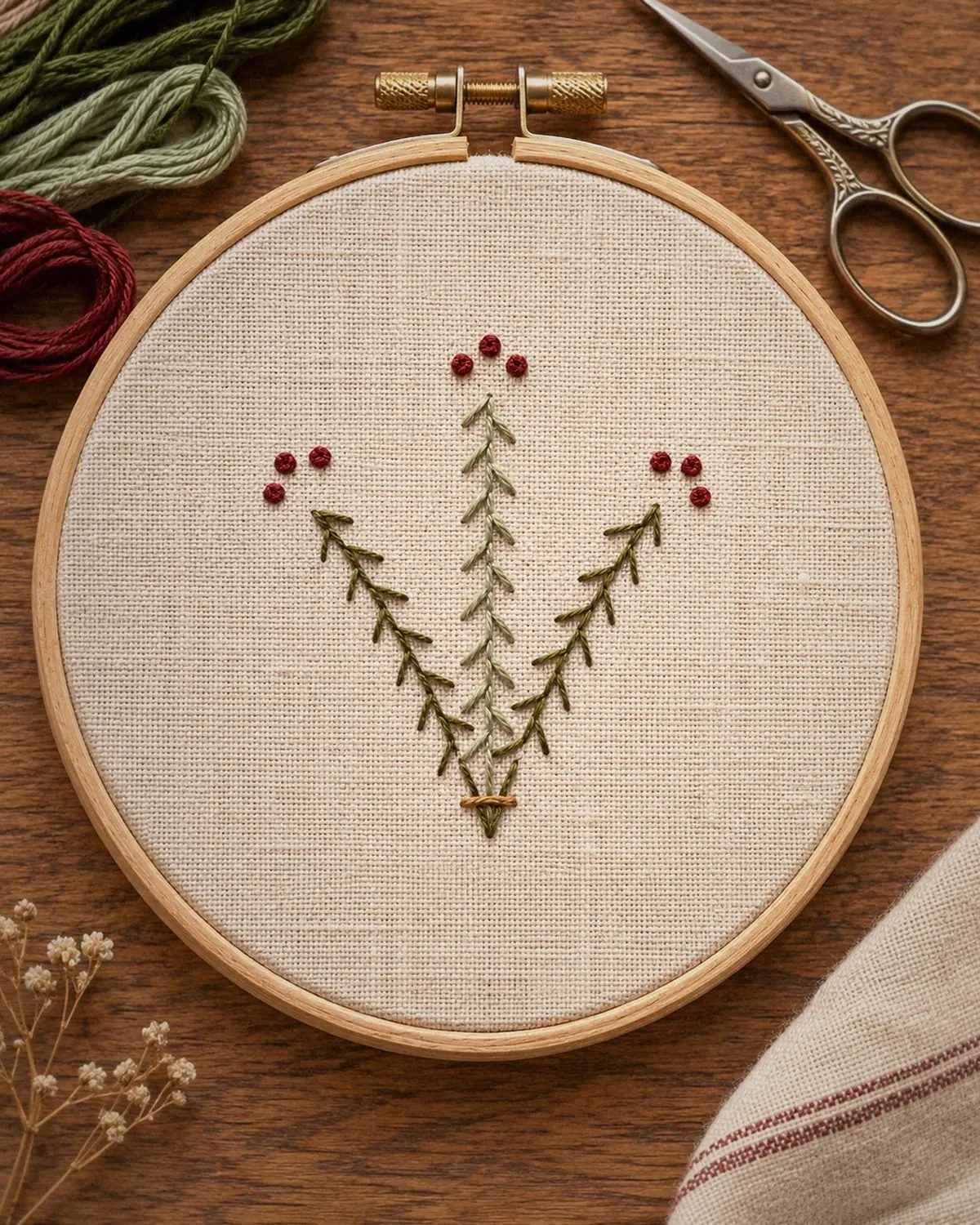
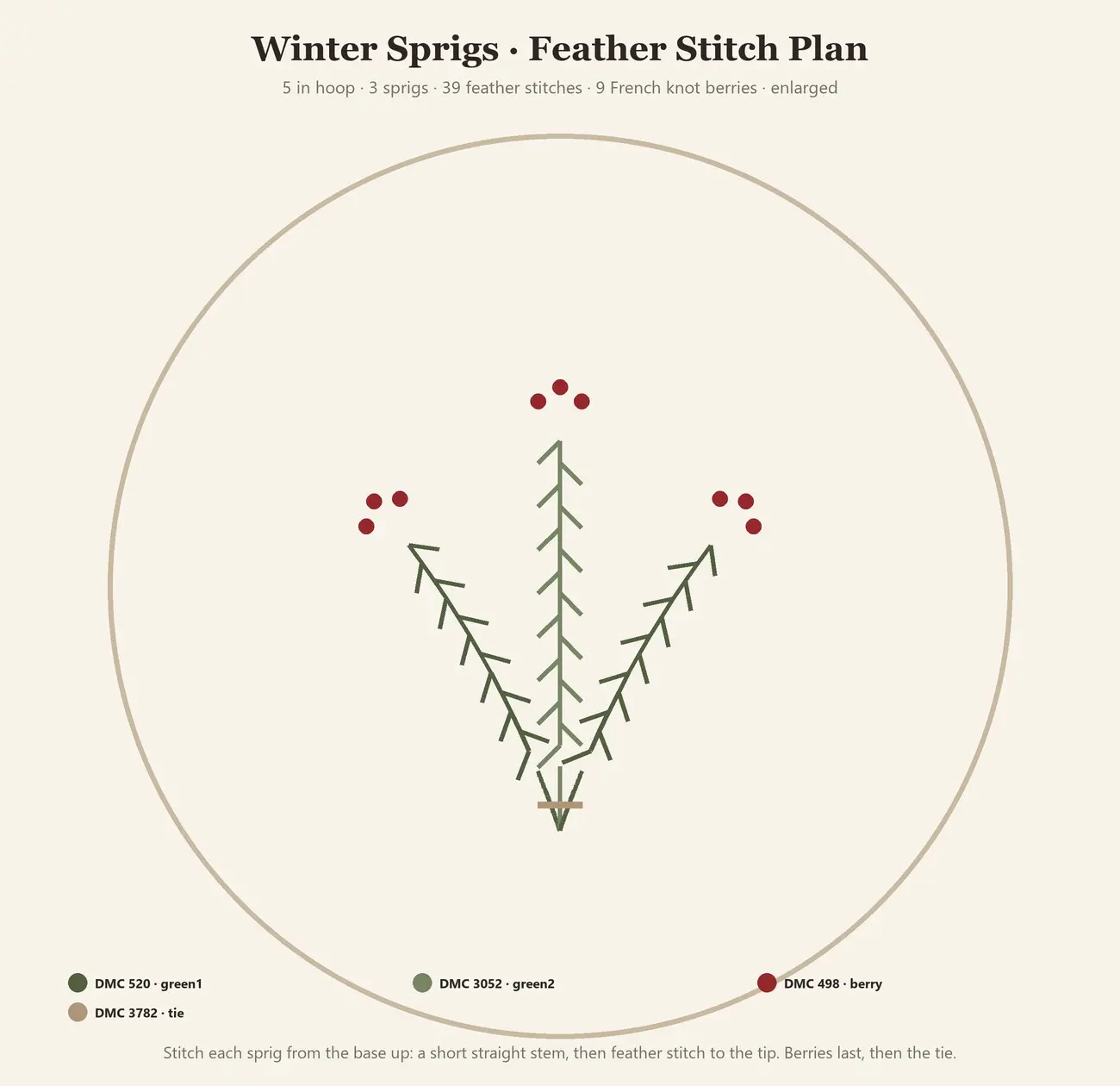
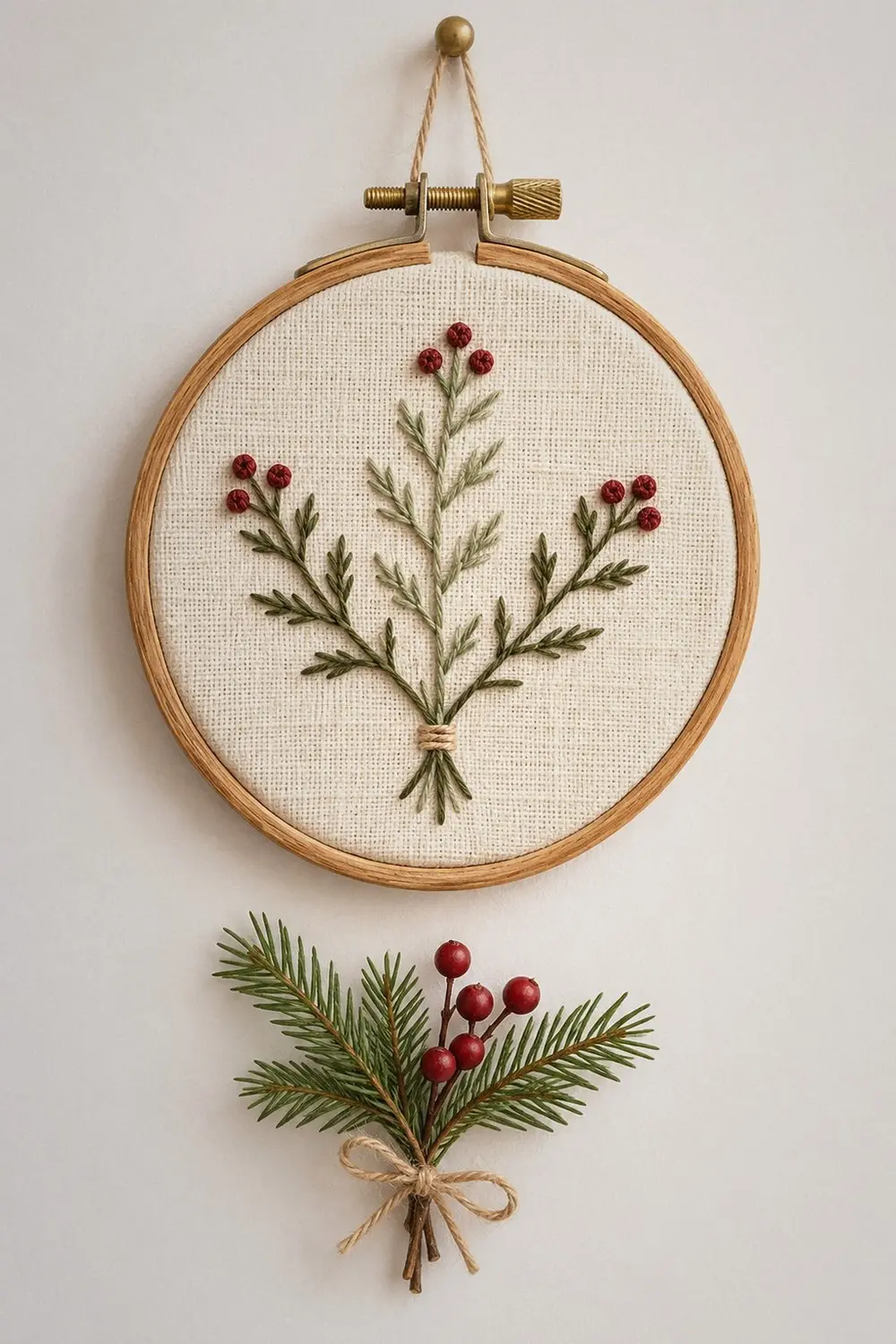
3 sprigs fan out from a small tie: a short straight stem, then feather stitch to the tip, with 3 French knot berries on each. There are 39 feather stitches in all.
You'll need
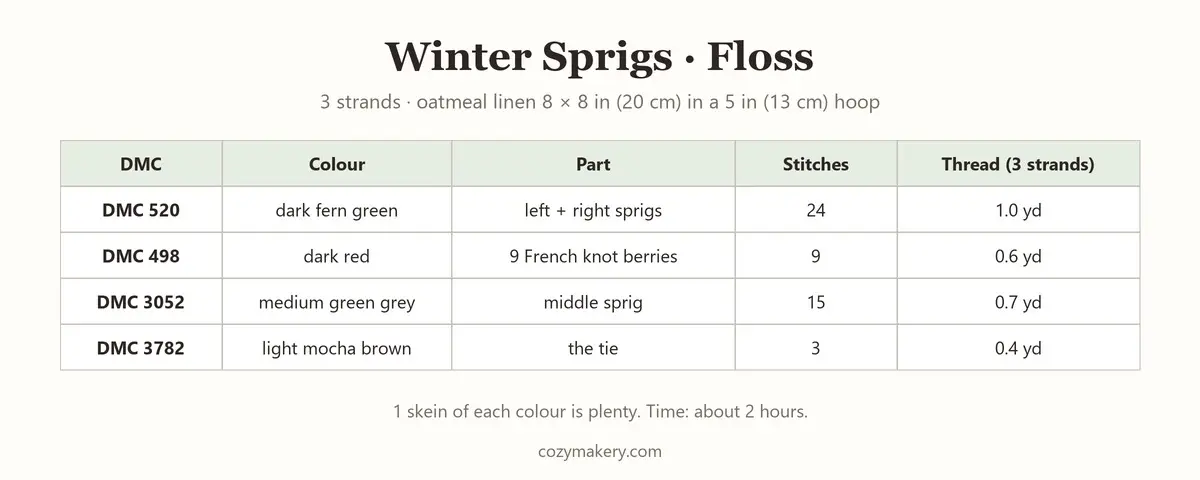
- DMC stranded cotton: 520, 3052, 498, 3782, 1 skein each
- 8 × 8 in (20 cm) oatmeal linen, a 5 in (13 cm) hoop
- Size 7 embroidery needle, a water-soluble pen
How to stitch it
- Trace: Print the template at 100%, check the 1 in (2.5 cm) bar, and trace the 3 centre lines and the berry dots.
- DMC 520: Left and right sprigs: short stem, then feather stitch to the tip. (24 sts)
- DMC 3052: The middle sprig the same way. (15 sts)
- DMC 498: 3 French knots at each tip. (9 sts)
- DMC 3782: 3 straight stitches across the stems. (3 sts)
- Finish: Rinse out the pen, dry face down, press and frame.
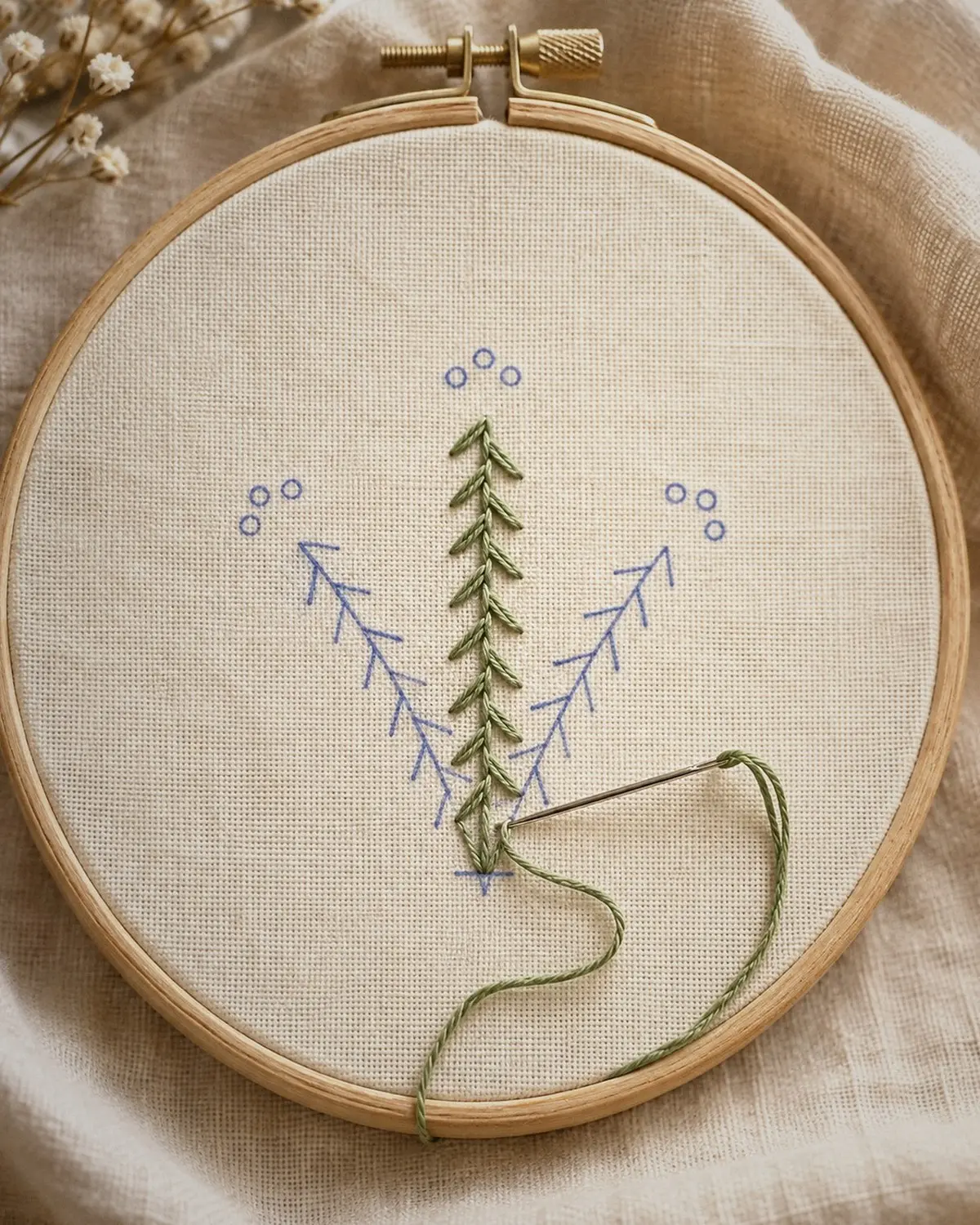
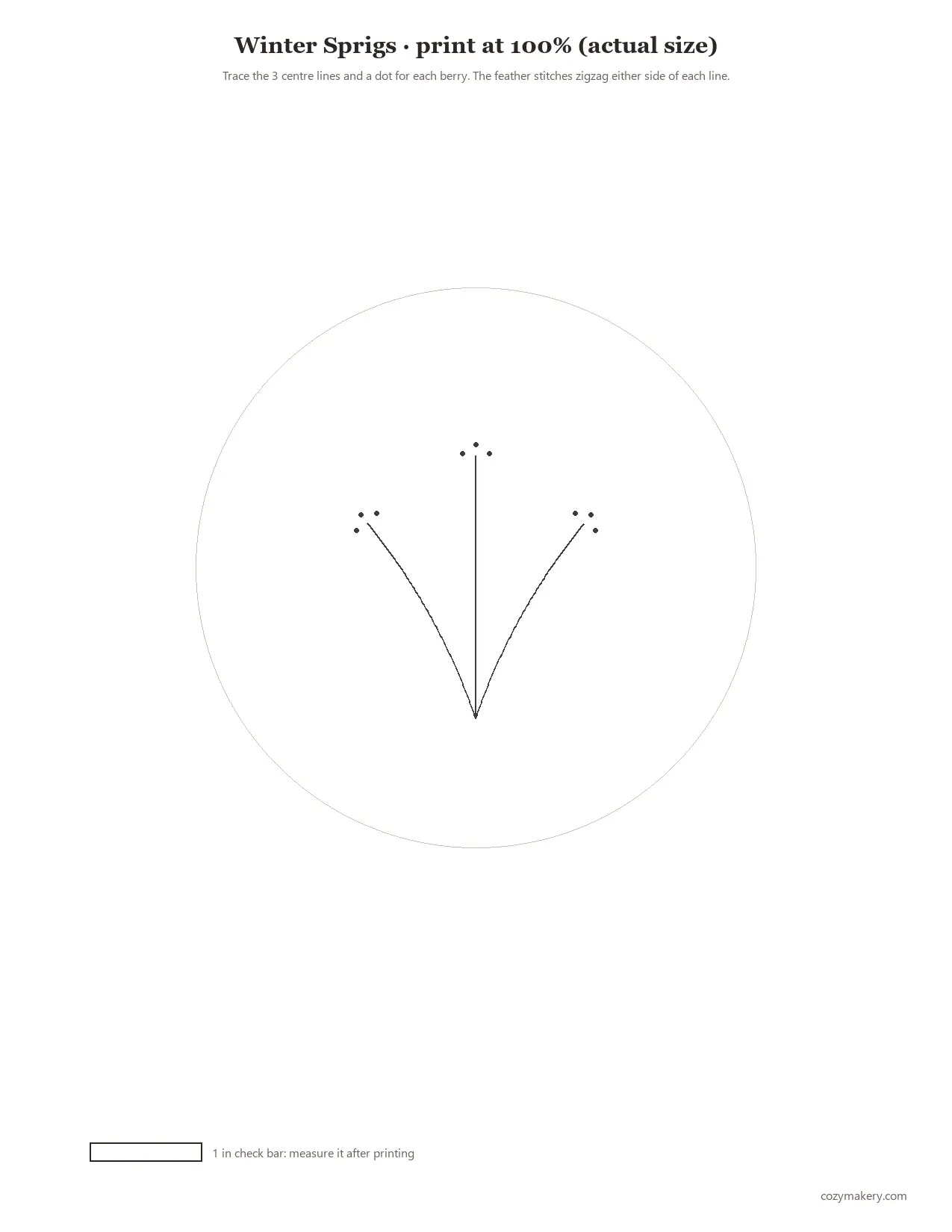
We placed every feather stitch in code along its curve: the stitches alternate sides, they’re 3 mm apart, neighbouring sprigs never touch, the berries sit clear of the stitches and everything is inside the hoop. For the berries, see French knots; more seasonal designs in Christmas embroidery patterns.
Frequently asked questions
What is feather stitch used for?
Borders, crazy quilt seams, ferns, seaweed and winter sprigs.
What is the difference between feather stitch and fly stitch?
Fly stitch is a single open V; feather stitch is a chain of V’s worked alternately left and right.
How do I keep feather stitch even?
Draw 3 guide lines (the centre and both sides) and keep the catch points on the centre line.
How many strands for feather stitch?
3 strands for this pattern; 2 for fine work, 6 or perle cotton for bold borders.
How many pages is the Feather Stitch Embroidery PDF?
5 pages on US Letter, including a true-size template. Print the template at 100%; on A4 use “Fit to page” for the other pages.
Can I add more sprigs?
Yes: add 2 shorter sprigs between the others, keeping their tips at least 3 mm apart.
Save it for later
Pin the photo below to keep the winter sprigs hoop on your Pinterest board. Made the winter sprigs hoop? I’d love to see it: send a photo to info@cozymakery.com.
More stitches: hand embroidery stitches, lazy daisy and free embroidery patterns.