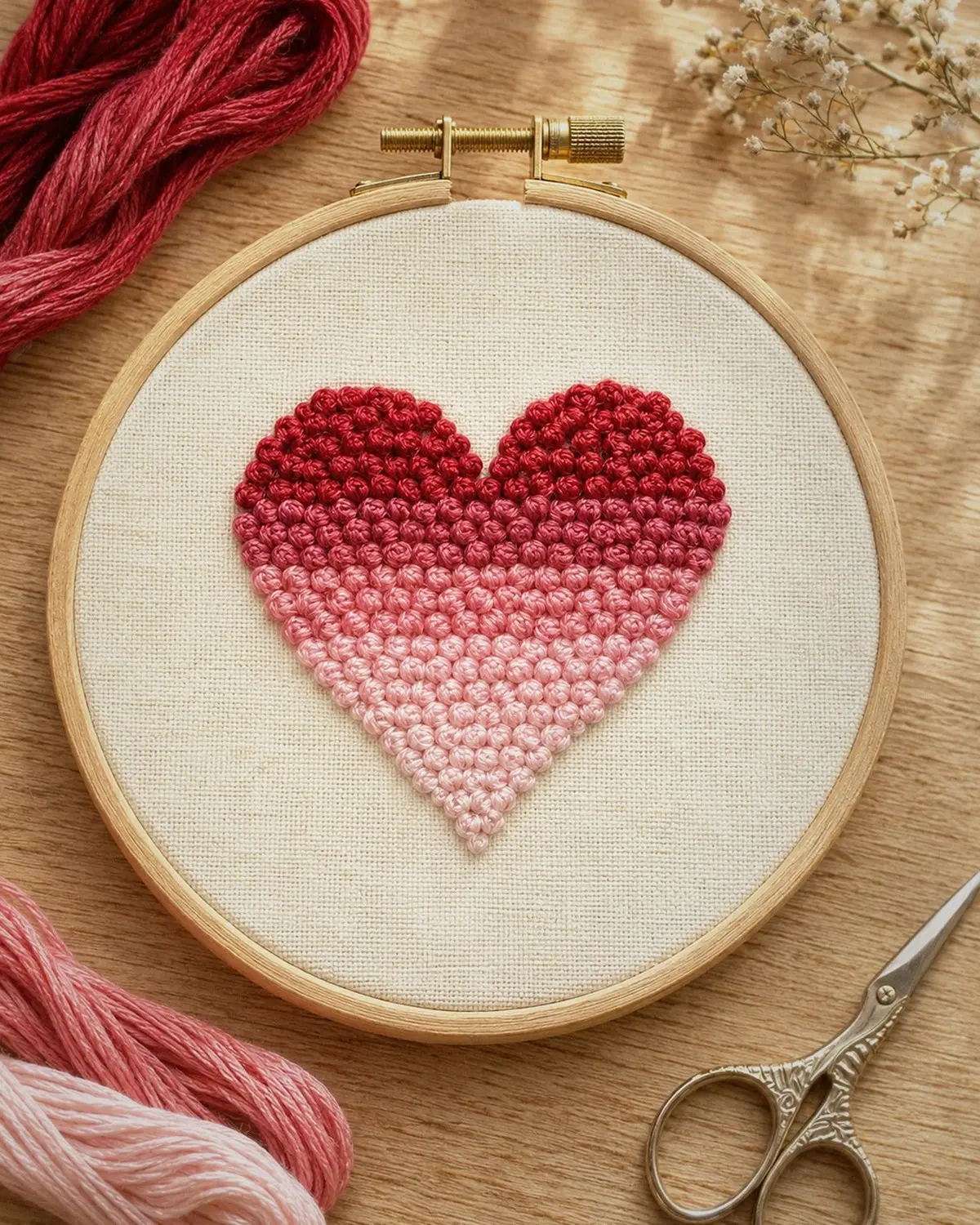
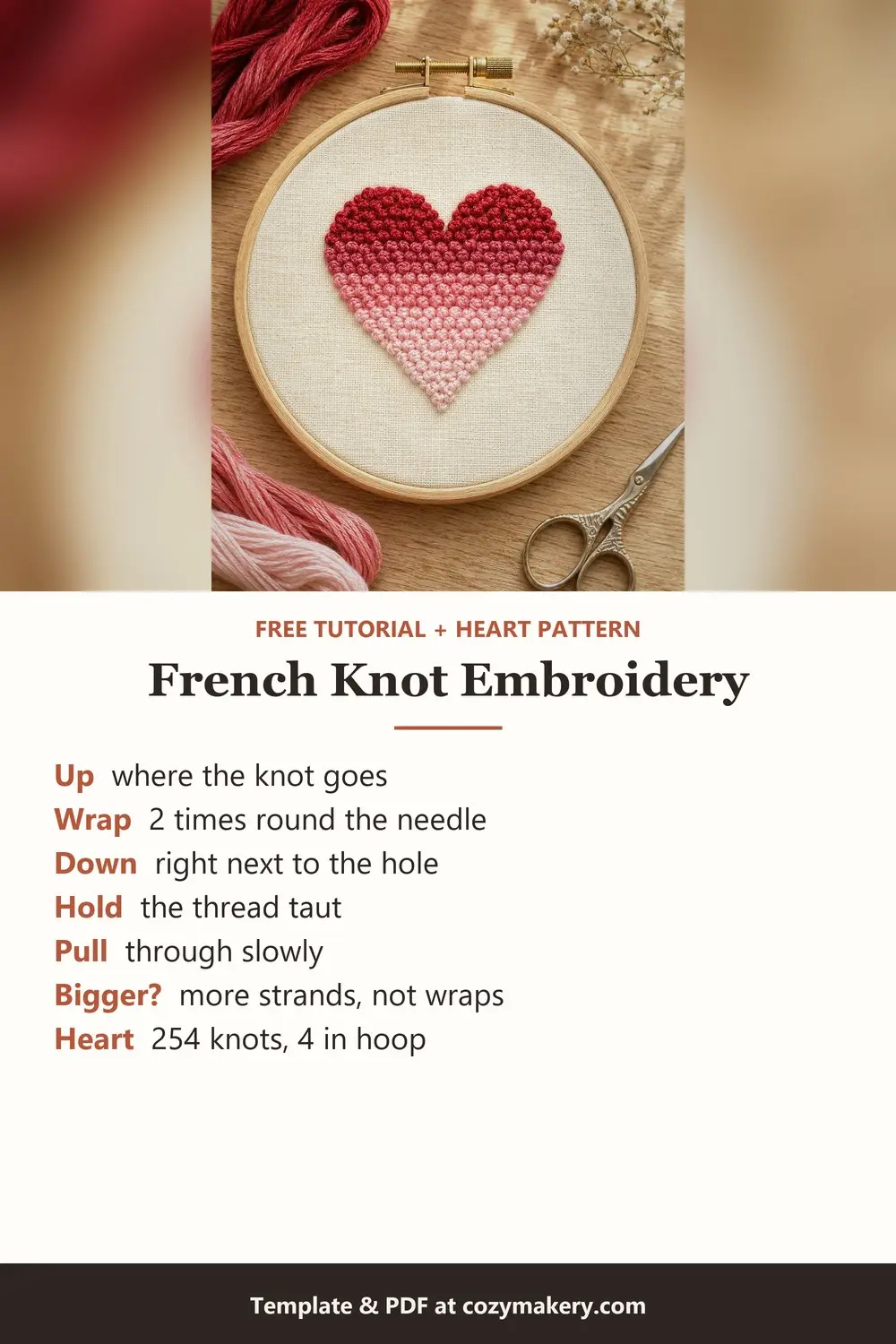
A French knot is a tiny raised dot of thread, and it’s the stitch most beginners fear. It doesn’t have to be fiddly: come up, wrap twice, go down right next to the hole, keep the thread taut, pull through. In this tutorial you’ll learn the 5 steps, how to make knots bigger or smaller, the mistakes that make knots vanish or loop, and a practice pattern that is nothing but French knots: an ombre heart for a 4 in (10 cm) hoop, with 254 knots and a true-size template.
In this post
Pattern at a glance
- Skill levelBeginner
- Hoop4 in (10 cm)
- Design2.2 in (5.6 cm) heart
- FlossDMC, 4 pinks and reds
- Knots254 French knots
- TimeAbout 3 hours
Free printable pattern
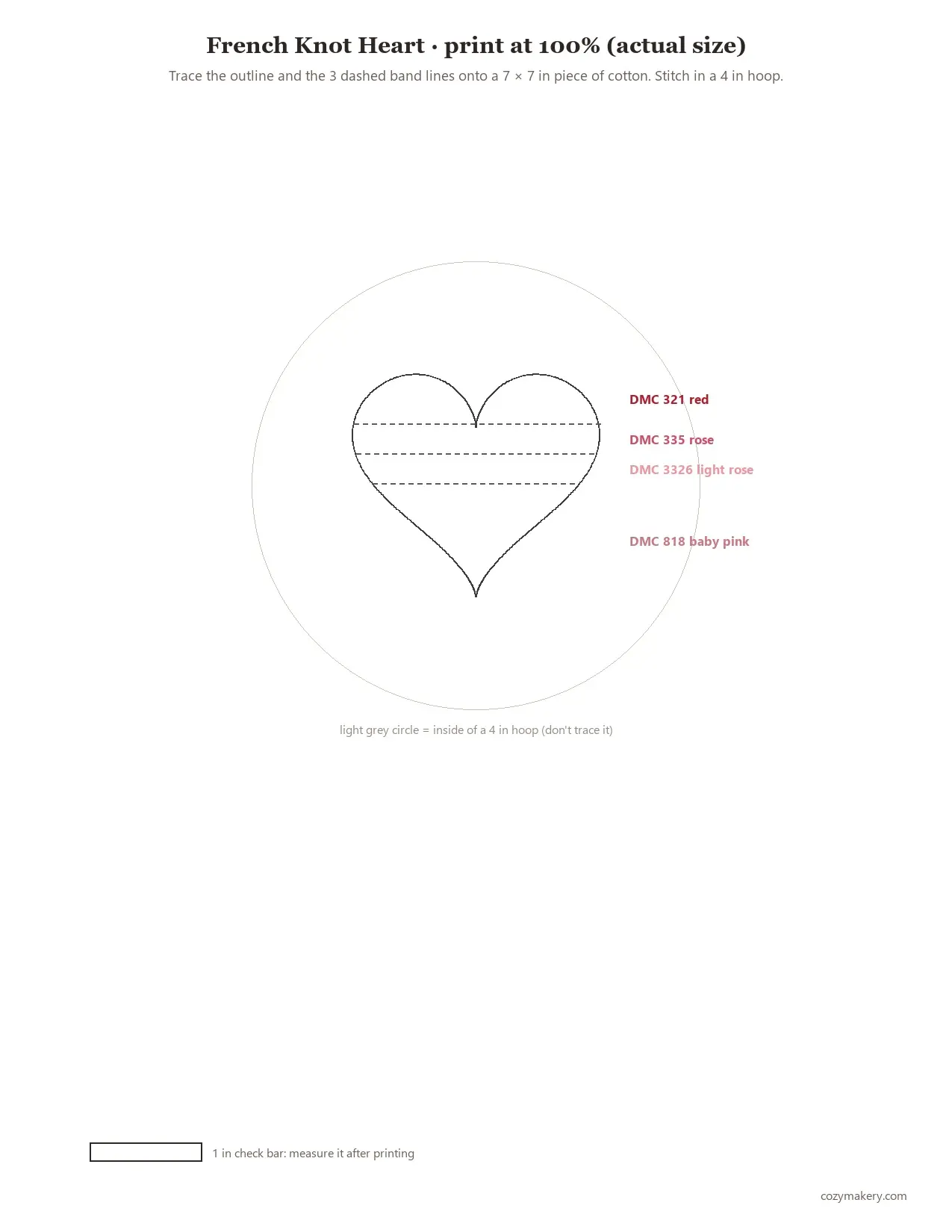
The PDF has the 5 steps, the size guide, the knot plan, the floss table and the heart template at actual size.
The French Knot Embroidery PDF has 6 pages and prints on US Letter paper; on A4, choose “Fit to page” in the print dialog.
What you need
- Stranded embroidery floss (DMC or similar). Separate the strands you need from the 6-strand length.
- A size 7 embroidery needle, or a milliner’s (straw) needle: its eye is no wider than the shaft, so the wraps slide off easily.
- Fabric in a hoop, pulled drum-tight. French knots are much easier on taut fabric.
How to make a French knot in 5 steps
- Step 1: Bring the needle up from the back exactly where the knot goes.
- Step 2: Hold the thread taut with your other hand and wrap it round the needle 2 times, close to the fabric.
- Step 3: Put the needle tip back into the fabric right next to where it came up, a thread's width away, not in the same hole.
- Step 4: Slide the wraps down the needle so they sit on the fabric, and keep the thread taut.
- Step 5: Pull the needle through to the back slowly. Let the thread go only when the knot has formed.
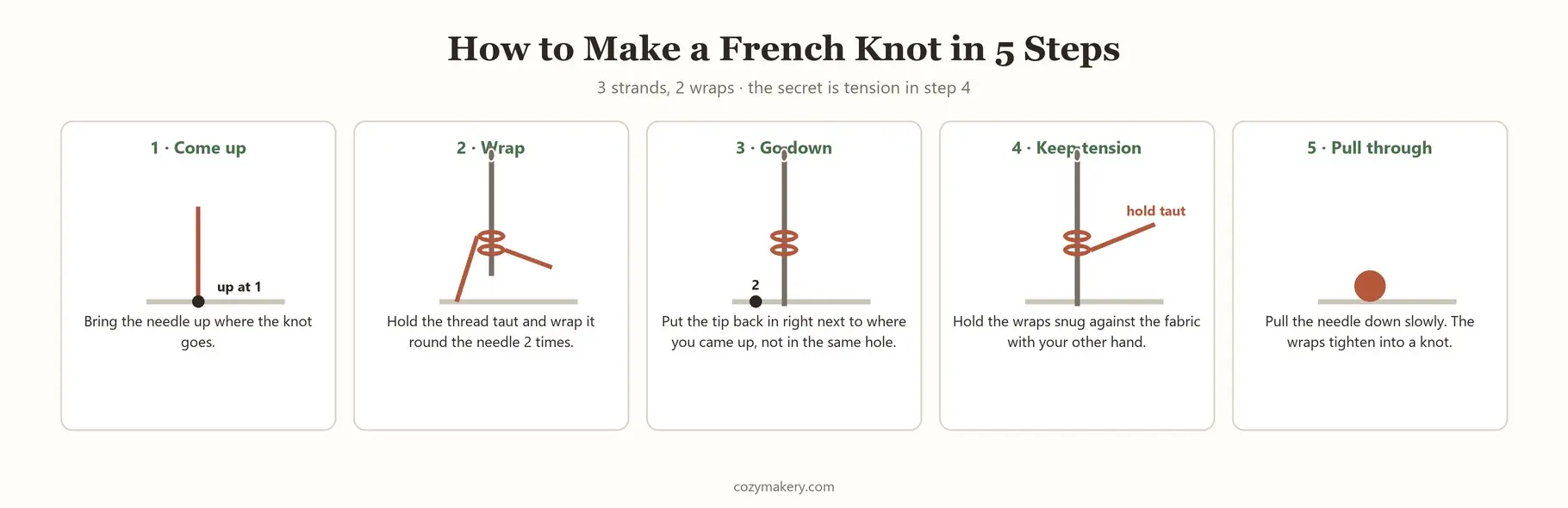
The secret is Step 4. Loose thread while you pull through = a messy loop. Tight thread = a neat round knot.
How to make French knots bigger or smaller
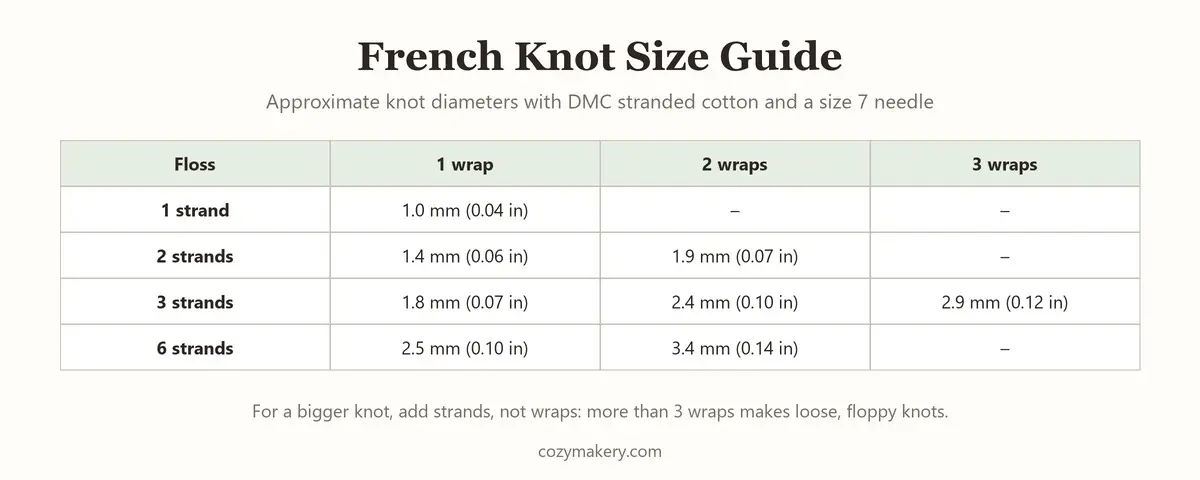
Change the number of strands first, then the wraps. More than 3 wraps tends to make a loose knot that flops to one side. These are typical sizes; your tension and needle will change them a little.
French knot problems and fixes
- The knot pulled through to the back: you went down in the same hole. Go down one or two fabric threads away.
- A loop instead of a knot: the thread went slack while you pulled through. Keep it taut until the end.
- The needle won’t go through the wraps: the wraps are too tight, or the needle eye is wider than the shaft. Use a milliner’s needle.
- Knots of different sizes: wrap with the same tension each time, and always wrap the same way round the needle.
Practice pattern: French knot heart
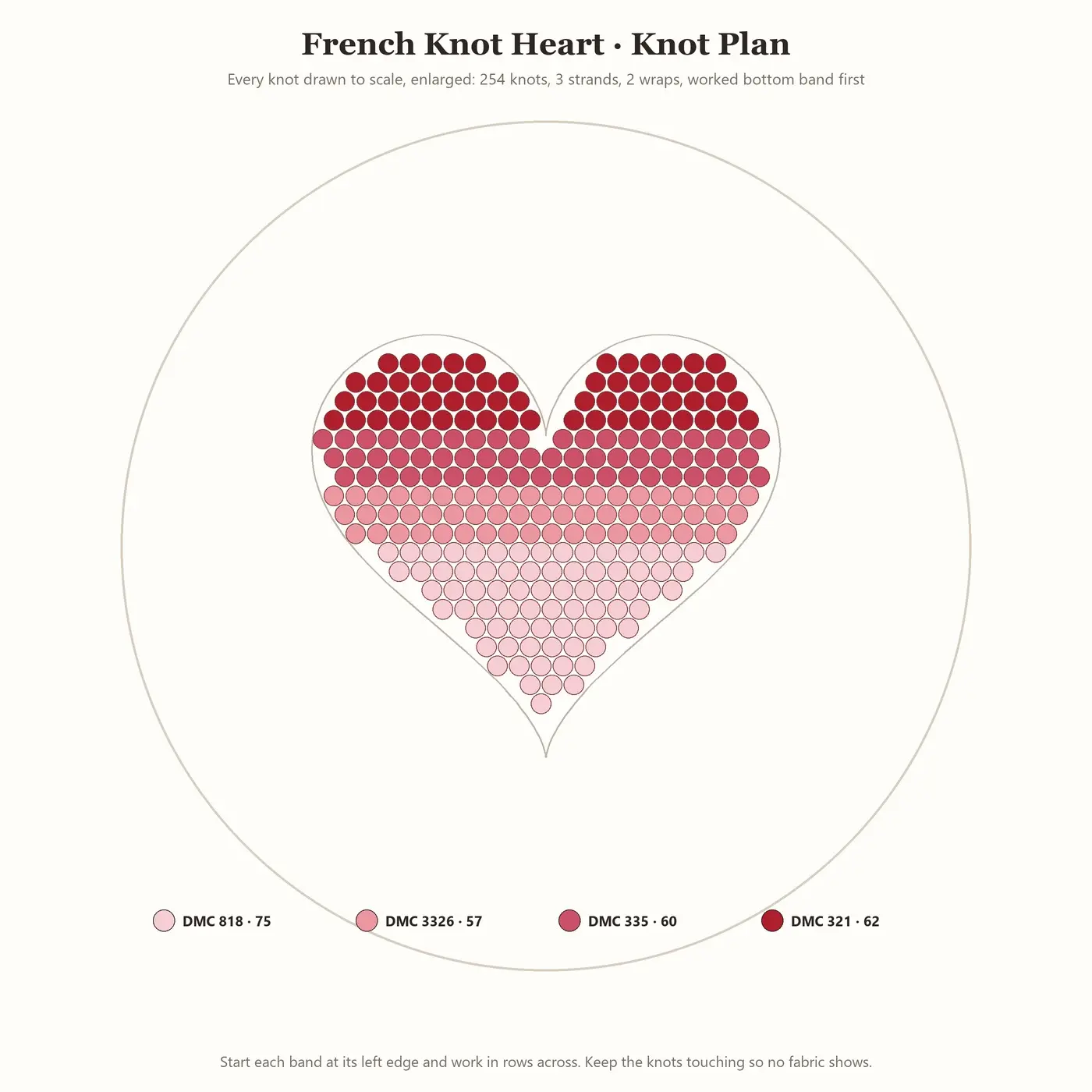
The heart is 2.2 in (5.6 cm) wide and fits a 4 in (10 cm) hoop with room to spare. It’s filled with knots in four colour bands, pale at the point and red at the top. We placed every knot on a honeycomb grid, 0.10 in apart, so neighbours just touch and no fabric shows, and checked that no two knots overlap and none sits over the outline. The bands are split so each colour gets about the same number of knots.
You'll need
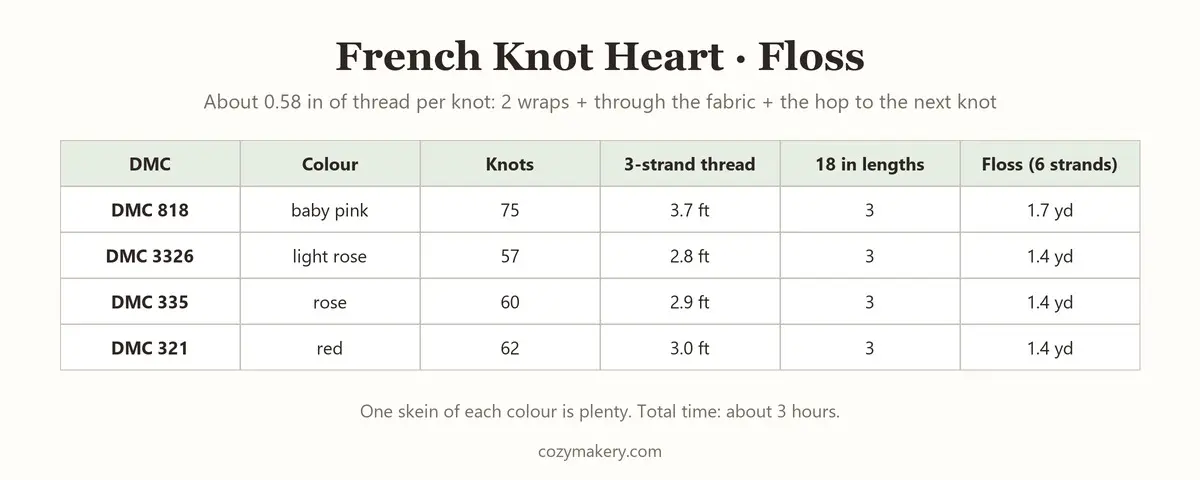
- DMC stranded cotton: DMC 818 (baby pink), DMC 3326 (light rose), DMC 335 (rose), DMC 321 (red), 1 skein each
- 7 × 7 in cotton or linen, a 4 in (10 cm) hoop, a size 7 embroidery or milliner’s needle, a water-soluble pen
How to stitch the heart
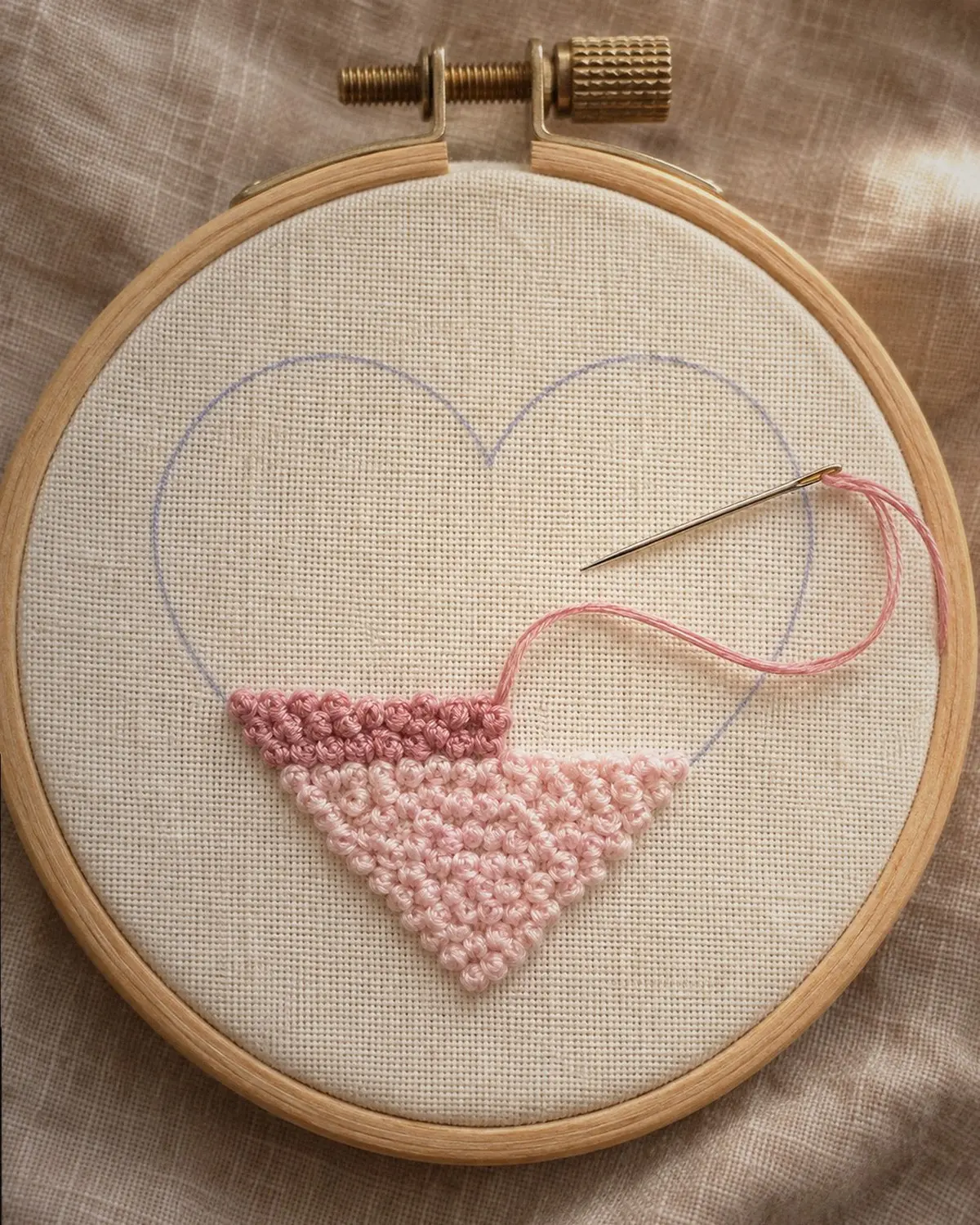
- Trace: Print the template at 100%, check the 1 in bar, and trace the heart and the 3 band lines onto the fabric.
- Band 1: DMC 818 baby pink, 3 strands, 2 wraps. Start at the outline and work in rows across the band, each knot touching the last. (75 knots)
- Band 2: DMC 3326 light rose, 3 strands, 2 wraps. Start at the outline and work in rows across the band, each knot touching the last. (57 knots)
- Band 3: DMC 335 rose, 3 strands, 2 wraps. Start at the outline and work in rows across the band, each knot touching the last. (60 knots)
- Band 4: DMC 321 red, 3 strands, 2 wraps. Start at the outline and work in rows across the band, each knot touching the last. (62 knots)
- Blend: Where 2 bands meet, scatter a few knots of each colour into the other band for a softer ombre.
- Finish: Rinse out the pen, let it dry, press face down on a towel and frame it in the hoop.
More stitches to pair with French knots: stem stitch for stems and outlines, and the full hand embroidery stitches guide. French knots also make perfect flower centres in our wildflower pattern.
Next stitch: satin stitch, with a free lemon slices pattern.
Frequently asked questions
How many times do you wrap a French knot?
Usually 2. One wrap makes a tiny knot; 3 is the most before the knot gets loose. For bigger knots use more strands.
Why does my French knot keep pulling through?
The needle went back into the same hole it came up from. Go down right next to it instead.
How many strands for French knots?
2 or 3 strands for most designs. 1 for tiny details, 6 for big, bold dots.
Can you make French knots without a hoop?
Yes, but it’s harder: the fabric needs to be taut so the wraps sit on top of it. A hoop helps a lot.
How many pages is the French knot embroidery PDF, and how do I print the template?
The French knot embroidery PDF has 6 pages on US Letter paper. Print the template page at 100% (no scaling) and check its 1 in (2.5 cm) bar before tracing the French knot embroidery; the other pages can use Fit to page on A4.
Save it for later
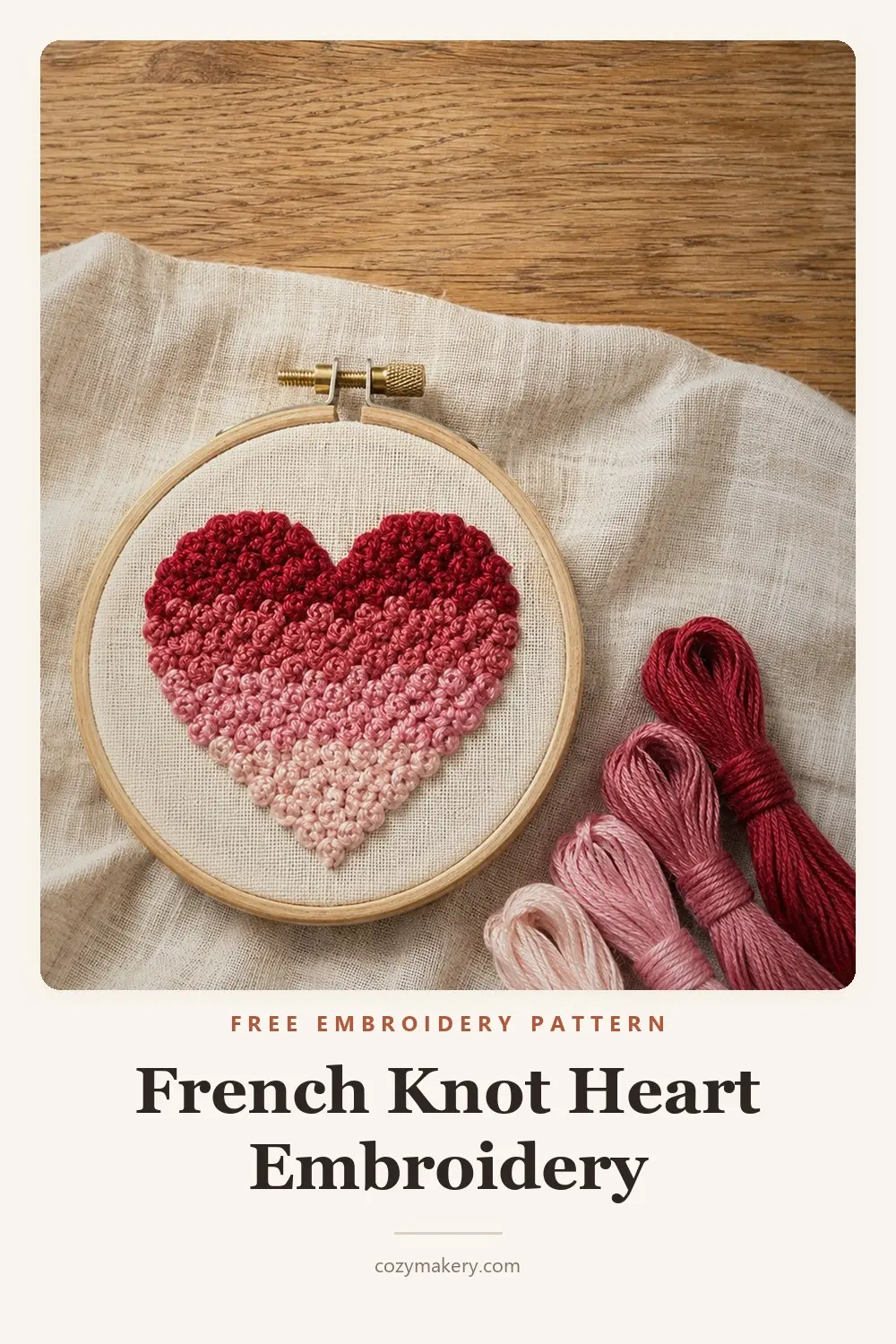
Pin the image below to keep the French knot embroidery pattern on your Pinterest board. Made the French knot embroidery? I’d love to see your version: send a photo to info@cozymakery.com.
More free designs: free embroidery patterns and Christmas embroidery patterns. French knots make perfect flower centres for lazy daisy petals. Wrap the needle more times along a longer stitch and you get a bullion stitch.