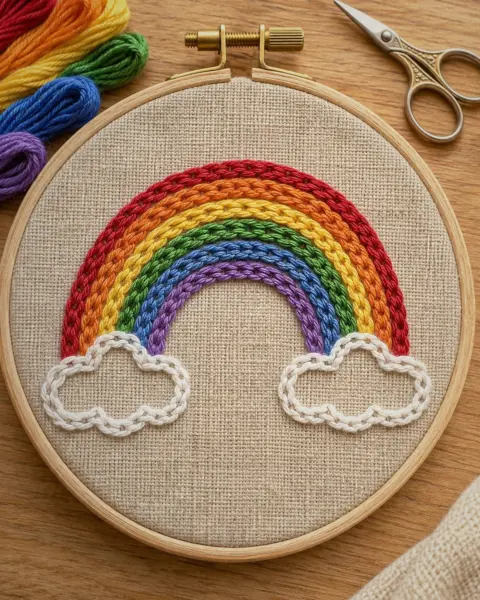
Couching stitch is a way to embroider bold lines: you lay a thick thread on the surface of the fabric and hold it down with tiny stitches in a second, thinner thread. Because the thick thread never goes through the fabric along the way, you can couch yarn, metallic threads or all 6 strands of floss. This tutorial covers laying and tacking, spacing on curves, starting and finishing, and a free pattern: a tree rings hoop like the end of a log.
In this post
Pattern at a glance
- Skill levelBeginner
- Hoop6 in (15 cm)
- Design6 rings + a crack
- Floss5 DMC colours
- StitchesCouching (191 tacks)
- TimeAbout 2–3 hours
Free printable pattern
The PDF has the couching steps, the stitch plan, the floss table and a true-size template. The Couching Stitch PDF has 5 pages and prints on US Letter paper; on A4, choose “Fit to page” in the print dialog.
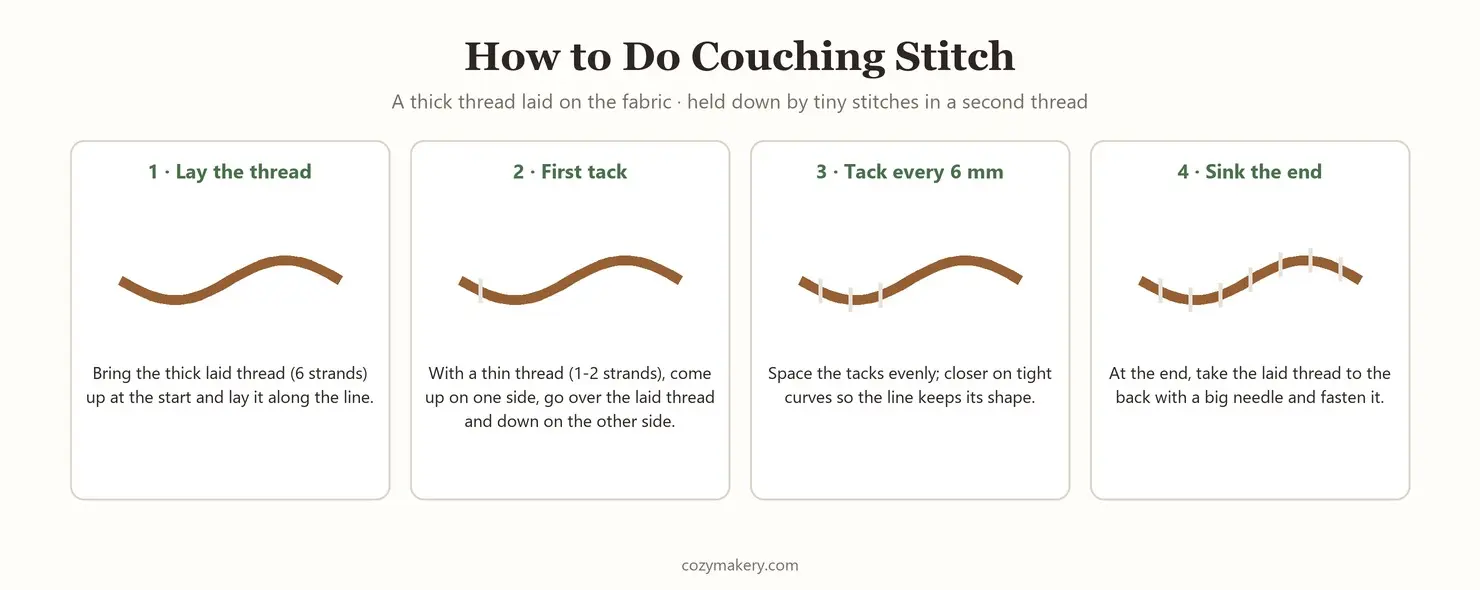
How to do couching stitch
- Lay the thread: Bring the thick laid thread (here, all 6 strands) up at the start of the line and lay it along the line.
- First tack: With a thin thread (1 or 2 strands), come up just beside the laid thread, go over it and down on the other side.
- Tack every 6 mm: Space the tacks evenly, about 1/4 in apart, and closer on tight curves so the line keeps its shape.
- Sink the end: At the end, take the laid thread through to the back with a large needle and fasten it.
Tips for neat couching
- Tack straight across the laid thread, at a right angle, for a crisp look; or at a slant for a twisted look.
- Contrast or match: tacks in a matching colour almost disappear; in a contrast colour, like here, they become part of the design.
- Big needle for sinking: a chenille needle opens a hole big enough for a thick laid thread.
- Couching vs stem stitch: both make lines; stem stitch twists, couching lies flat and smooth.
What you can couch
Almost anything that’s too thick, too fragile or too textured to pull through the fabric: all 6 strands of floss, perle cotton, smooth knitting yarn, metallic threads, narrow ribbon or even a thin cord. Couching also saves thread, because the laid thread stays on the surface instead of running along the back. For a raised look, couch 2 or 3 laid threads side by side, or lay a padding thread first and couch the top thread over it.
Practice pattern: tree rings hoop
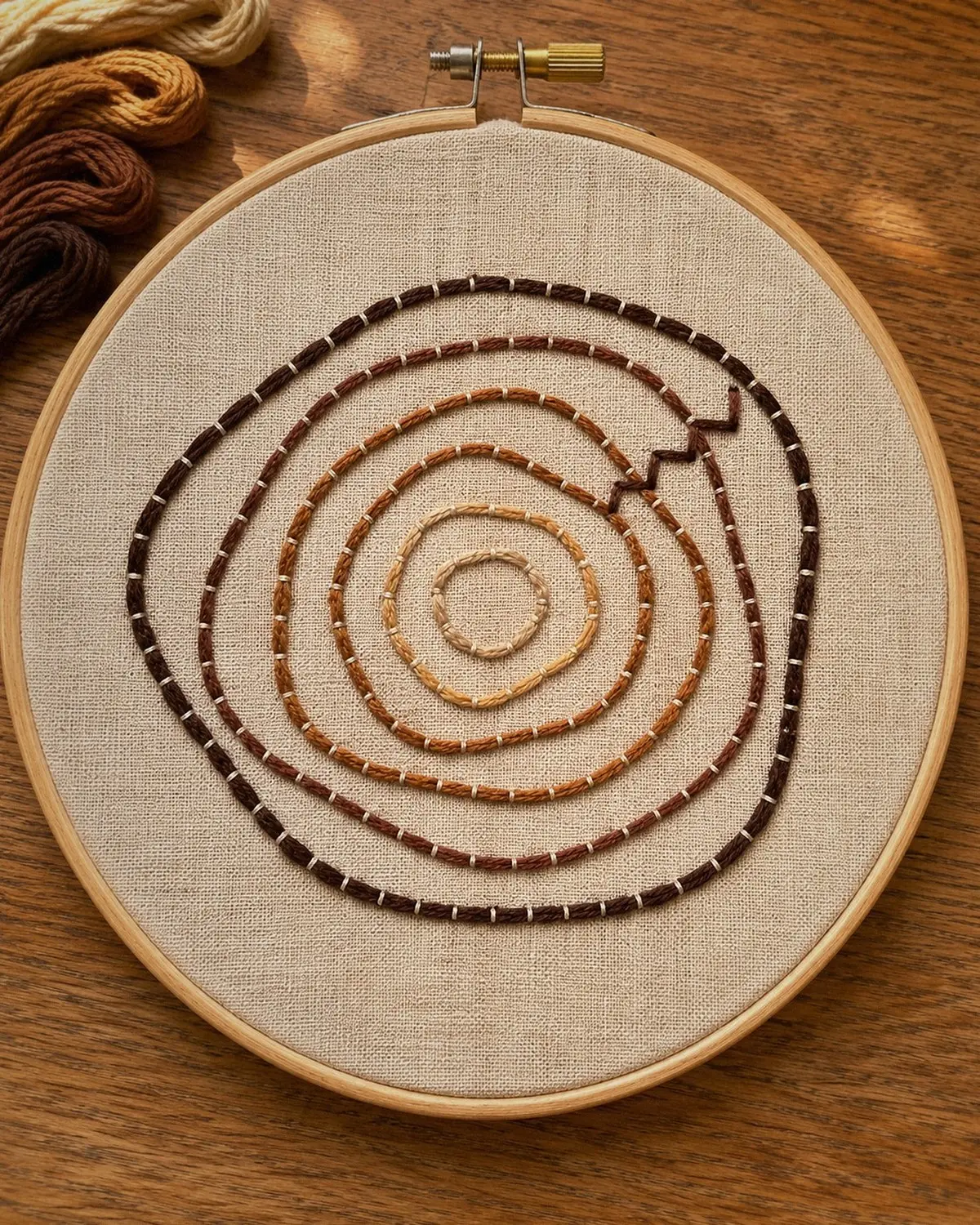
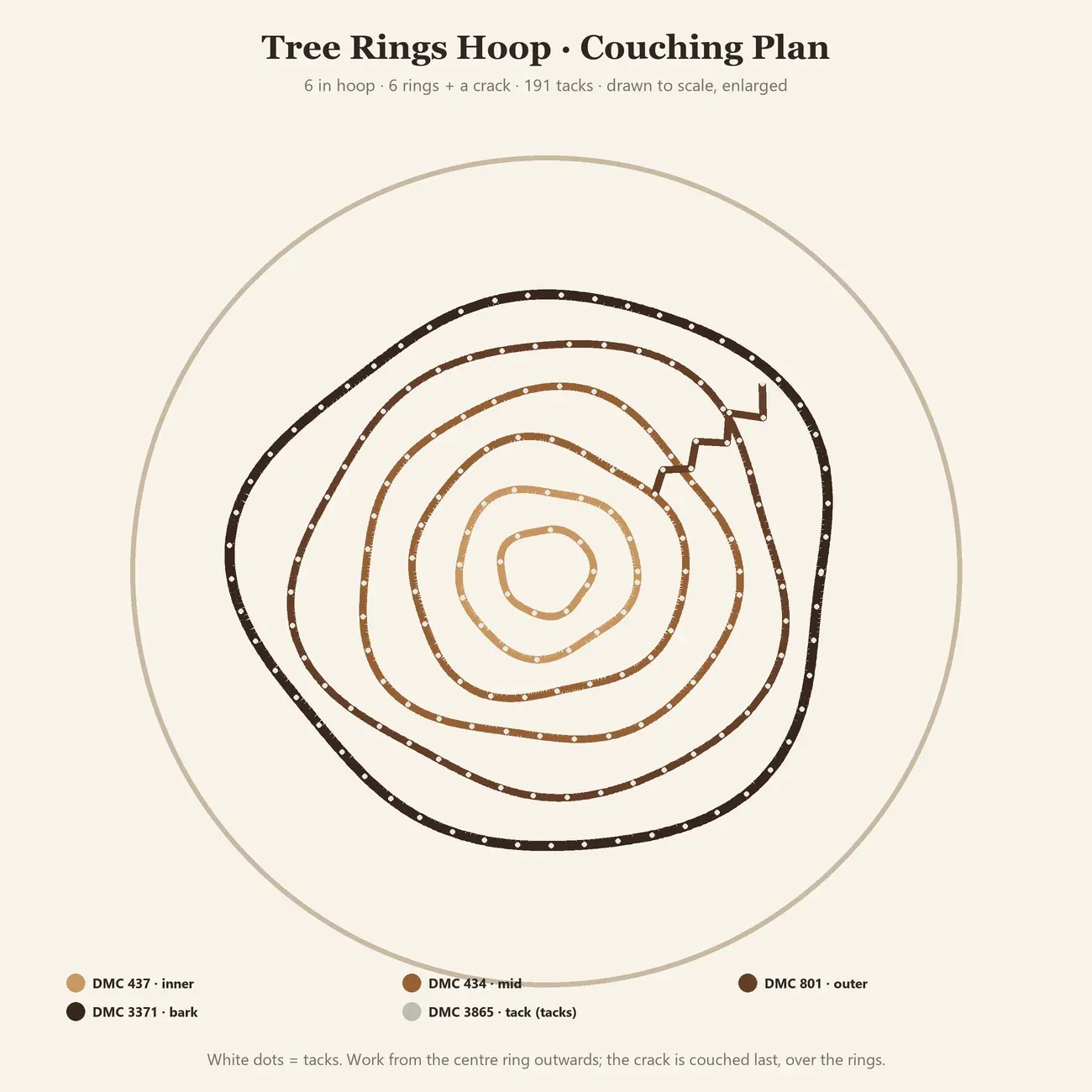
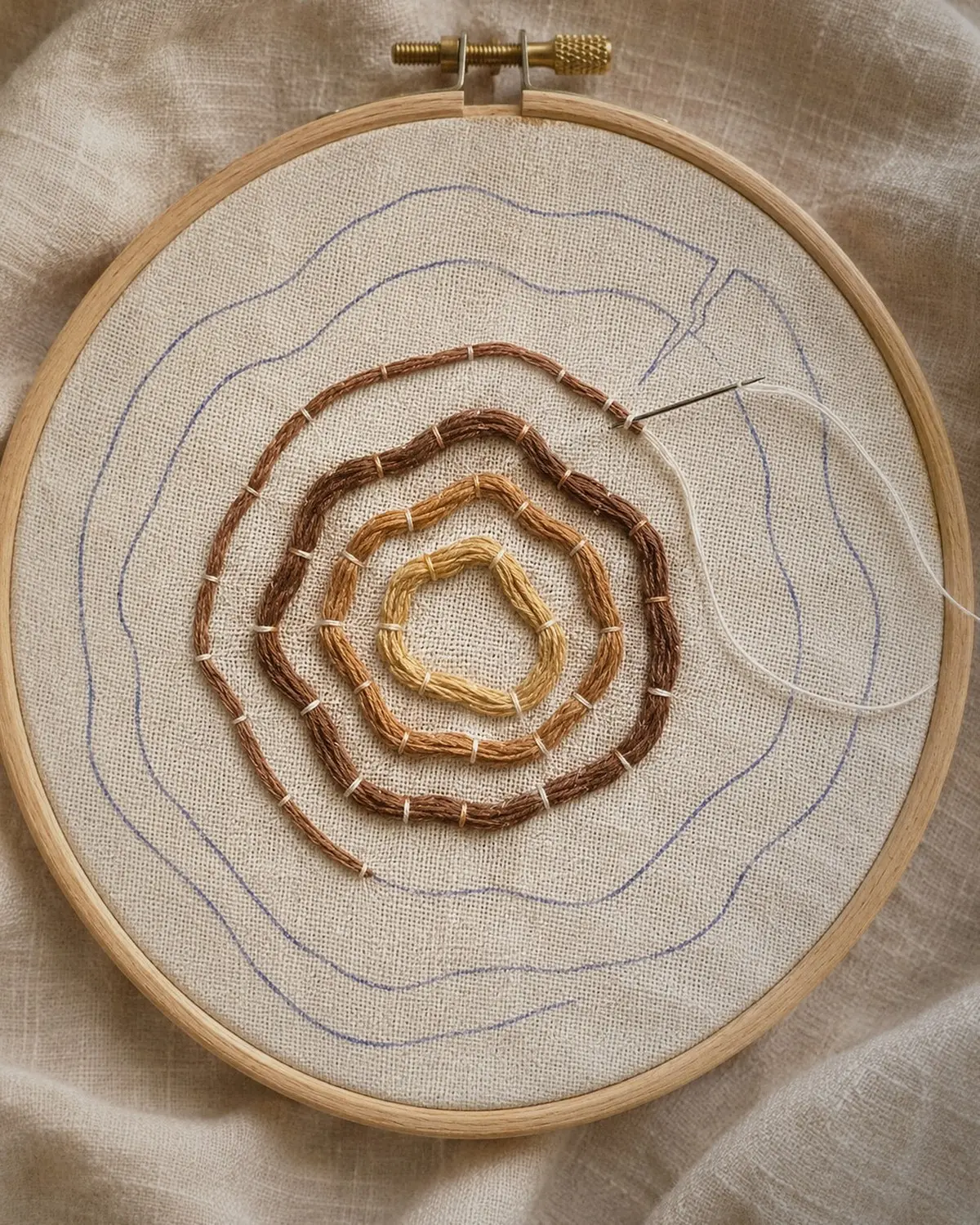
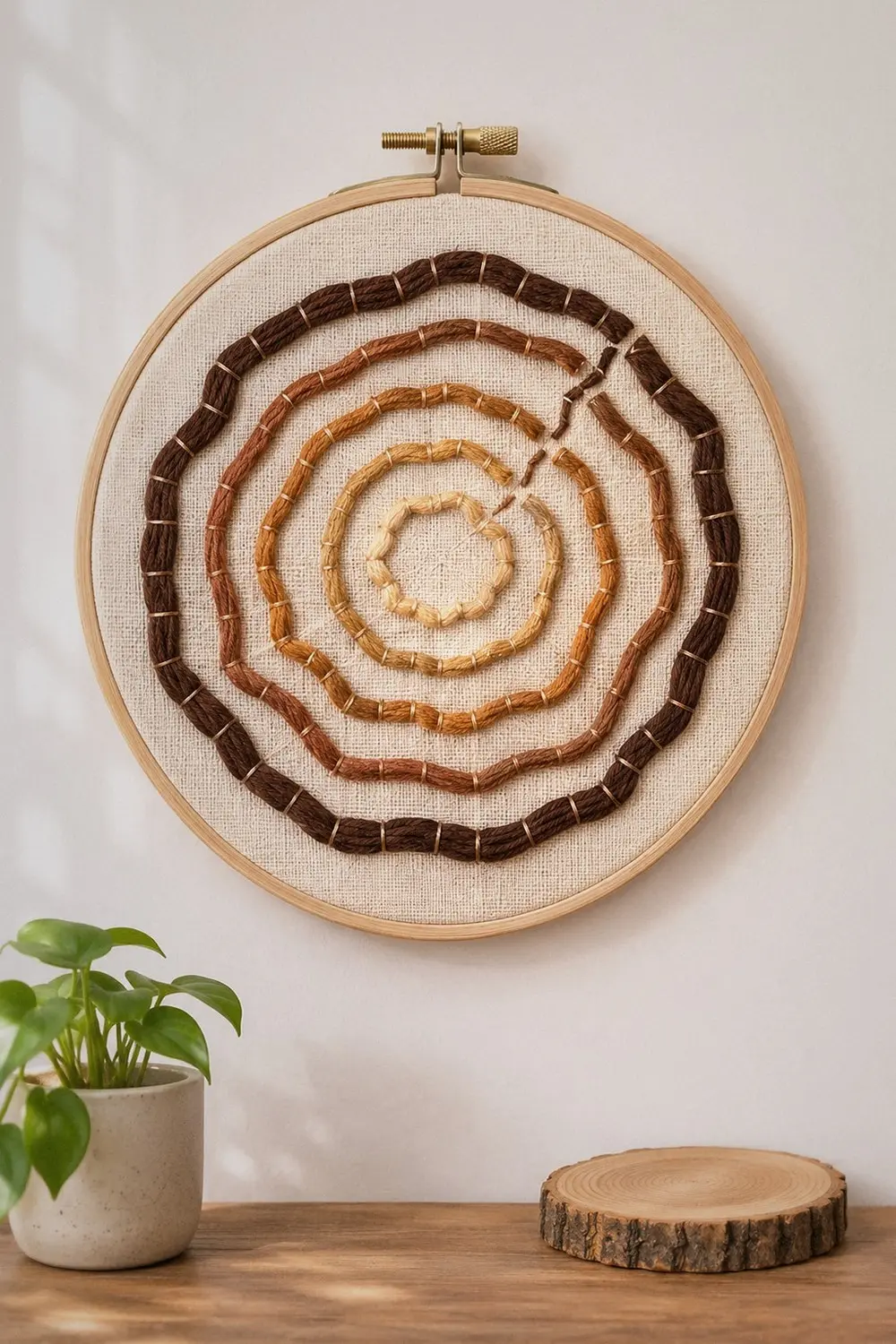
6 wobbly rings in 4 browns, like the rings of a log, with a crack running out from the middle. The laid threads are all 6 strands; the tacks are 2 strands of winter white.
You'll need
- DMC stranded cotton: 437, 434, 801, 3371 and 3865, 1 skein each
- 9 × 9 in (23 cm) natural linen, a 6 in (15 cm) hoop
- Size 7 embroidery needle, a large chenille needle, a water-soluble pen
How to stitch it
- Trace: Print the template at 100%, check the 1 in (2.5 cm) bar, and trace the 6 rings and the crack.
- DMC 437: Couch the 2 inner rings. (26 tacks)
- DMC 434: Couch the 2 middle rings. (59 tacks)
- DMC 801: Couch ring 5, then the crack last, over the rings. (52 tacks)
- DMC 3371: Couch the bark ring. (54 tacks)
- Finish: Rinse out the pen, dry face down, press lightly and frame.
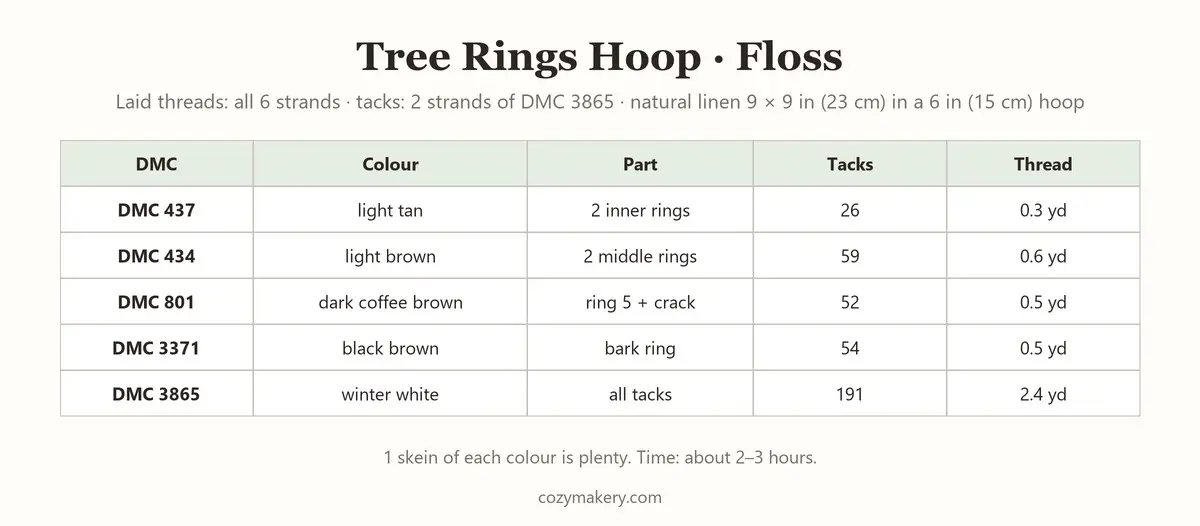
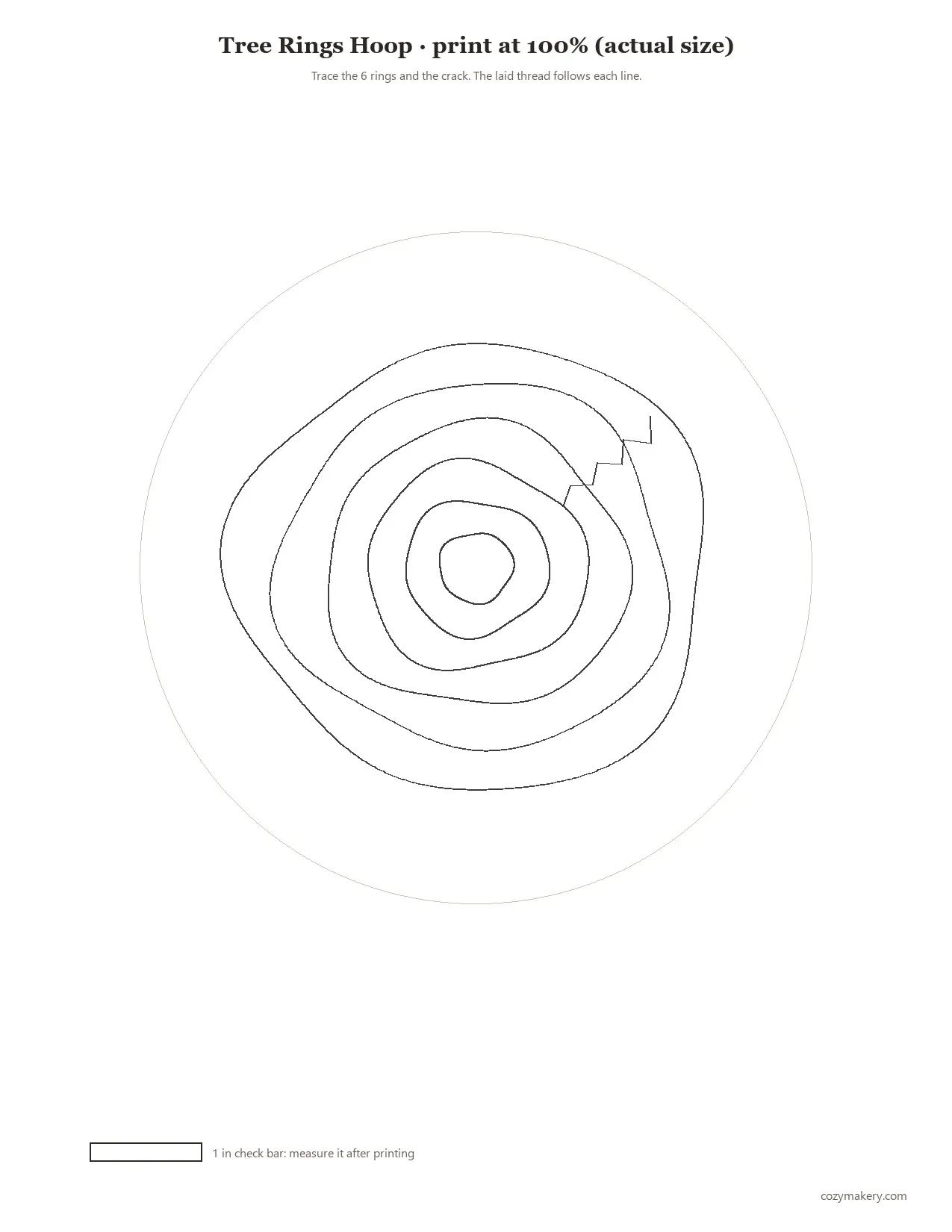
We drew the rings in code and checked the design: every ring is inside the hoop and never touches the next one, and the tacks are spaced evenly (closer on the tight bends). The thread lengths come from the lines. More line stitches: back stitch and running stitch.
Frequently asked questions
What is couching used for?
Bold outlines, lettering, metallic threads and yarns that are too thick to pull through the fabric.
How far apart should couching stitches be?
About 1/4 in (6 mm) on straight lines and gentle curves, closer on tight curves.
Can I couch yarn?
Yes: a smooth yarn makes a lovely bold line. Sink the ends with a large needle or tuck them under.
What thread do I use for the tacks?
1 or 2 strands of floss, in a matching colour to hide them or a contrast colour to show them off.
How many pages is the Couching Stitch PDF?
5 pages on US Letter, including a true-size template. Print the template at 100%; on A4 use “Fit to page” for the other pages.
Is couching good for beginners?
Yes: there’s only one simple stitch, and the laid thread does most of the work.
Save it for later
Pin the photo below to keep the tree rings hoop on your Pinterest board. Made the tree rings hoop? I’d love to see it: send a photo to info@cozymakery.com.
More stitches: hand embroidery stitches, satin stitch and free embroidery patterns.