C2C crochet (corner-to-corner) builds a square or rectangle diagonally, from one corner to the opposite one, out of little blocks of 3 double crochet. Each block is a pixel, so C2C is the easiest way to crochet a picture from a graph. This tutorial covers the first block, increase rows, decrease rows, reading a C2C graph and changing colours, and a practice project: a pixel heart wall hanging on a wooden dowel, in 2 sizes.
In this post
Pattern at a glance
- Skill levelAdvanced beginner
- PracticeHeart wall hanging, 2 sizes
- YarnWorsted (#4), 3 colours
- Hook5 mm (US H-8)
- Gauge1 block ≈ 0.5 in (1.3 cm)
- TimeAbout 3–6 hours
Free printable pattern
The PDF has the C2C steps, the diagonal row diagram, both heart graphs, the size table and every row of the mini heart written out. The C2C Crochet PDF has 7 pages and prints on US Letter paper; on A4, choose “Fit to page” in the print dialog.
How to start C2C: the first block
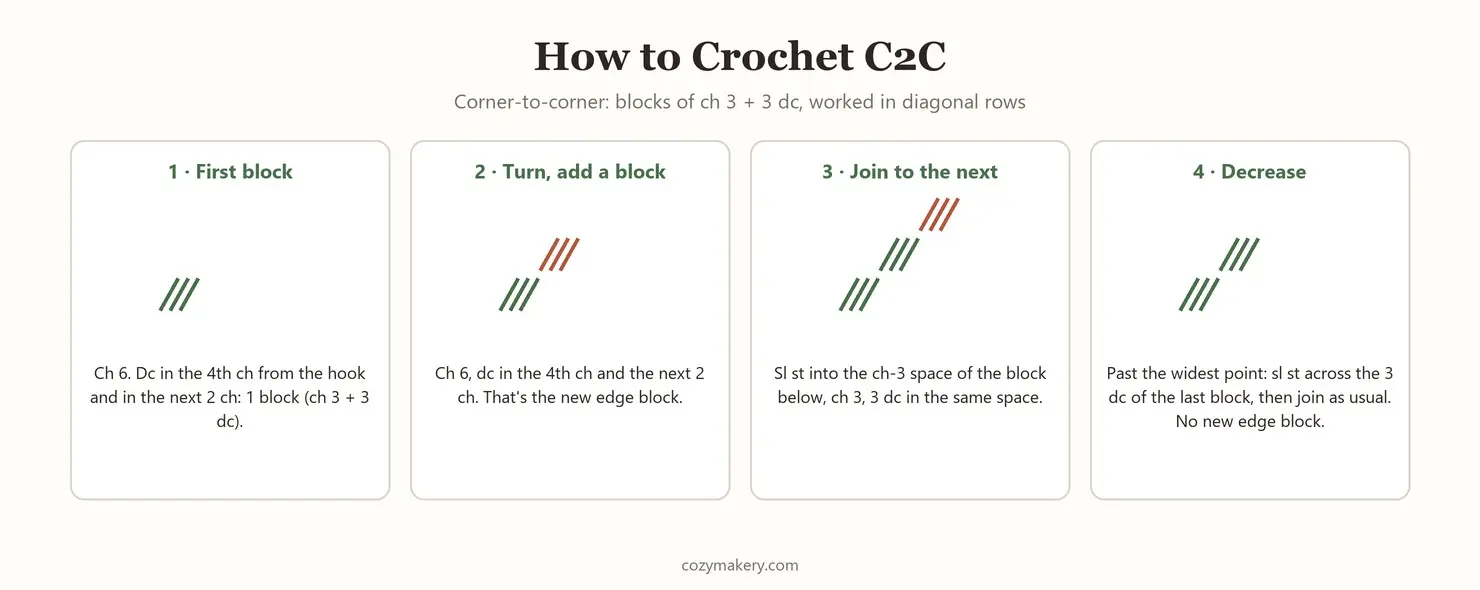
Chain 6. Double crochet in the 4th chain from the hook and in the next 2 chains. That’s 1 block: a ch-3 space on one side and 3 dc. Turn.
Increase rows
- New edge block: Chain 6, dc in the 4th ch from the hook and in the next 2 ch.
- Join: Slip stitch into the ch-3 space of the next block of the row below.
- Next block: Chain 3, then 3 dc into that same ch-3 space.
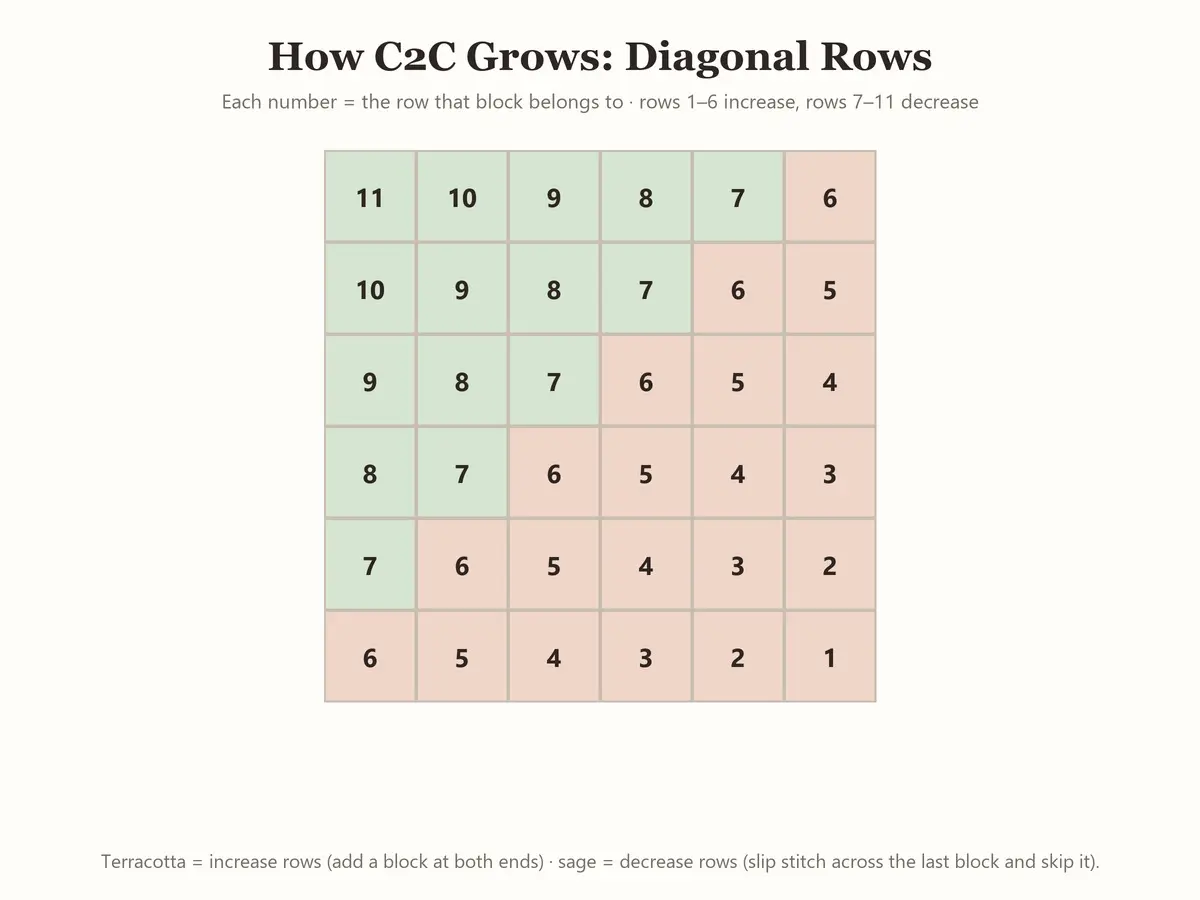
- Repeat: Keep joining and making blocks across. Each increase row has 1 more block than the last.
Decrease rows
Once the piece is as wide as you want (the widest diagonal), you stop adding edge blocks. At the start of each decrease row, slip stitch across the 3 dc of the last block and into its ch-3 space, chain 3, 3 dc in the same space, then carry on as usual. At the end of the row, stop before the last block. Each decrease row has 1 block fewer.
Reading a C2C graph and changing colours
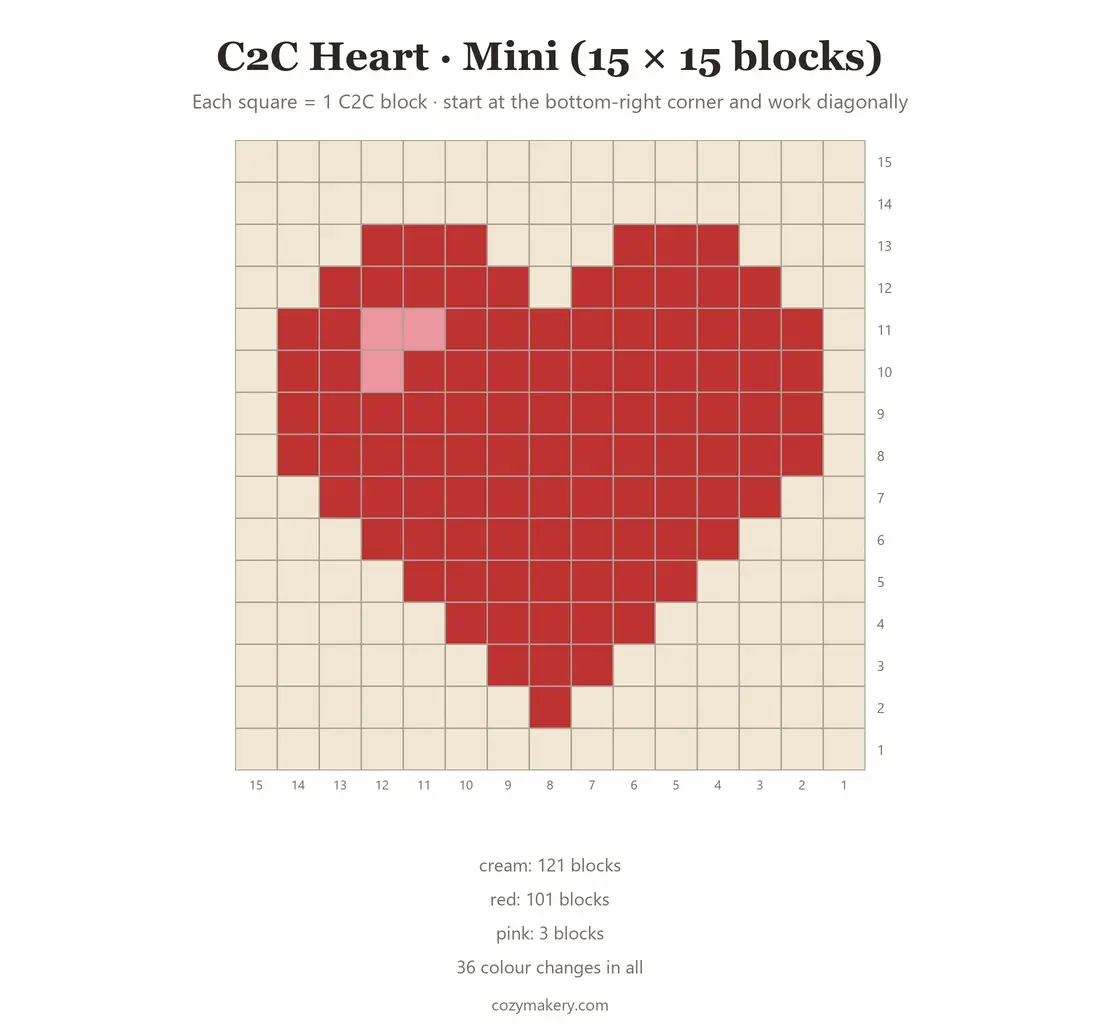
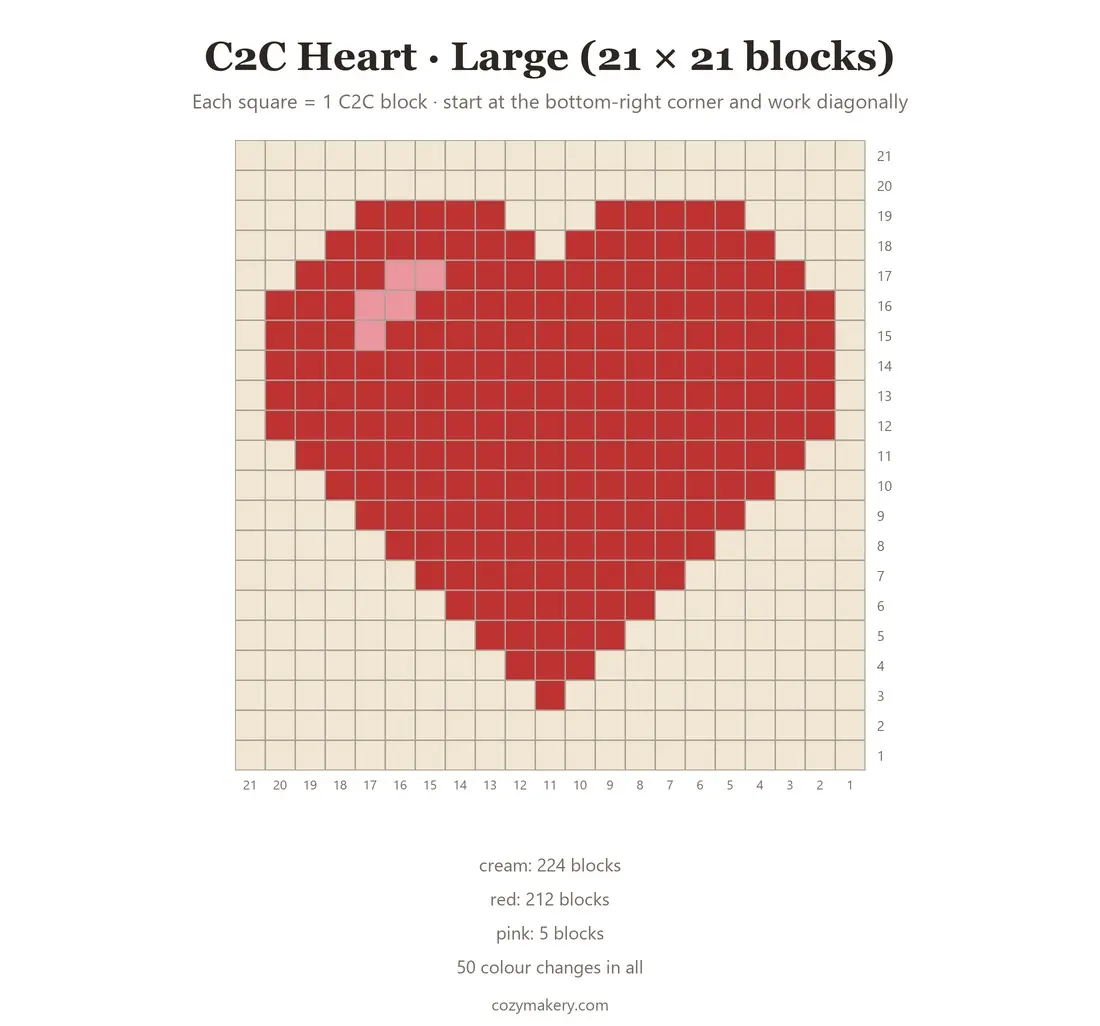
Each square of the graph is 1 block. Start at the bottom-right corner and read each diagonal in the direction you’re working. To change colour, finish the last dc of the old colour with the new colour (yarn over with the new colour for the final pull-through). Use a small ball or bobbin for every colour section rather than carrying yarn across. Our changing colours in crochet guide shows the move.
Practice project: C2C heart wall hanging
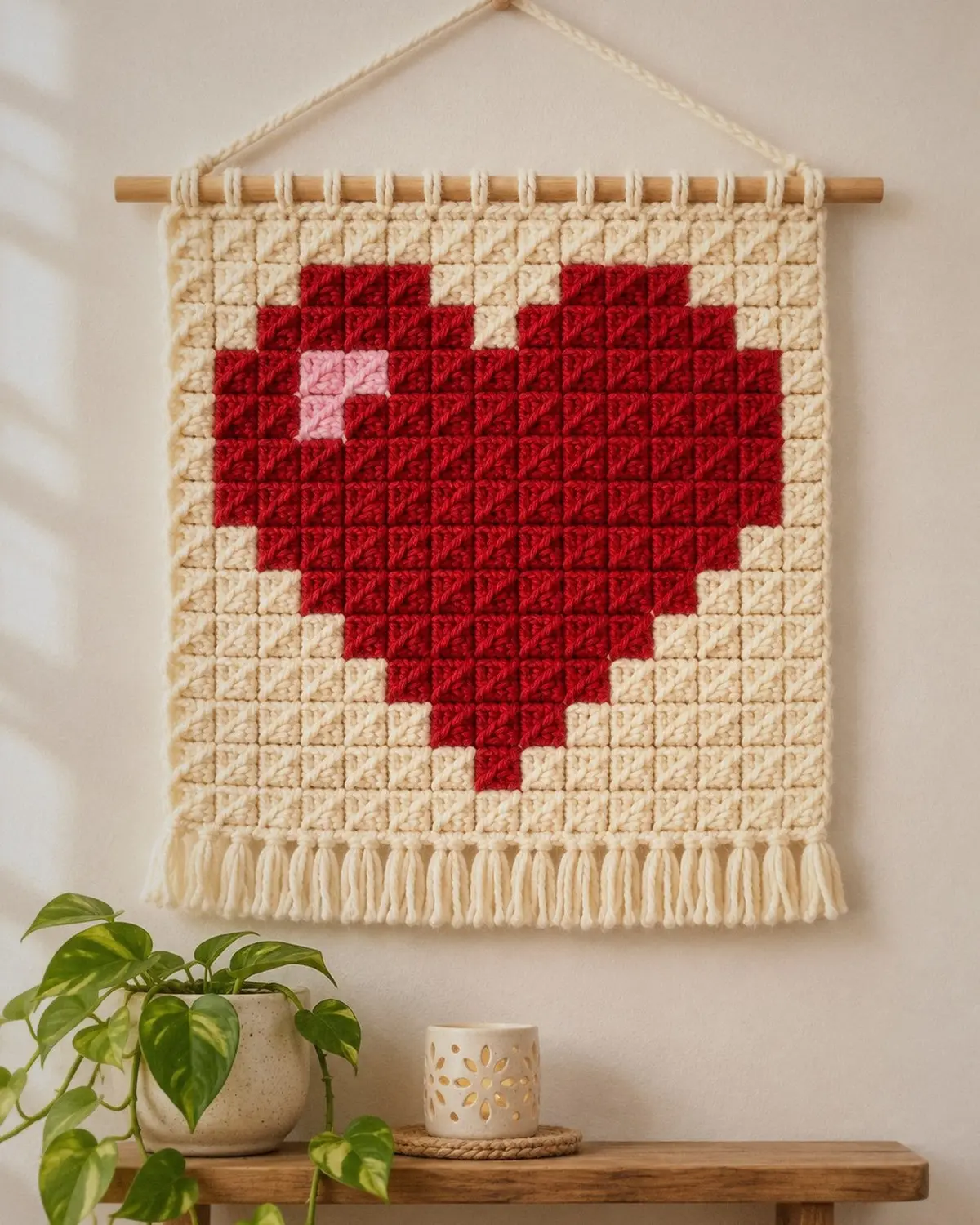
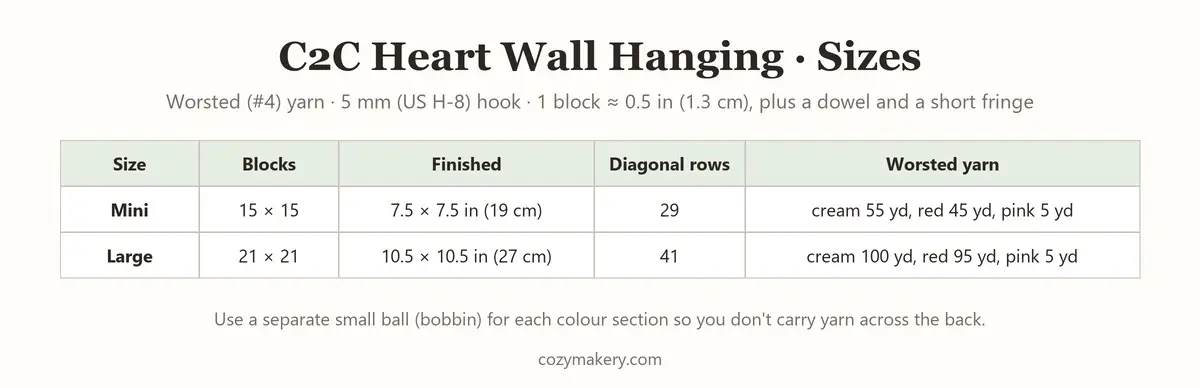
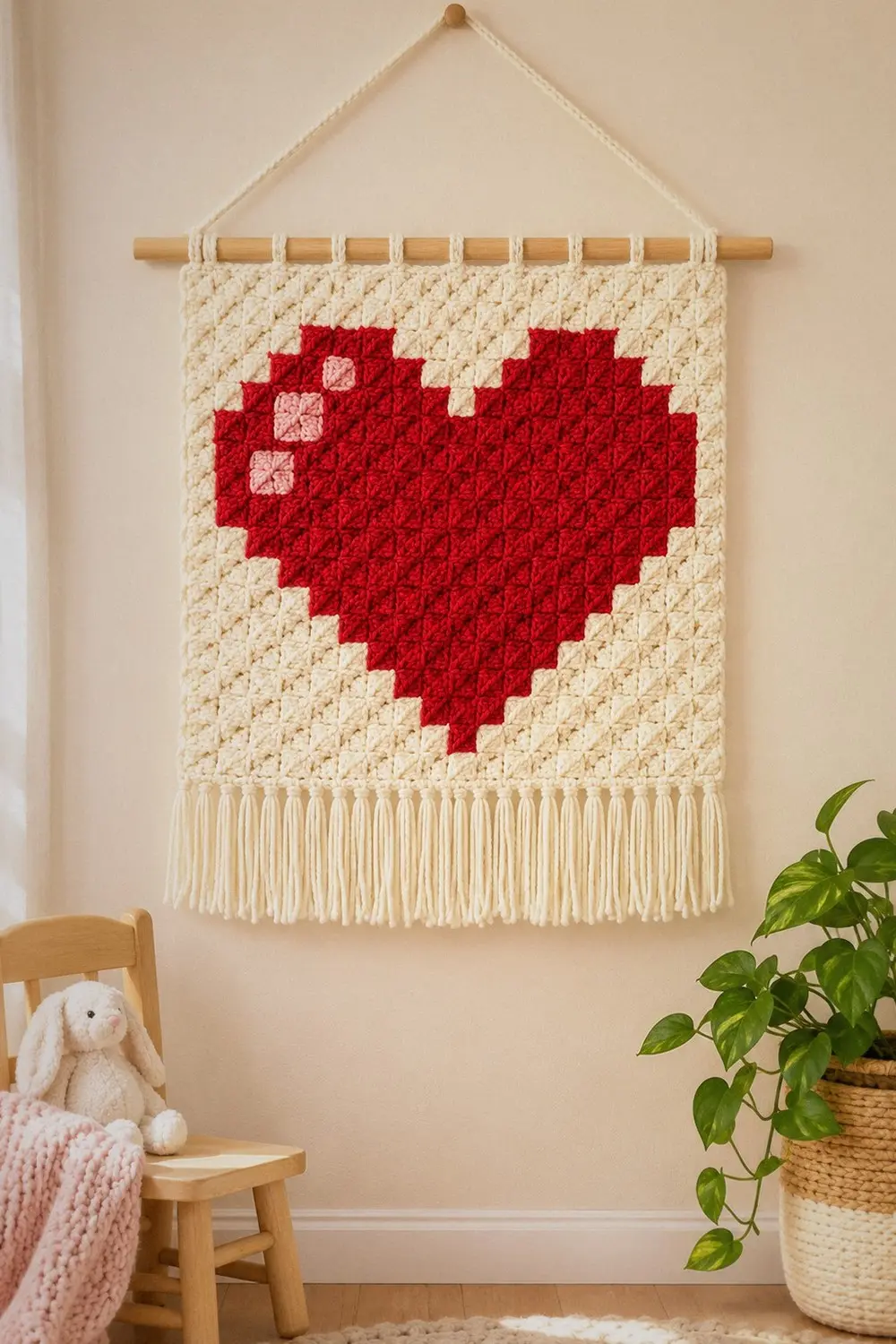
The mini heart is 15 × 15 blocks: cream background, a red heart and a tiny pink highlight. Hung on a dowel with a short fringe, it makes a sweet nursery or Valentine’s decoration. The large version is 21 × 21 blocks.
You'll need
- Worsted (#4) yarn for the mini: cream 55 yd, red 45 yd, pink 5 yd (the large size is in the table)
- 5 mm (US H-8) hook, tapestry needle, yarn bobbins
- A 10 in (25 cm) wooden dowel for the mini, 14 in (36 cm) for the large
Gauge: 1 block ≈ 0.5 in (1.3 cm) in worsted with a 5 mm hook. It’s a typical value, not a measured one: measure a few rows, and if your blocks are bigger the hanging is simply bigger.
Mini heart, every row (29 rows)
- Row 1: increase: 1 cream (1)
- Row 2: increase: 2 cream (2)
- Row 3: increase: 3 cream (3)
- Row 4: increase: 4 cream (4)
- Row 5: increase: 5 cream (5)
- Row 6: increase: 6 cream (6)
- Row 7: increase: 7 cream (7)
- Row 8: increase: 8 cream (8)
- Row 9: increase: 1 cream, 7 red, 1 cream (9)
- Row 10: increase: 1 cream, 7 red, 2 cream (10)
- Row 11: increase: 2 cream, 8 red, 1 cream (11)
- Row 12: increase: 1 cream, 8 red, 3 cream (12)
- Row 13: increase: 3 cream, 8 red, 2 cream (13)
- Row 14: increase: 2 cream, 8 red, 4 cream (14)
- Row 15: increase: 4 cream, 8 red, 3 cream (15)
- Row 16: decrease: 2 cream, 8 red, 4 cream (14)
- Row 17: decrease: 3 cream, 8 red, 2 cream (13)
- Row 18: decrease: 2 cream, 7 red, 3 cream (12)
- Row 19: decrease: 2 cream, 5 red, 4 cream (11)
- Row 20: decrease: 3 cream, 5 red, 2 cream (10)
- Row 21: decrease: 1 cream, 2 red, 2 pink, 1 red, 3 cream (9)
- Row 22: decrease: 2 cream, 2 red, 1 pink, 2 red, 1 cream (8)
- Row 23: decrease: 1 cream, 4 red, 2 cream (7)
- Row 24: decrease: 2 cream, 3 red, 1 cream (6)
- Row 25: decrease: 5 cream (5)
- Row 26: decrease: 4 cream (4)
- Row 27: decrease: 3 cream (3)
- Row 28: decrease: 2 cream (2)
- Row 29: decrease: 1 cream (1)
Finishing
- Border (optional): 1 round of sc all around, 3 sc in each corner.
- Hang: Fold the top edge over the dowel and sew it down, or tie it on with short yarn loops every 1 in (2.5 cm).
- Fringe: Cut 6 in (15 cm) strands, fold each in half and loop it through the bottom edge.
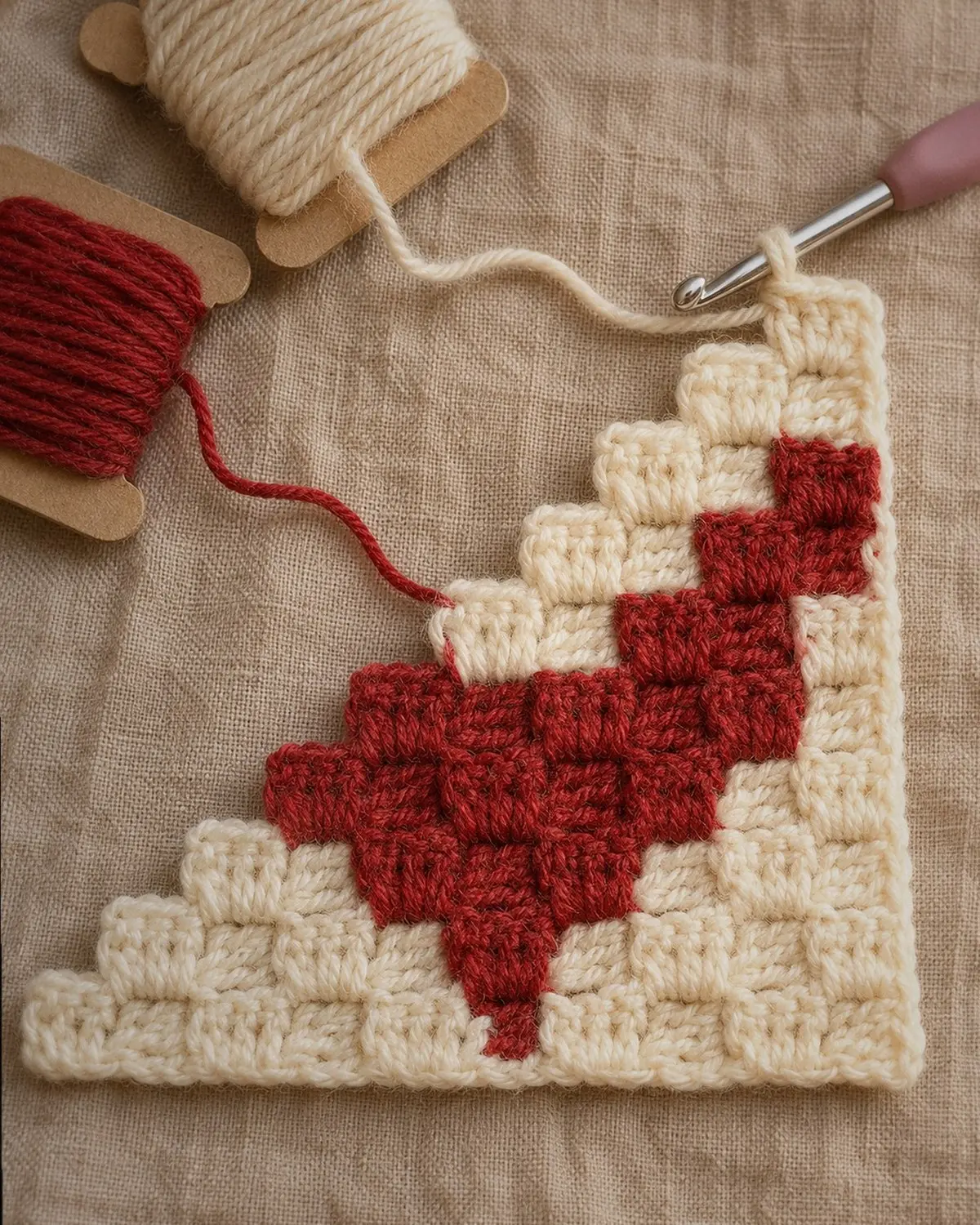
We walked the graph diagonal by diagonal in code: every block is worked exactly once, the rows go 1, 2, 3 … 15 and back down, and the heart shape is symmetric. The written rows above come from the same model, so they always match the graph (36 colour changes in the mini).
Frequently asked questions
What does C2C mean in crochet?
Corner-to-corner: the piece is worked diagonally from one corner to the opposite one, in blocks of ch 3 + 3 dc.
Is C2C crochet hard?
No. Once you can do the first 3 rows the rest is the same moves; the decrease rows are the only new part.
How do I make a C2C rectangle?
Increase until one side is as long as the short side you want, then increase on one edge and decrease on the other until the long side is long enough, then decrease on both.
How many blocks wide is a C2C baby blanket?
In worsted yarn, about 60–70 blocks for 30–35 in (76–90 cm). Measure your blocks first.
How many pages is the C2C Crochet PDF?
7 pages on US Letter, with both graphs and every row of the mini heart written out. On A4, print with “Fit to page”.
Can I use the heart graph for a pillow or blanket?
Yes. Any C2C graph works for any project; just add more background blocks around it.
Save it for later
Pin the photo below to keep the C2C heart wall hanging on your Pinterest board. Made the C2C heart wall hanging? I’d love to see it: send a photo to info@cozymakery.com.
More crochet techniques: changing colours, weaving in ends and crochet hearts. Knitters can make the same kind of pixel heart in double knitting, reversible on both sides. Another way to crochet a 2-colour picture is mosaic crochet, one colour per row.