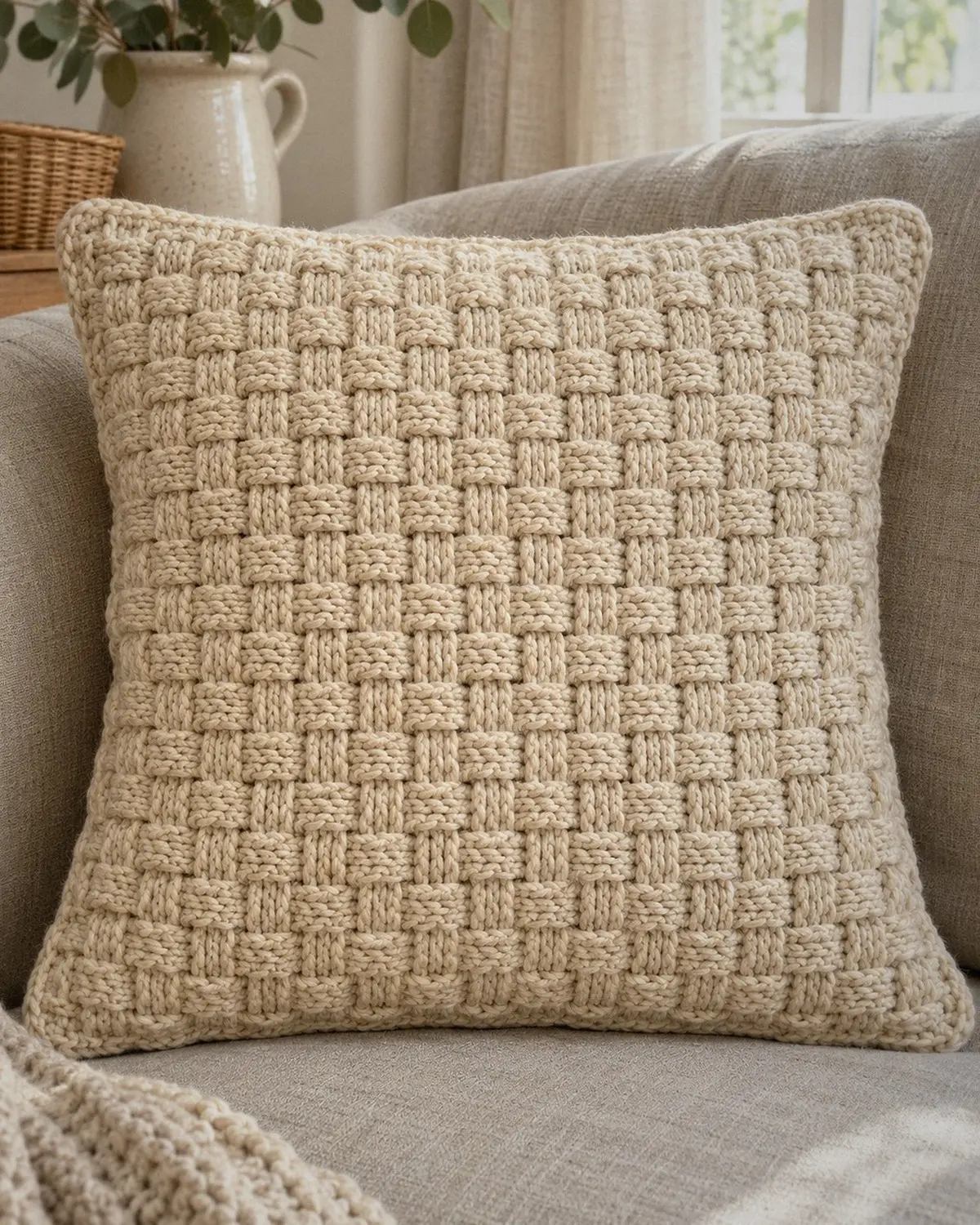
Raised blocks next to sunken ones, trading places every couple of rows, so the fabric looks like woven strips: that’s the basketweave stitch in crochet. It’s made with front post and back post double crochet, worked around the posts of the stitches below, and the result is thick, squishy and very warm, which is why it turns up so often on pillows and blankets. This tutorial covers both post stitches, how the blocks work on right side and wrong side rows, and a practice project: a basketweave pillow cover in 2 sizes.
In this post
Project snapshot
- Skill levelIntermediate
- PracticePillow cover, 2 sizes
- YarnWorsted (#4)
- Hook5 mm (US H-8)
- Gauge14 sts × 8 rows = 4 in (10 cm)
- TimeAbout 10 / 12 hours
PDF with both pillow sizes
The 6-page PDF has the post stitch steps, the chart, the panel diagram, the size table and both pillow sizes row by row. It’s formatted for US Letter; for A4, choose “Fit to page”.
How to crochet the basketweave stitch
- Front post double crochet: Yarn over, insert the hook from front to back round the post (the upright part) of the next stitch and out to the front again. Finish as a dc.
- It sits on top: The front post dc pushes its stitch forward: a raised column on the side facing you.
- Back post double crochet: Yarn over, insert from back to front round the post and to the back again. Finish as a dc. That stitch sinks away from you.
- Blocks: Work 3 front post, 3 back post across. After 2 rows, swap them: the raised blocks sit above sunken ones.
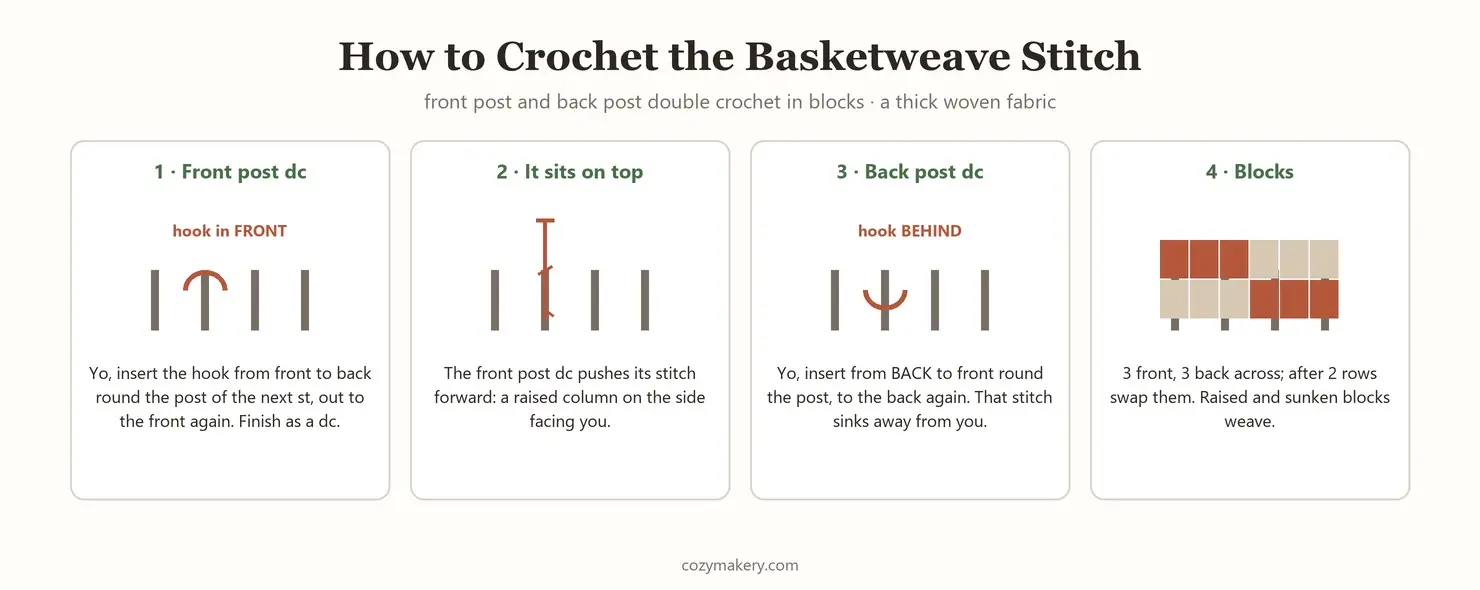
Post stitches come from front post double crochet; if double crochet is new, practise that first.
Right side and wrong side rows
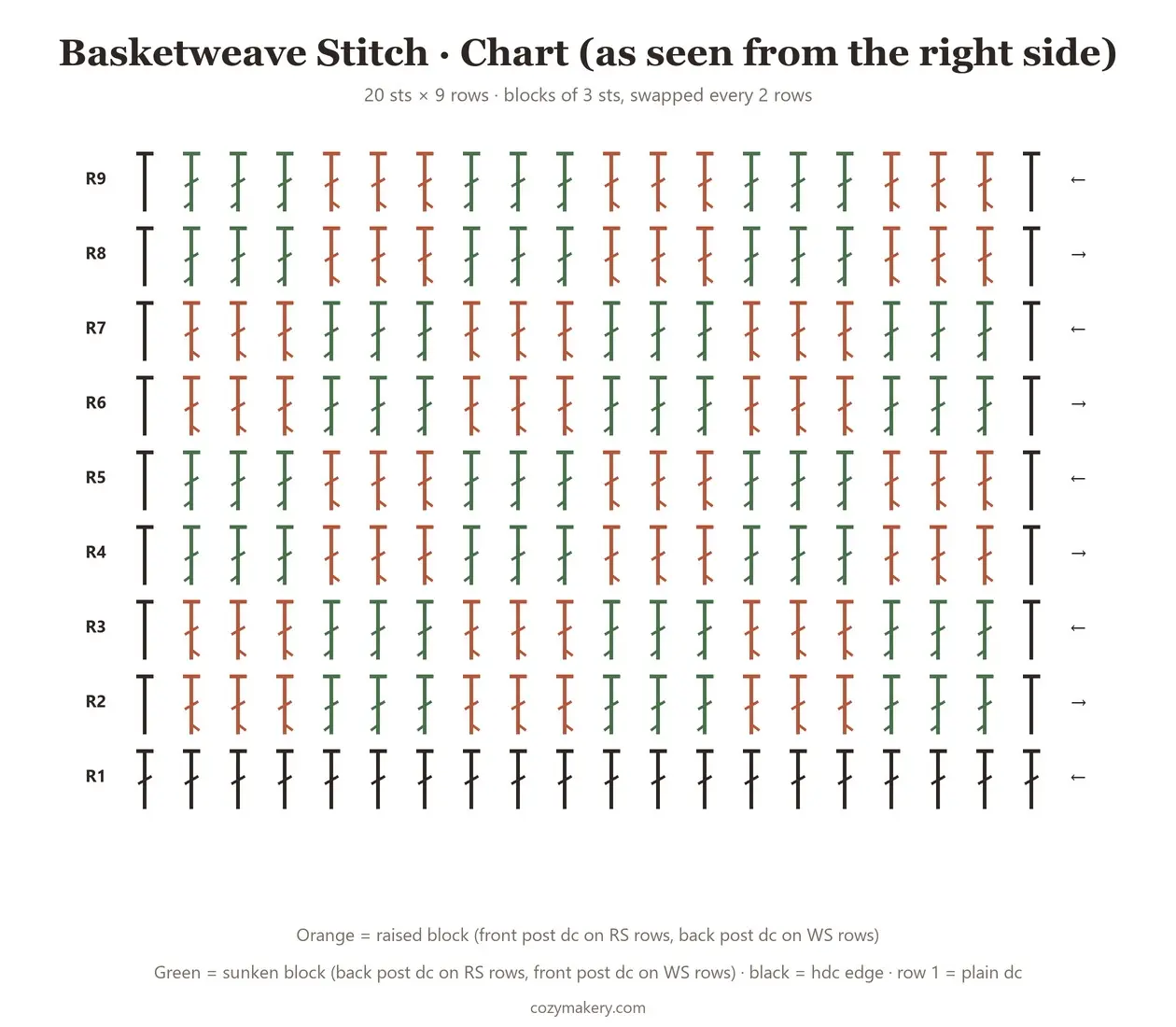
Here’s the part that confuses everyone: a front post stitch worked on the wrong side looks sunken from the right side. So on wrong side rows you swap them. If a block should look raised on the right side, work it as back post on a wrong side row; if it should look sunken, work it as front post. Our chart shows the fabric as you see it from the right side, and the written rows tell you which stitch to make.
Tips for even blocks
- Edge stitches: the first and last stitch of every row are hdc, so the blocks stay neat and the edges straight.
- Loose post stitches: pull up the first loop to dc height, or the fabric pulls in and curls.
- Count the blocks every row: if a block grows to 4, you missed a stitch at the edge or worked twice round one post.
- Lots of yarn: post stitches use about a third more yarn than plain dc. Buy an extra skein.
Practice project: basketweave pillow cover
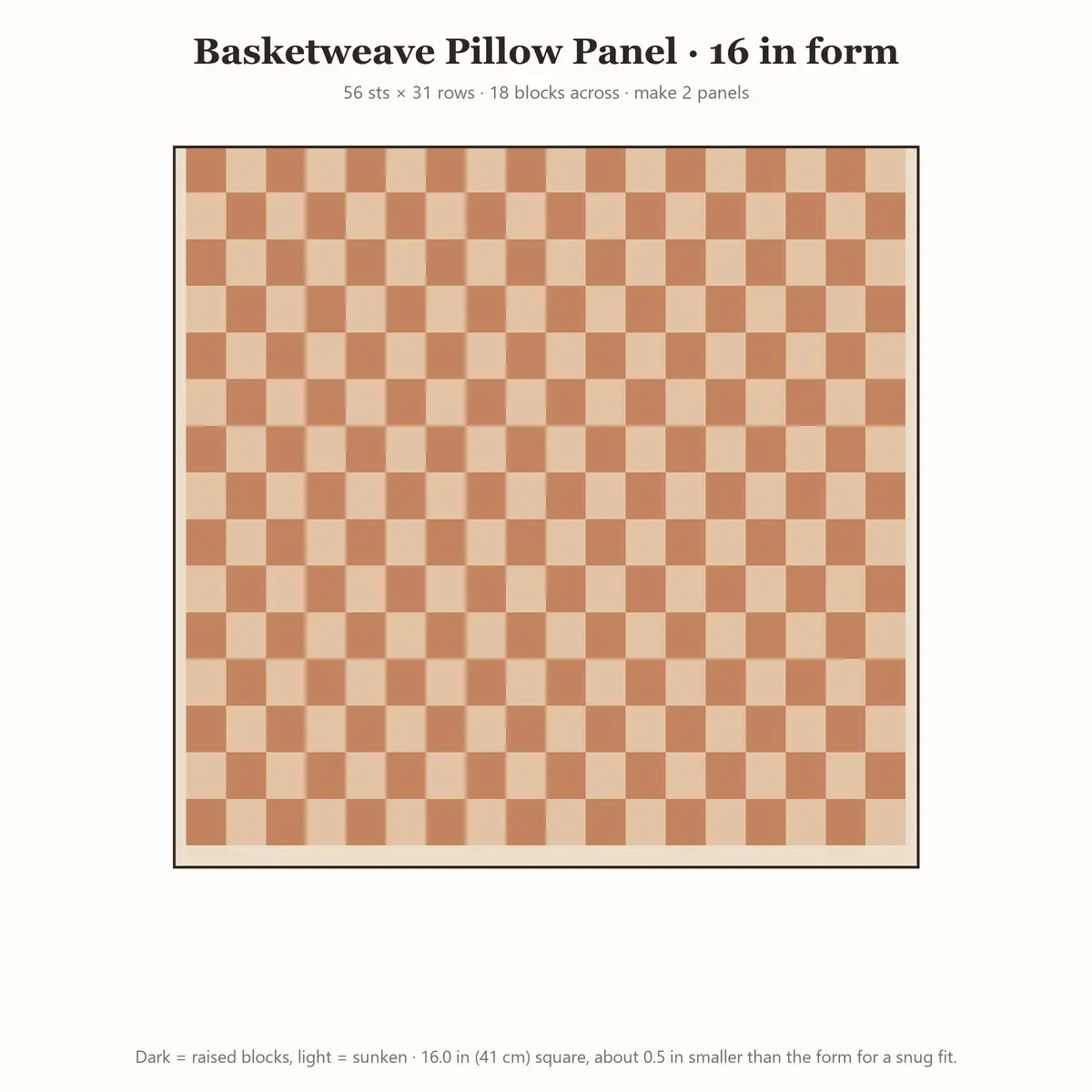
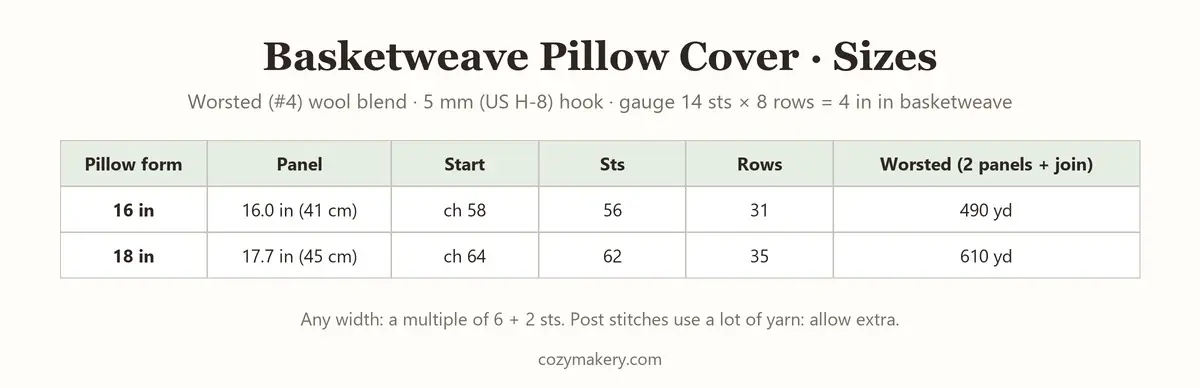
2 identical square panels, joined with sc round 3 sides; slip in the pillow form and close the last side. Each panel for a 16 in form is 56 stitches by 31 rows, about half an inch smaller than the form so the cover fits snugly.
You'll need
- Worsted (#4) wool blend: 490 yd for a 16 in (41 cm) form or 610 yd for an 18 in (46 cm) form
- 5 mm (US H-8) hook, tapestry needle, a pillow form
Gauge: 14 sts and 8 rows = 4 in (10 cm) in basketweave, a typical worsted value, not one we measured.
Panel for a 16 in (41 cm) form
- Foundation: Ch 58.
- Row 1 (WS): Dc in the 3rd ch from the hook and in each ch across (56 dc). Turn. (56)
- Row 2 (RS): Ch 2 (doesn't count as a st), hdc in the first st, *fpdc in the next 3, bpdc in the next 3*; repeat 9 times, hdc in the last st. Turn. (56)
- Row 3 (WS): Ch 2 (doesn't count as a st), hdc in the first st, *fpdc in the next 3, bpdc in the next 3*; repeat 9 times, hdc in the last st. Turn. (56)
- Row 4 (RS): Ch 2 (doesn't count as a st), hdc in the first st, *bpdc in the next 3, fpdc in the next 3*; repeat 9 times, hdc in the last st. Turn. (56)
- Row 5 (WS): Ch 2 (doesn't count as a st), hdc in the first st, *bpdc in the next 3, fpdc in the next 3*; repeat 9 times, hdc in the last st. Turn. (56)
- Rows 6–31: Repeat rows 2–5, ending after row 31. The panel measures about 15.5 in (39 cm) square. (56)
- Second panel: Make a second panel the same.
- Join: Hold the panels wrong sides together. Sc through both layers round 3 sides (3 sc in each corner), insert the pillow form, then sc the 4th side closed. Join, fasten off.
For an 18 in (46 cm) form: ch 64, 62 stitches and 35 rows, with the same 4-row repeat.
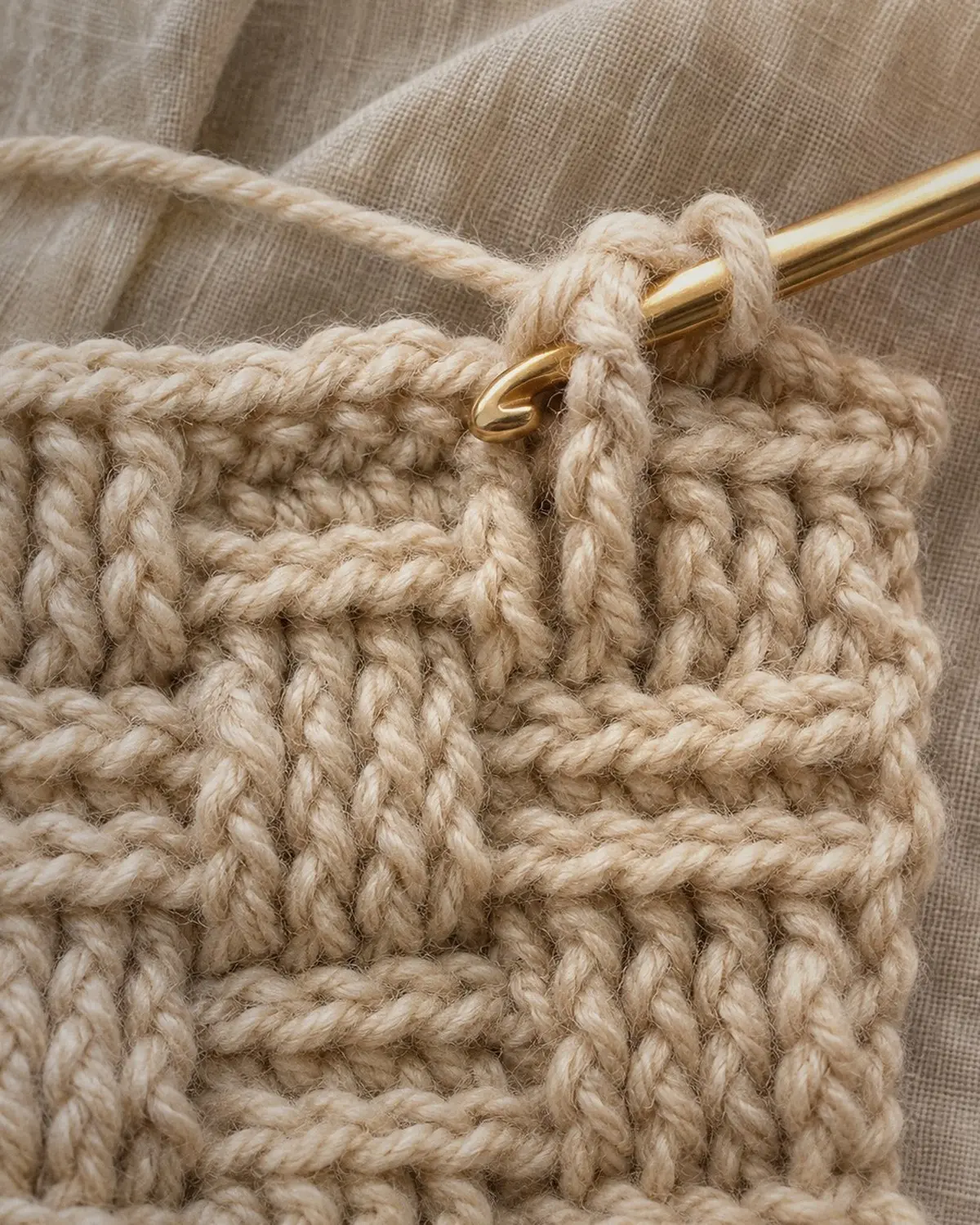
Every row is checked column by column: which blocks are raised, which post stitch to use on right and wrong side rows, that the blocks are 3 stitches wide and 2 rows tall, and that they alternate in both directions. For more texture, see the waffle stitch and these crochet pillow patterns.
Basketweave questions
Why are my basketweave blocks not showing?
On wrong side rows, front and back post must swap. If you work the same stitch on both sides, the blocks flatten out.
How many stitches for basketweave crochet?
A multiple of 6 plus 2 here: blocks of 3 raised and 3 sunken, plus an hdc at each edge.
Does basketweave use a lot of yarn?
Yes, about a third more than plain double crochet, because each post stitch wraps round the stitch below.
Is basketweave reversible?
Almost: the back shows the same checkerboard with raised and sunken swapped.
Can I make a blanket in basketweave?
Yes: chain a multiple of 6 + 4 and keep going. It’s heavy and warm, so a lap blanket size is plenty.
More crochet: popcorn stitch, alpine stitch and how to block crochet.