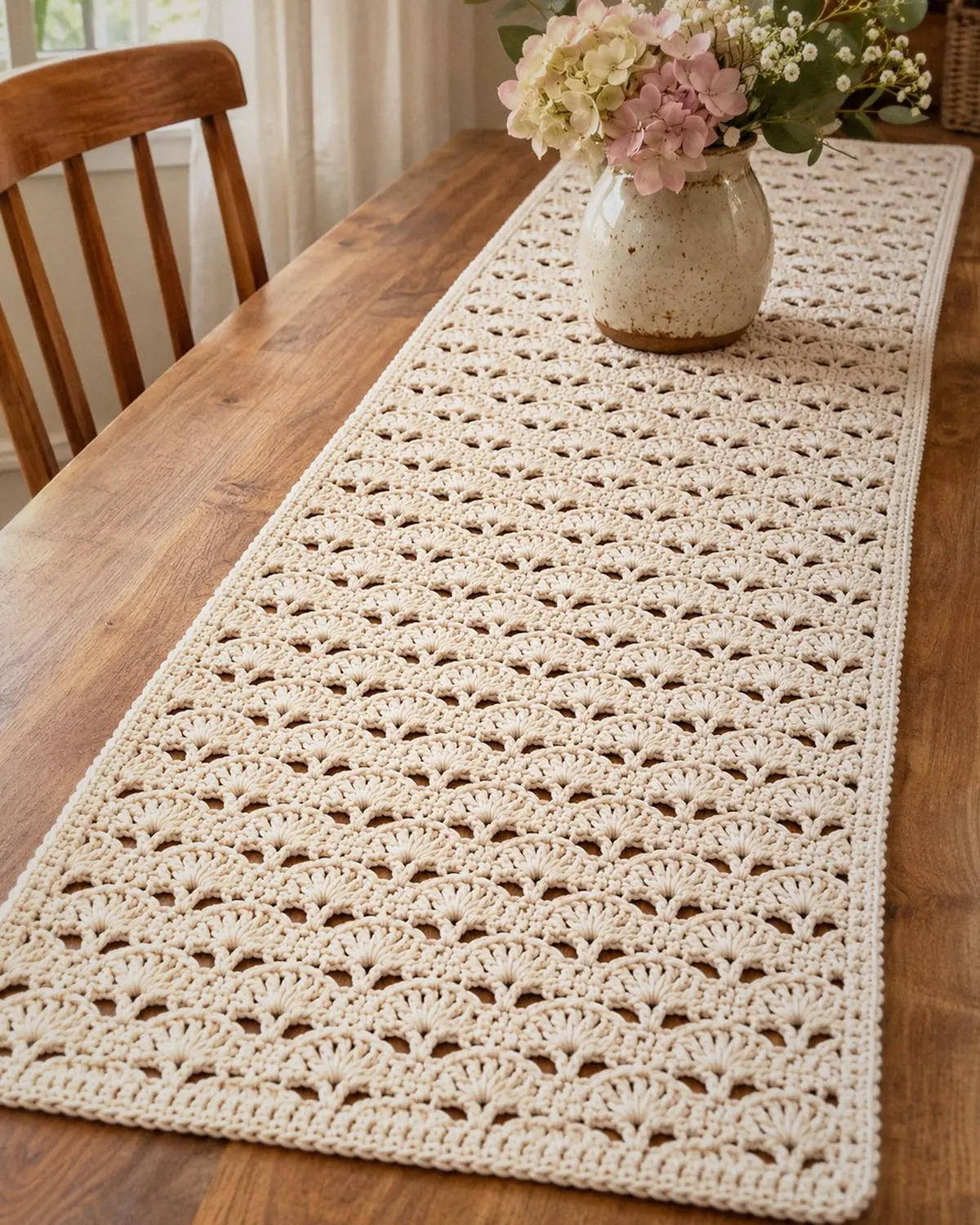
Start 3 double crochets in one stitch, leave each one unfinished, then close them all together with one yarn over: that’s the 3-dc cluster, the most common cluster stitch in crochet. Worked into one stitch it fans out into a little bobble that still sits flat, and with chains between the clusters the fabric turns lacy. This tutorial covers the 3-dc cluster, how it differs from puff, bobble and popcorn stitches, a brick-style row pattern, and a practice project: a table runner in 2 sizes.
In this post
Before you start
- Skill levelAdvanced beginner
- PracticeTable runner, 2 sizes
- YarnWorsted (#4) cotton
- Hook5 mm (US H-8)
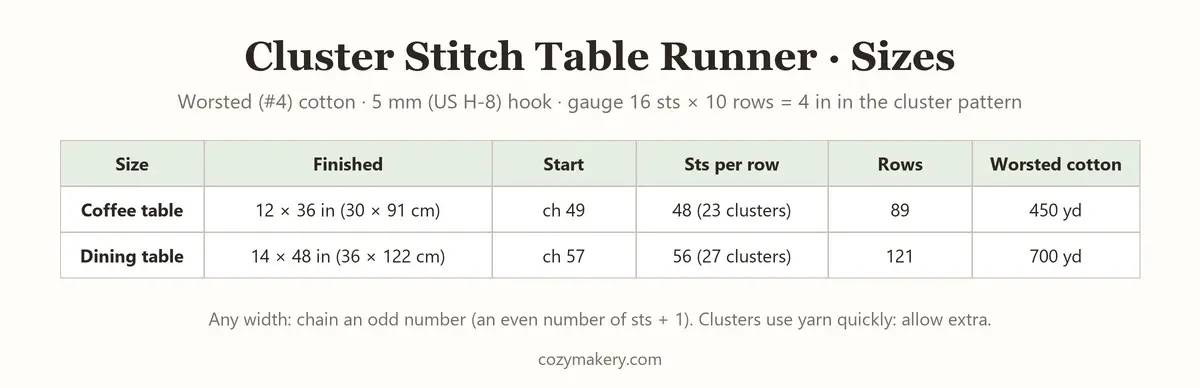
- Gauge16 sts × 10 rows = 4 in (10 cm)
- TimeAbout 7 / 11 hours
Print the runner pattern
The 6-page PDF has the cluster steps, the chart, the runner diagram, the size table and both runners row by row. It prints on US Letter; on A4, choose “Fit to page”.
How to crochet a cluster stitch
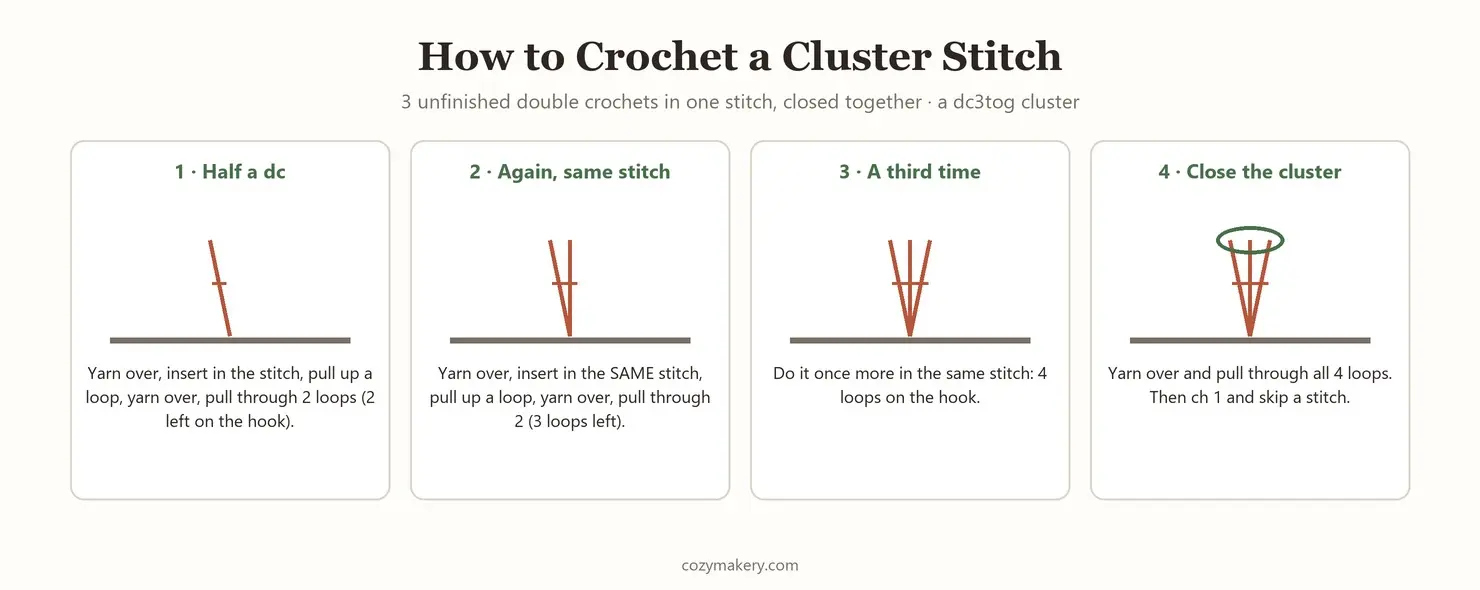
- Half a double crochet: Yarn over, insert the hook in the stitch, pull up a loop, yarn over and pull through 2 loops. 2 loops stay on the hook.
- Again in the same stitch: Yarn over, insert in the SAME stitch, pull up a loop, yarn over, pull through 2. Now 3 loops are on the hook.
- A third time: Do it once more in the same stitch: 4 loops on the hook.
- Close the cluster: Yarn over and pull through all 4 loops. Then chain 1 and skip the next stitch.
Cluster, puff, bobble or popcorn?
- Cluster: unfinished dc closed together. Worked into one stitch, as here, it fans out; spread over several stitches it becomes a decrease (dc3tog).
- Puff: loops pulled up without yarning over through 2, so it’s softer and rounder; see puff stitch.
- Bobble: 5 unfinished dc on a wrong side row so it pops out; see bobble stitch.
- Popcorn: 5 complete dc closed with a slip stitch, the most raised of all; see popcorn stitch.
The row pattern
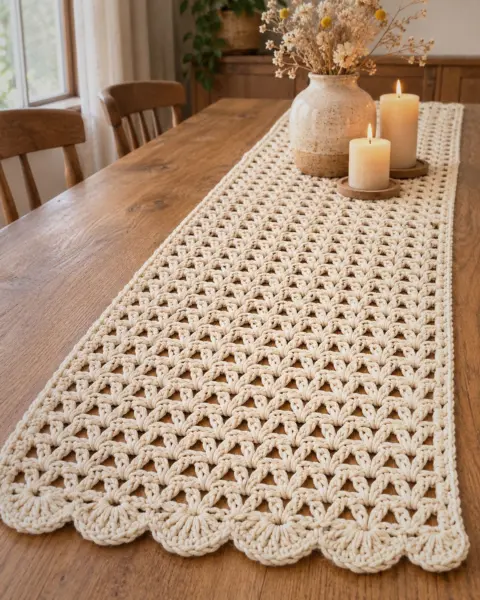
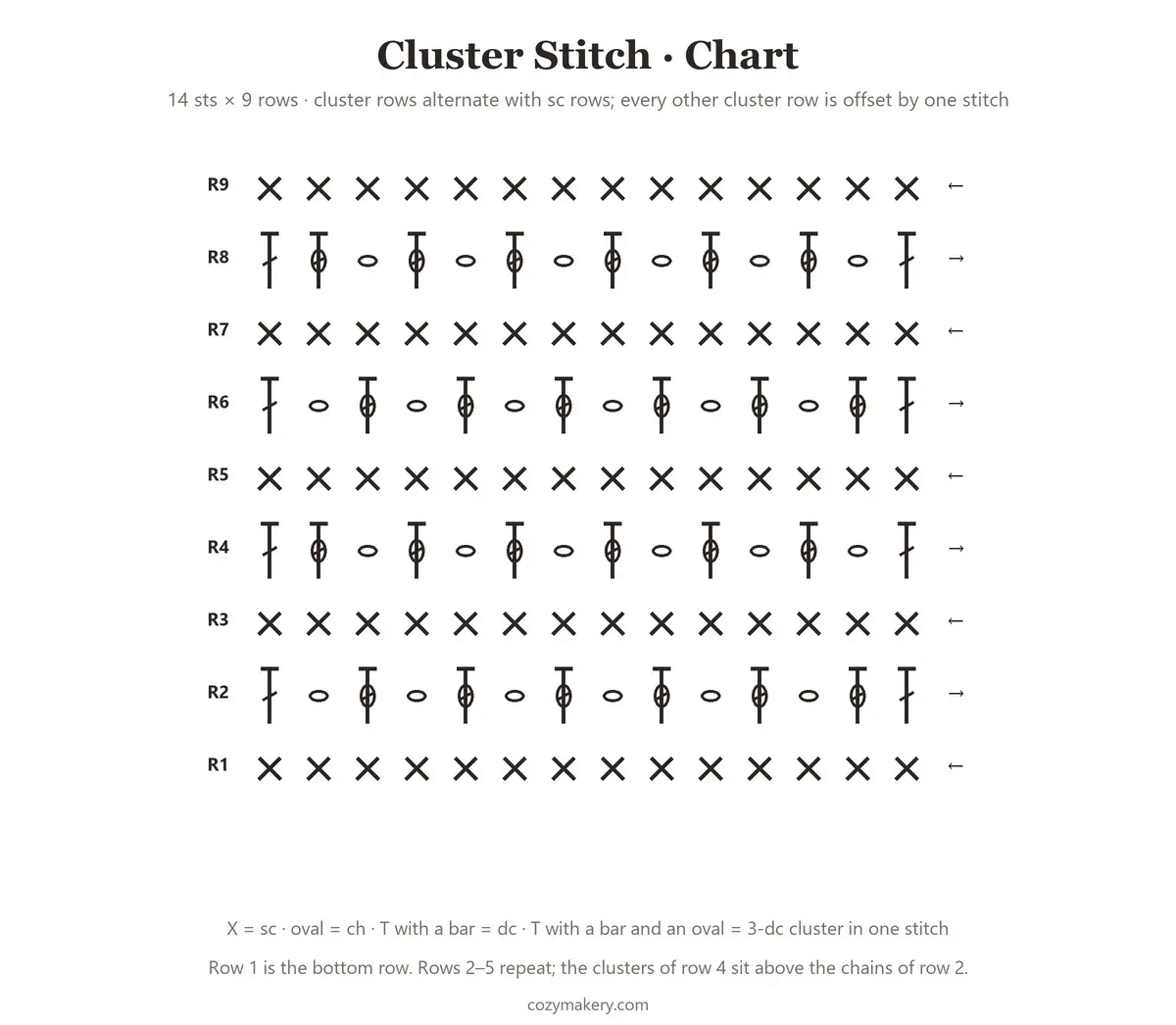
A foundation row of sc, then a 4-row repeat: a cluster row (ch 3, then cluster, ch 1, skip 1 across, dc at the end), an sc row, a second cluster row that starts with ch 1, skip 1 so its clusters move over by one stitch, and another sc row. The clusters of every other cluster row sit above the chains of the one before, like bricks. The coffee table runner has 48 stitches, so each cluster row has 23 clusters.
Tips for even clusters
- Same height: pull each loop up to dc height before you yarn over, or the cluster leans.
- The ch-3 counts as a dc at the start of a cluster row; work the last sc of the next row into its top chain.
- Work into the ch-1 space or the stitch? In the sc rows, put 1 sc in each cluster, each chain space and each dc, so the count never changes.
- Block it: pin a cotton runner flat and spritz it; the clusters open up and the edges straighten.
The table runner
The runner is worked in rows across the short width, so it builds up the length. A round of sc finishes the edge and makes it easy to block straight.
You'll need
- Worsted (#4) cotton: 450 yd (coffee table) or 700 yd (dining table)
- 5 mm (US H-8) hook, tapestry needle
Gauge: 16 sts and 10 rows = 4 in (10 cm) in the cluster pattern, a typical worsted cotton value, not one we measured.
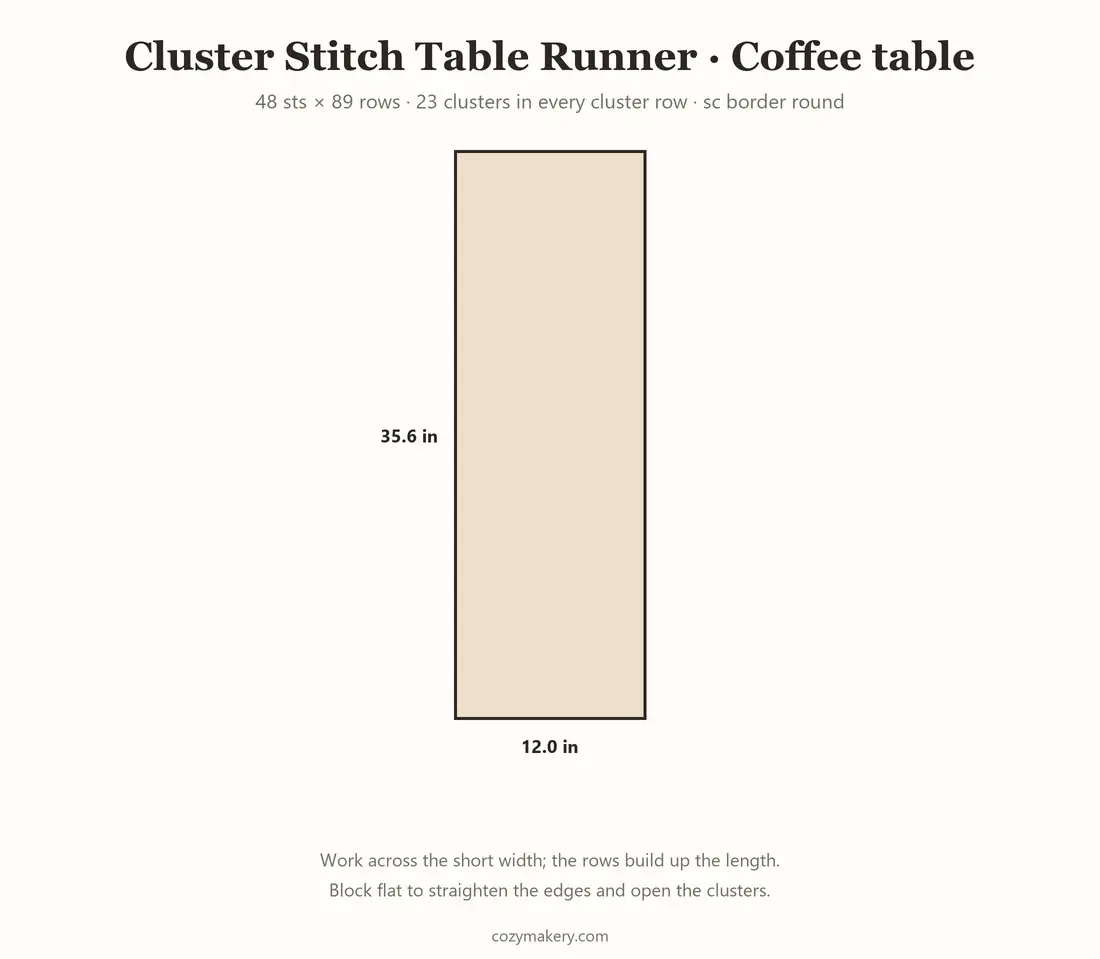
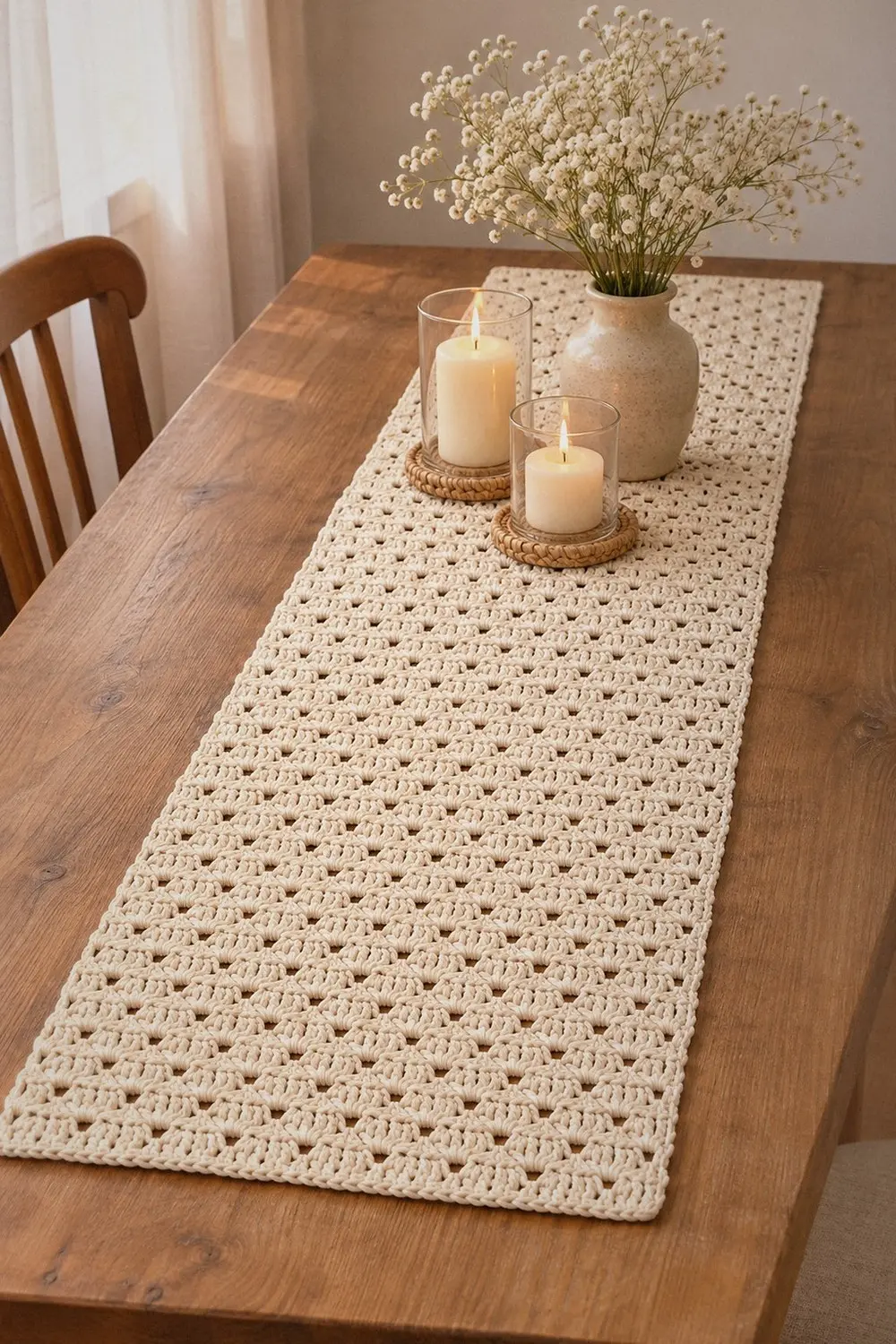
Coffee table runner (12 × 36 in (30 × 91 cm))
- Foundation: Ch 49.
- Row 1 (WS): Sc in the 2nd ch from the hook and in each ch across (48 sc). Turn. (48)
- Row 2 (RS): Ch 3 (counts as a dc), *cl in the next st, ch 1, skip the next st*; repeat 23 times, dc in the last st (23 clusters). Turn. (48)
- Row 3 (WS): Ch 1, sc in each st across: in each dc, cluster and ch-1 space, and in the top of the ch-3. Turn. (48)
- Row 4 (RS): Ch 3 (counts as a dc), *ch 1, skip the next st, cl in the next st*; repeat 23 times, dc in the last st (23 clusters, offset by one stitch). Turn. (48)
- Row 5 (WS): Repeat row 3. (48)
- Rows 6–89: Repeat rows 2–5, ending after a row 5 (an sc row). The runner measures about 36 in (90 cm). (48)
- Border: Don't turn. Ch 1, sc evenly round the edge: 48 sc along the top and bottom, 1 sc in the end of each sc row and 2 in the end of each cluster row down the sides, 3 sc in each corner. Join, fasten off and block.
Dining table runner (14 × 48 in (36 × 122 cm)): ch 57 for 56 stitches (27 clusters) and work 121 rows.
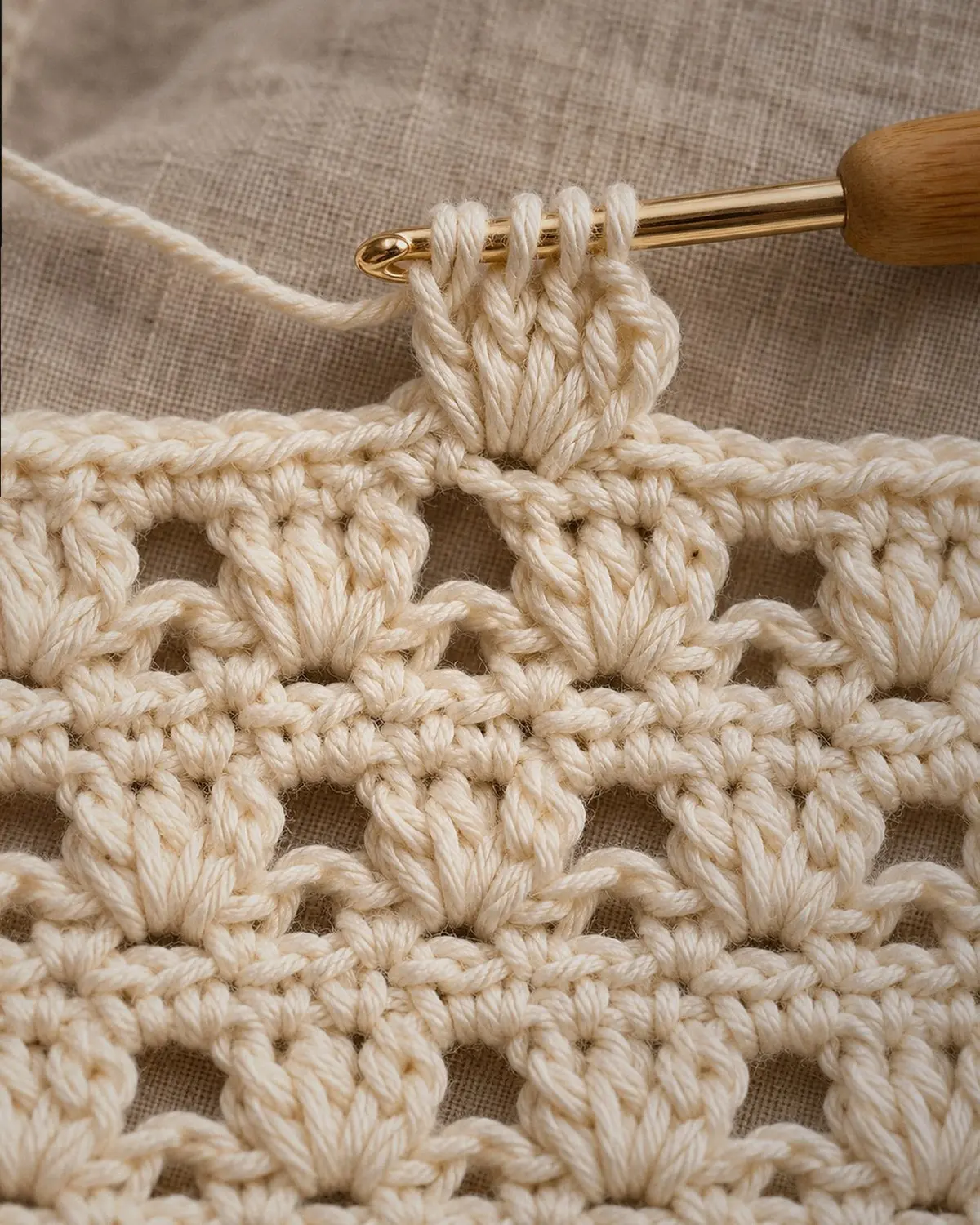
Every row is checked stitch by stitch: each row keeps the same count, every cluster goes into an sc, and the clusters of each second cluster row sit over the chains of the row 2 below. For more lacy textures, try V-stitch and shell stitch.
Clusters beyond the runner
If your clusters look flat, the loops are too short: pull each one up to full dc height before you yarn over.
Clusters aren’t just for rows. With ch-1 spaces between them they work in the round too, in granny squares, hats and coasters.
For the runner itself, cotton is the one to pick: it shows the clusters crisply, blocks flat and washes well.
More crochet: dishcloth patterns, star stitch and double crochet.