Cross stitch and embroidery both use a needle, floss and a hoop, so it’s easy to think they’re the same thing. They aren’t quite. Cross stitch is one specific stitch (the little X) worked by counting holes on a grid fabric. Embroidery is the big family of decorative stitches that you can work freely on almost any fabric. In fact, cross stitch is a type of embroidery, just a very structured one.
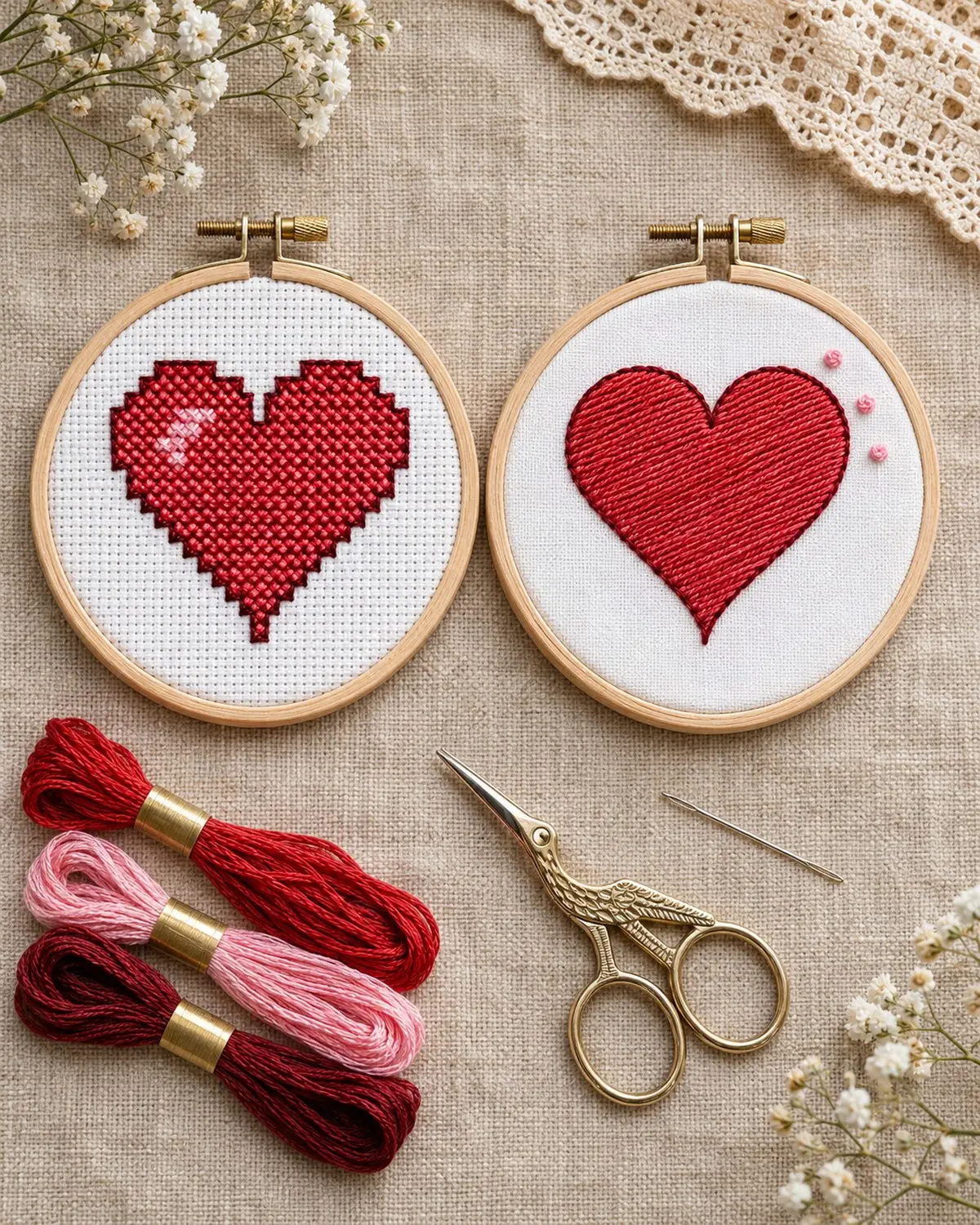
The easiest way to see the difference is to stitch the same design both ways. So I designed one small heart and turned it into a counted cross stitch chart and a hand embroidery template, at exactly the same size. Below you’ll find the comparison, both free patterns and a printable PDF, so you can try the two techniques side by side.
In this post
The short answer
- Cross stitchOne stitch (X) on counted grid fabric
- EmbroideryMany stitches on any woven fabric
- PatternGrid chart vs drawn design
- LookPixel-like vs smooth curves
- Easiest startCross stitch
- Free patternHeart, 1.5 in (3.8 cm), both ways
- Skill levelBeginner
- TimeAbout 1 hour per heart (estimate)
Free printable pattern
The PDF has the counted chart for the cross stitch heart, the true-size template for the embroidered heart, step-by-step instructions for both and the comparison table.
The Cross Stitch vs Embroidery PDF has 4 pages and prints on US Letter paper; on A4, choose “Fit to page” in the print dialog.
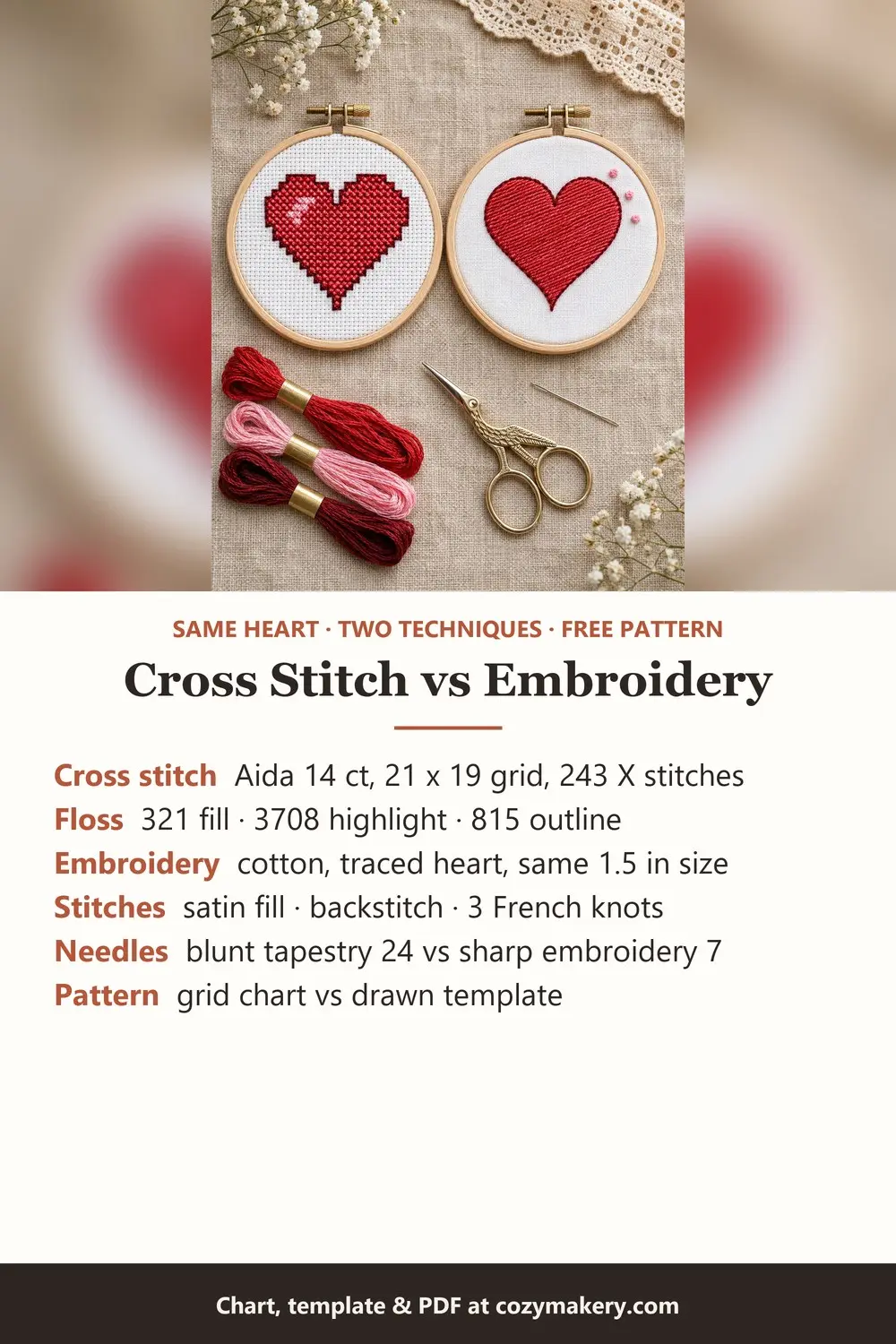
Cross stitch vs embroidery, side by side
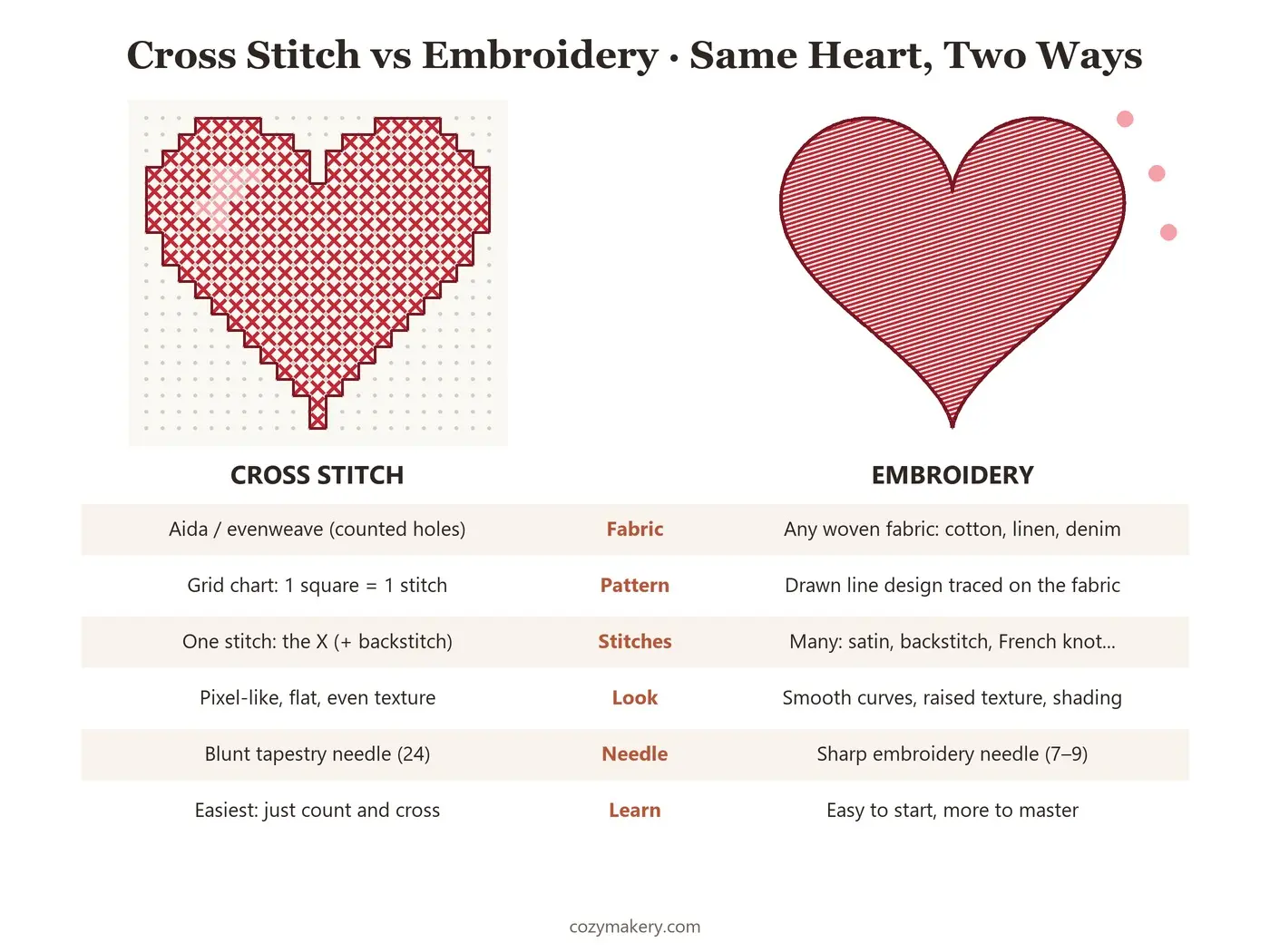
| Cross stitch | Embroidery | |
|---|---|---|
| Fabric | Aida or evenweave, with a visible grid of holes | Any woven fabric: cotton, linen, denim, felt |
| Pattern | A grid chart; every square is one stitch | A line drawing you trace onto the fabric |
| Stitches | Full cross, plus backstitch for outlines | Dozens: backstitch, satin, stem, chain, French knot… |
| Look | Even, flat, slightly pixel-like | Smooth curves, raised texture, shading |
| Needle | Blunt tapestry needle (size 24 for 14 ct) | Sharp embroidery needle (size 7–9) |
| Floss | Usually 2 strands | 1–6 strands, depending on the stitch |
| Learning | Learn one stitch and count | Easy start, more to master |
Which one should you start with?
If you like calm, repetitive stitching and following a chart, start with cross stitch: you only need one stitch, and the grid fabric tells you exactly where every stitch goes. If you’d rather draw, add texture or stitch on clothes and tote bags, start with embroidery and a few basic stitches. Our guide to 15 hand embroidery stitches is a good next step.
Materials for both hearts
- Cross stitch: a 6 x 6 in (15 x 15 cm) piece of white 14-count Aida and a size 24 tapestry needle
- Embroidery: a 6 x 6 in (15 x 15 cm) piece of white cotton or linen, a size 7 embroidery needle and a water-soluble pen
- Stranded cotton floss (less than 1 skein of each): DMC 321 red, DMC 3708 light pink, DMC 815 dark red
- Two 4 in embroidery hoops and small scissors
Heart 1: the cross stitch version
The heart is 21 stitches wide and 19 stitches tall: 235 red crosses, 8 pink crosses for the highlight and a backstitch outline. On 14-count Aida it’s 1.5 in (3.8 cm) wide (1.31 in on 16 ct, 1.17 in on 18 ct).
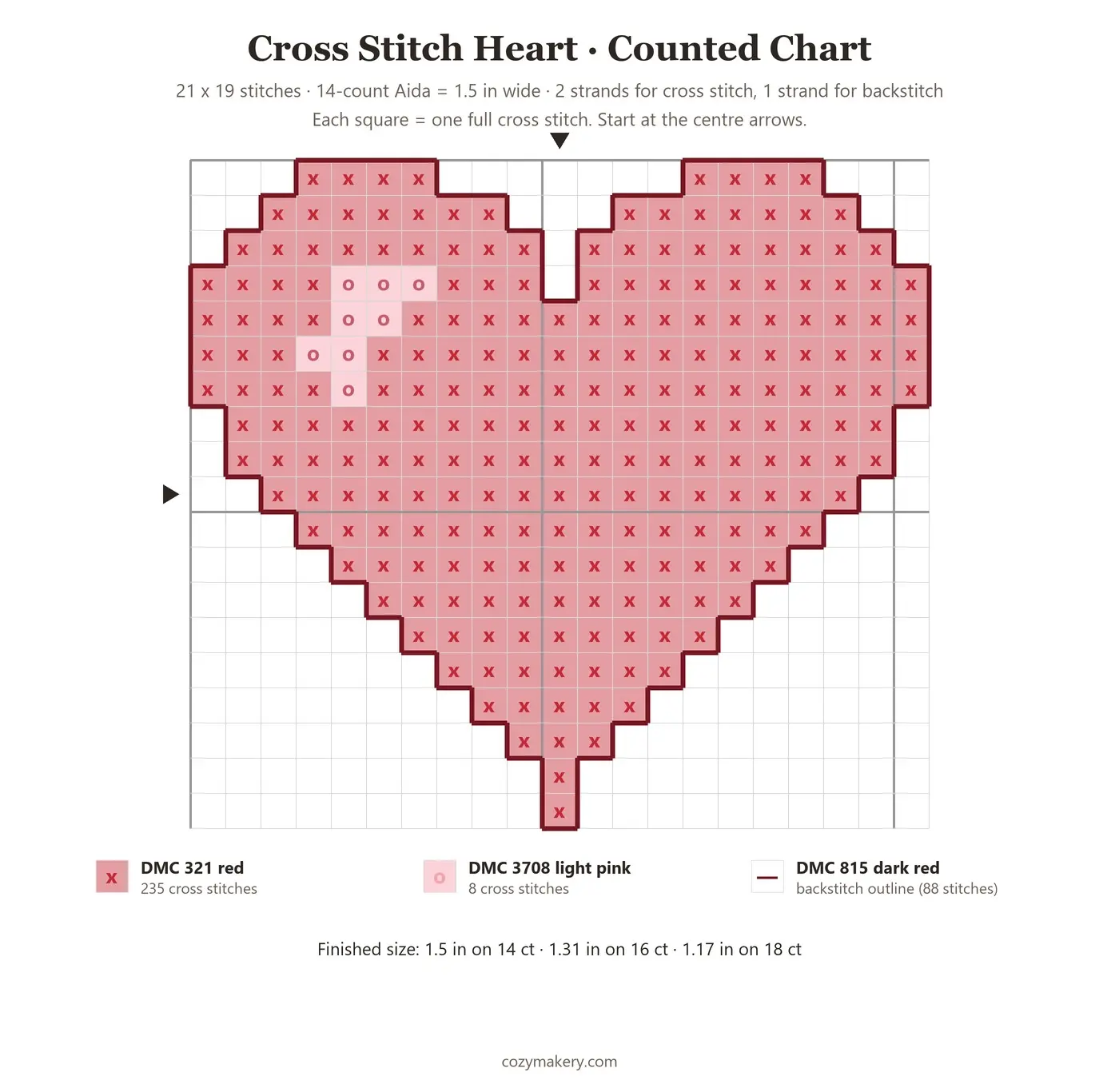
- Find the centre: fold the Aida in half both ways and put it in the hoop, drum tight. The centre of the chart is marked by the two arrows.
- Red fill: with 2 strands of DMC 321, work every x square as one full cross. Work in rows: all the half stitches (/) first, then come back with the (\). Keep every top leg slanting the same way. (235 crosses)
- Highlight: with 2 strands of DMC 3708, cross stitch the o squares on the upper left lobe. (8 crosses)
- Outline: with 1 strand of DMC 815, backstitch along the thick line, one stitch per square edge. (88 backstitches)
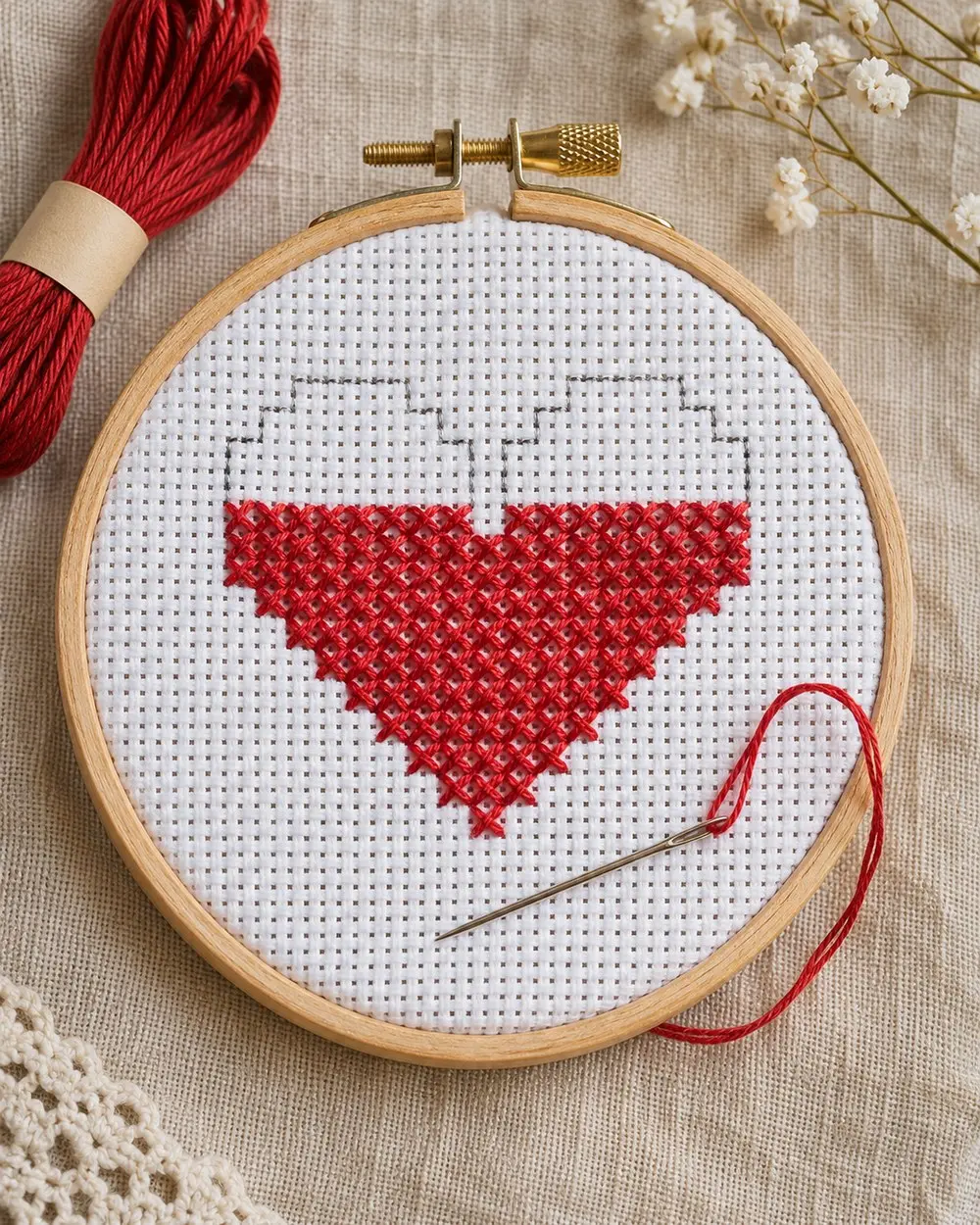
Heart 2: the embroidered version
For the embroidered heart there’s no grid to count. You trace the outline and fill it with stitches that follow the shape. Print the template page from the PDF at 100% (the check square must measure 1 in (2.5 cm)) and the heart will be the same 1.5 in as the cross stitch one.
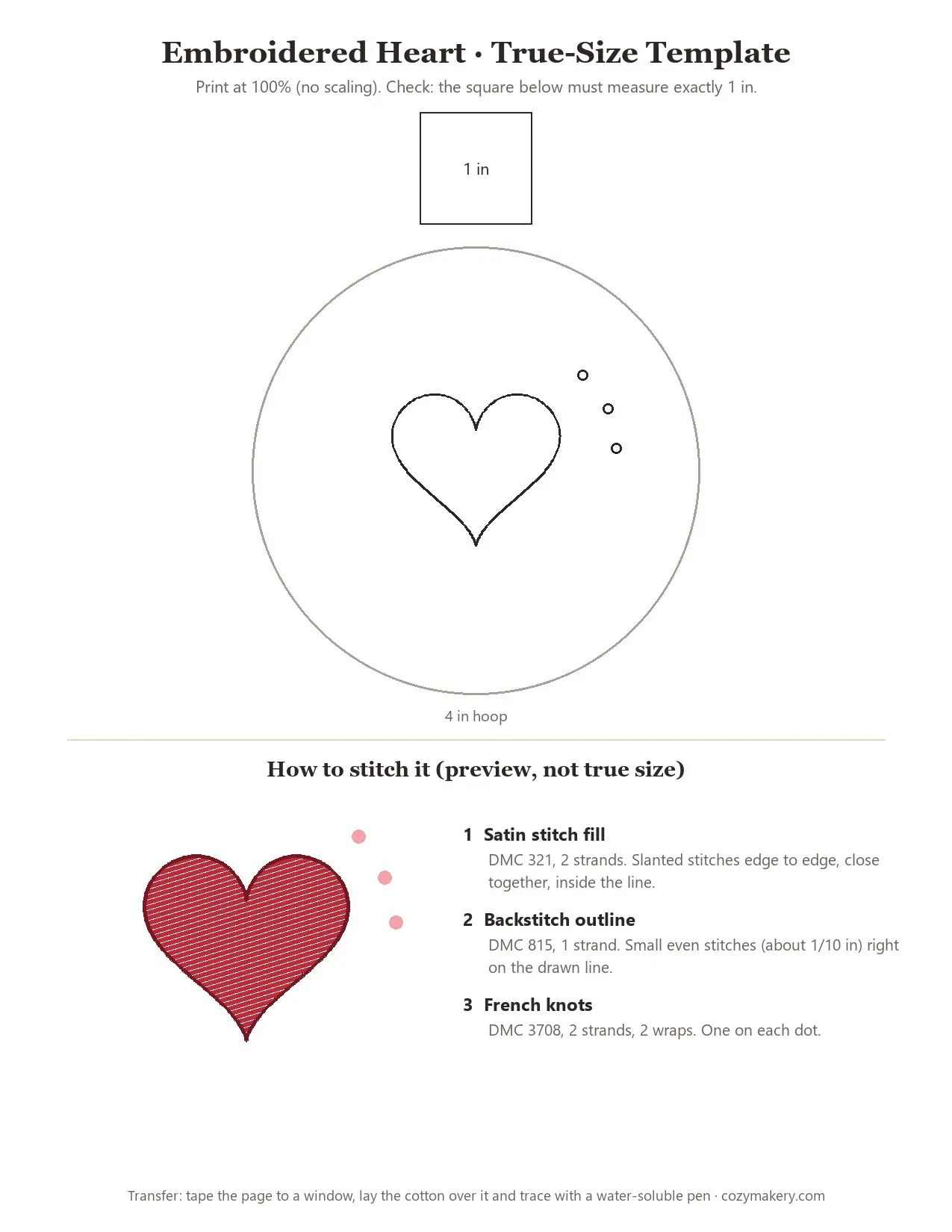
- Transfer: tape the template to a window, lay the cotton over it and trace the heart and the three dots with a water-soluble pen. Put the fabric in the hoop.
- Satin stitch fill: with 2 strands of DMC 321, fill the heart with slanted stitches from edge to edge. Keep them close together, side by side, without overlapping.
- Backstitch outline: with 1 strand of DMC 815, backstitch right on the line in small, even stitches (about 1/10 in (25 cm)). This hides the uneven ends of the satin stitches.
- French knots: with 2 strands of DMC 3708, make a French knot with 2 wraps on each dot. Rinse the fabric in cold water to remove the pen lines.
What you’ll notice when you stitch both
- Speed: the embroidered heart is usually faster, because satin stitches cover more fabric than tiny crosses.
- Precision: the cross stitch heart comes out exactly as charted every time; the embroidered one depends on your hand.
- Texture: cross stitch is flat and even; satin stitch has a soft sheen, and the French knots add little raised dots.
- Curves: look at the top of the heart: steps in cross stitch, a smooth curve in embroidery.
Ready to try cross stitch? Start with these free Christmas cross stitch patterns for beginners.
Frequently asked questions
Is cross stitch a type of embroidery?
Yes. Embroidery is any decorative stitching with a needle and thread. Cross stitch is one counted form of it, built from a single X-shaped stitch on grid fabric.
Can I use embroidery floss for cross stitch?
Yes, it’s the same stranded cotton. Cross stitch usually uses 2 of the 6 strands on 14-count Aida; embroidery uses anything from 1 to all 6 strands.
Can I cross stitch on regular fabric?
You can, with waste canvas: baste it onto the fabric, cross stitch through both layers using its grid, then dampen it and pull the threads out.
How many pages is the stitch sampler PDF, and how do I print the template?
The stitch sampler PDF has 4 pages on US Letter paper. Print the template page at 100% (no scaling) and check its 1 in (2.5 cm) bar before tracing the stitch sampler; the other pages can use Fit to page on A4.
How do I transfer the stitch sampler to fabric?
Print the stitch sampler template at 100%, tape it to a bright window or a light pad, lay the fabric on top and trace the lines with a water-soluble pen. If the stitch sampler goes on dark fabric, use a white transfer pencil or tear-away stabilizer instead.
Save it for later
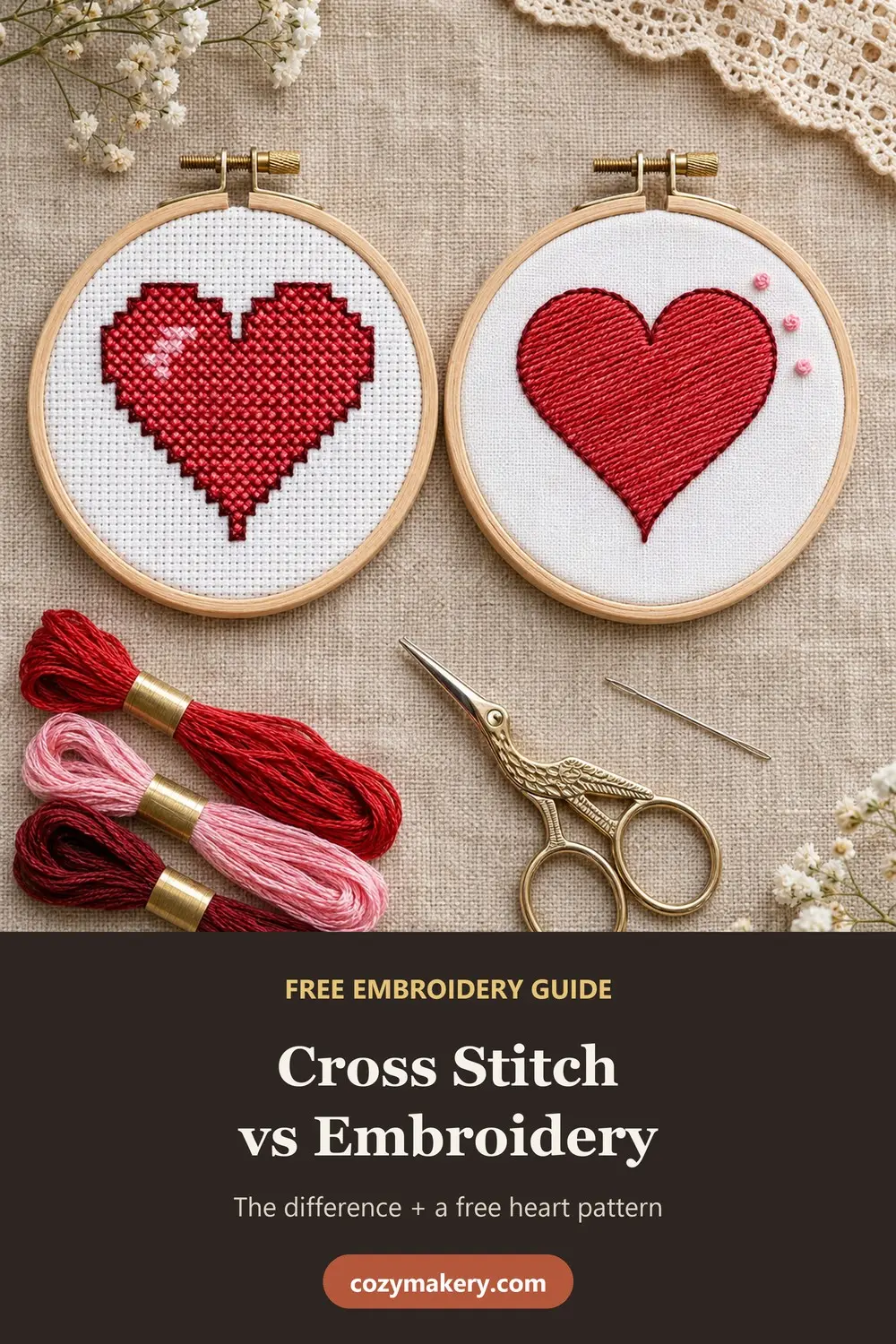
Pin the image below so the comparison and both patterns are easy to find. If you stitch the hearts, I’d love to see them: send a photo to info@cozymakery.com.
Keep stitching: learn 15 hand embroidery stitches, try our free embroidery patterns, or stitch a seasonal hoop with the Christmas embroidery patterns. Browse everything in Embroidery.